Reverse Retell in Rhyme

At a recent workshop, I was asked “How do you differentiate this for students with IEPs?” I felt like my answer of easing the rigor by adjusting text complexity and time on task was too generic. In this post, I want to introduce a new differentiation strategy I am calling Reverse Retell in Rhyme.

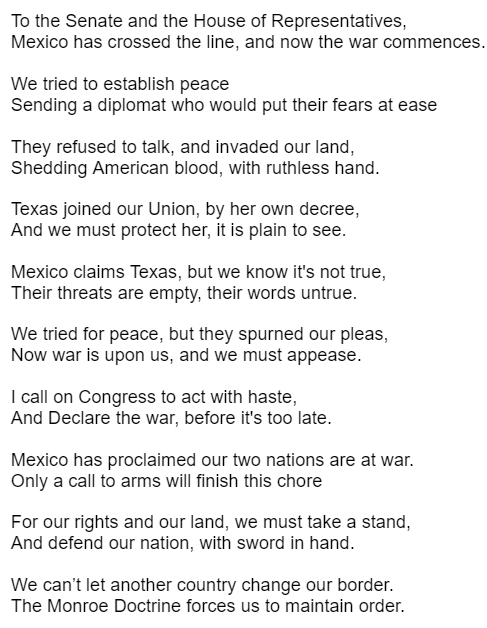
First, select a primary source for students to interpret via the Retell in Rhyme EduProtocol. See Chapter 15 in the Social Studies Edition. Then, ask Google Bard or Chat GPT to retell the main ideas of the document in 10 rhyming couplets so an 8th grader will understand it. You may have to edit and improve the focus of this mentor text before you put it in front of students. I borrowed this excerpt from my friend, Dr. Mark Jarrett’s work with primary sources.

Next, I usually ask my students to work in pairs or small groups to interpret the primary source by retelling it in 10 rhyming couplets. This typically takes one class period. This time, I asked Google Bard for the 10 couplets, but it only gave me 7, so I had to add three of my own. I would usually ask students to come up with a creative and unique title before comparing their work to this mentor text the next day.
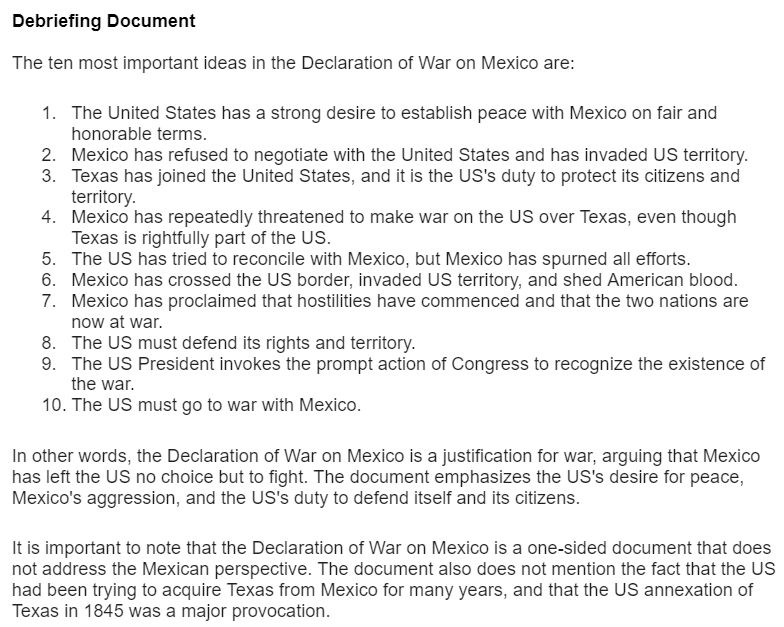
I asked Bard to read the primary source again and tell me the top ten most important ideas. I would give this to students as a debriefing document, so they can see how many of the significant historical details they included in their couplets instead of just picking words that were easy to rhyme.
After students analyzed their own work, I would try to extend their learning by having them triangulate five of the ideas in the Google Bard authored couplets and the debriefing document with the original text in the primary source. This sounds complicated, but here’s what it looks like. I’d like to add a writing extension, but I am worried about overwhelming students. I’m hoping the group activity and discussion are enough to help them understand the academic language in the primary source.

This is one of those ideas that hit me in the middle of the night and I can’t wait to try the Reverse Retell in Rhyme with students. I’d like to know how you have used the Retell in Rhyme EduProtocol in your classes. RTR will be the focus of our October 19, 2023 show. Our special guest will be Camarillo High School history teacher Mike Hernandez. We look forward to seeing you on EduProtocols Plus.
To recap, when I follow the traditional Retell in Rhyme EduProtocol, I use these steps. This lesson helps students determine the central ideas or information in a primary or secondary source. It also builds student confidence in playing with language, improving creativity, and original thinking. Lastly, it is a powerful and fun EduProtocol that gives students practice writing accurate summaries that describe relationships and connections between key historical figures and events.

In order to prep the Reverse Retell in Rhyme differentiation strategy, I used the primary source and had AI to create a mentor text. Then Google Bard helped me create a debriefing document or success chart. Next, I would provide students with copies of all three documents so that they can understand the meaning of the important ideas in the historical document. Now students who might struggle to interpret a primary source, or balk at writing their own original couplets can still participate in the activity.
Inquiry with The Research EduProtocol

Coming up on Thursday, September 21 at 6 pm PT, Adam Moler and I will welcome educator Justin Unruh to the Social Studies Show on EduProtocols Plus. He teaches at a Title 1 school in the heart of California’s Central Valley. Justin is an advanced EduProtocols mixologist with a flair for creativity and innovation.

Justin has been sharing his students’ impressive work on Twitter/X and in Kim Voge‘s EduProtocols Facebook community. He will be speaking at Fall CUE during the weekend of Oct 21–22, 2023 in Stockton — don’t miss his session. Like many teachers working with technology, Justin shares our concerns about helping students learn to conduct plagiarism-free, original, academic research in the age of AI.

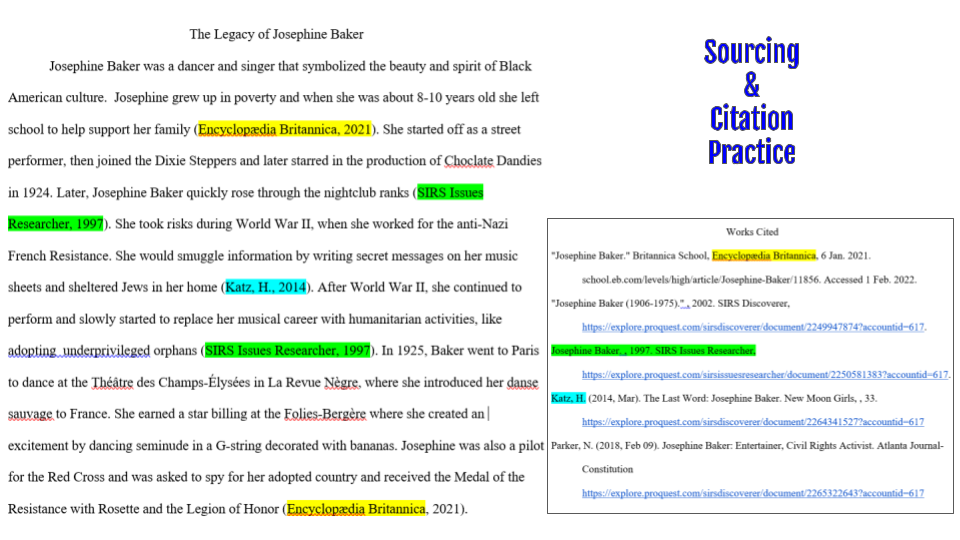
At first glance, a collaborative spreadsheet may look boring and uninteresting, but by focusing on the initial steps in research, teachers can prevent young learners from disappearing down rabbit holes of bias, misconceptions, and scholarly dead ends.

The Research EduProtocol can help your students manage, plan, and provide evidence of their complex, rigorous, and time-consuming work. Teachers can scaffold the research process to get students ready for the self-directed learning experiences they will encounter with project-based learning in high school or college.

Writing annotated bibliographies, participating in team presentations, and creating reflective portfolios can be isolating and overwhelming. The Research EduProtocol can simplify inquiry and turn it into a social and fun experience. By working together in collaborative teams, your students will be sharing and presenting their research with little to no anxiety.

Adding the Research EduProtocol to an inquiry sequence is not as challenging as you might think. Join us Thursday night to discuss how to help your students document their inquiry journey by clearly disclosing where AI informed and started, but also where their original ideas started and developed.

For a deeper dive on how to use the Research EduProtocol, check out Chapter 16 in our book The EduProtocol Field Guide: Social Studies Edition. If you already have the book, please consider posting a review on Amazon and sharing your students’ work on Twitter using the #EduProtocols hashtag.

8 pARTS as Critical Friend

The 8 p*ARTS EduProtocol is extremely versatile and can be used to help students learn from each other’s projects. The sample below served as evidence that one of my 10th-grade World History students had listened to another student’s podcast on WWI spies.

The 8 p*ARTS EduProtocol came from elementary ELA lessons designed to help students learn the 8 parts of speech. It is easily adaptable and has been used to help history students analyze art, primary sources, speeches, government policies, individuals, and events. As with most EduProtocols, the teacher is only limited by their own imagination when using the 8p*ARTS. There is even a DBQ version, which I have included, but not used myself.

Here’s an example of a student synthesis that needs more effort and detail before it can be deemed proficient. Details are sparse in the who, when, notice, and wonder columns. Similarly, this response does not compare three people, places, or events in Patton’s life to other historical periods that we have studied. At the very least, I would have liked to have seen Patton compared to fellow WWII Generals like Bradley, Eisenhower, Marshall, and MacArthur.

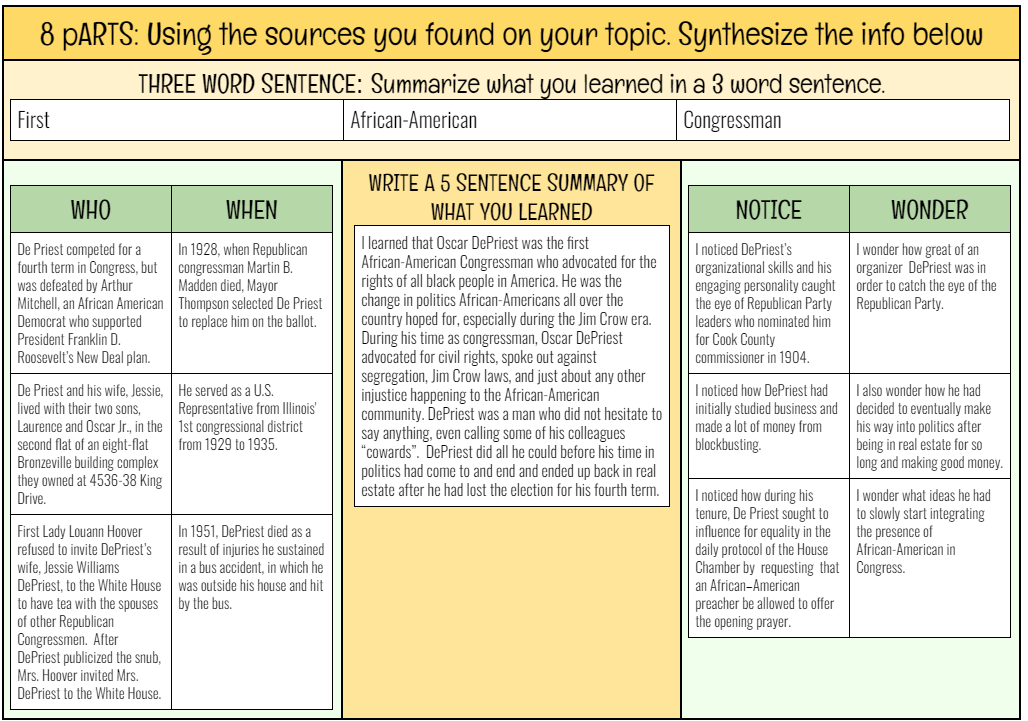
Here’s a stronger example on Oscar DePriest. This student does well with the noticing category, but I could have used more information to understand blockbusting and how DePriest made money from it.

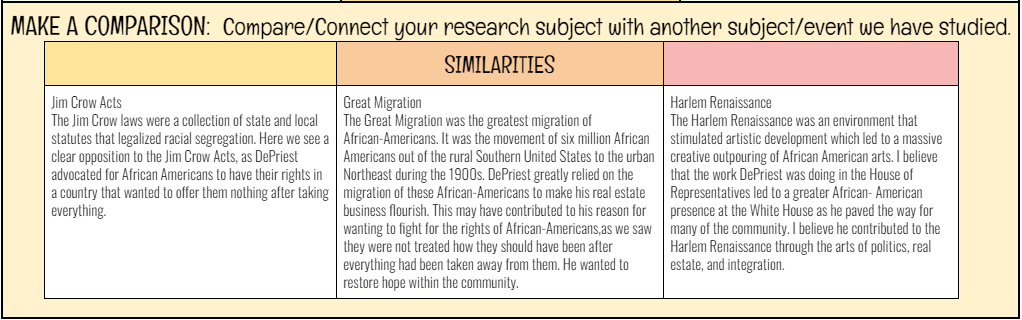
This student really put substantial effort into making comparisons. They were able to use their historical knowledge to link The Jim Crow Era, The Great Migration, and The Harlem Renaissance. They are on their way to an essay.

I know my students need more practice with 8 p*ARTS. I have noticed that using it as a critical friend where students review each other’s projects and report summaries and findings helps me provide an authentic audience for project-based learning. What EduProtocols do you use to hold students accountable for learning content from each other?

I am interested in learning how other History teachers use the 8pARTS EduProtocol to improve student writing. Angela Zorn shared some great ideas on our show last month. To learn how EduProtocols can help you increase the amount of writing your students do while decreasing your prep and grading time, pick up our book The EduProtocol Field Guide: Social Studies Edition. If you already have the book, please consider posting a review on Amazon and sharing your students’ work on Twitter using the #EduProtocols hashtag.