All posts by scottmpetri

Scott Petri has taught social studies for five years at the middle school level and six years at the high school level. He has also served as a coordinator and small school principal in the Los Angeles Unified School District. He holds a Doctorate in Educational Leadership and a Masters in Educational Administration from California State University Northridge, and a B.A. in Political Science from the University of San Diego.

Soviet Textbooks Essay

Soviet Txbks

What should be remembered in Soviet textbooks? Describe three achievements that should be included in Soviet textbooks. Support your reasoning with evidence from the documents: (A) Geographic Expansion; (B) Socio-Economic Accomplishments; (C) Great Terror; (D) Political Repression; (E) Military Strength; (F) Space Achievements; (G) Olympic Victories; and (H) Ballet & Cultural Achievements.

Thesis Statement Planning

Soviet textbooks should include: ____________, _____________, and _______________.

In 69 years as a country, the Soviet Union accomplished many great things, _________, _________, and _________; should be included in their textbooks to remember this time in history.

_________, ___________, and _____________ show that communism was capable of producing greatness, this paper will argue that the Soviet Union’s Cold War accomplishments should be included in their textbooks.

Outline

  1. Intro
    1. Background on the Cold War (czar, Bolshevik, capitalism, socialism, communism, Cold War, Stalin, Krushchev, Gorbachev, Sputnik, republics, satellites, and Bolshoi)
    2. Definition of terms
    3. Thesis statement
  2. MEAL paragraph – Accomplishment # 1
    1. M – Main Idea: Topic Sentence
    2. E – Evidence: Proof Found in Primary Source/Book/Research
    3. A – Analysis: How The Evidence Proves the Main Idea
    4. L – Link: How a Paragraph Fits in to what the paper is trying to prove.
  3. MEAL paragraph – Accomplishment # 2
    1. M – Main Idea: Topic Sentence
    2. E – Evidence: Proof Found in Primary Source/Book/Research
    3. A – Analysis: How The Evidence Proves the Main Idea
    4. L – Link: How a Paragraph Fits in to what the paper is trying to prove.
  4. MEAL paragraph – Accomplishment # 3
    1. M – Main Idea: Topic Sentence
    2. E – Evidence: Proof Found in Primary Source/Book/Research
    3. A – Analysis: How The Evidence Proves the Main Idea
    4. L – Link: How a Paragraph Fits in to what the paper is trying to prove.
  5. Conclusion
    1. Summarize rationale – Accomplishments 1, 2 & 3 show…
    2. Recap evidence
    3. Restate thesis

In-Text vs. Parenthetical Citations

Document A shows the incredible size of the Soviet Union and its satellite countries. This suggests that …

Poland was an East European satellite country of the Soviet Union (Document A).

Evidence-based Sentence Starters

Based on this evidence, it appears that _____________________.

This quote suggests that ______________________.

When viewing the map, it is evident that _____________.

This source reveals how US policy makers thought about ___________________.

This timeline illustrates how ____________________________.

This passage provides some insight into the nature of __________________________.

Great Terror Tweetathon

Steve Graham and Michael Herbert (2010) conducted a meta-analysis of the literature on reading and writing called Writing to Read. Part of this work, reports the results from nine studies that demonstrated how having students respond to a text in writing has a large effect (0.77) on their reading comprehension. This research suggests that writing personal reactions and/or analyzing/interpreting texts can increase reading comprehension. Therefore, I asked my students to use textual evidence to create rhyming couplets about the Great Terror. They were given a document about Stalin and the Great Terror from The DBQ Project’s excellent materials and allowed to use their cell phones to access an online rhyming dictionary.

2015-04-17 13.18.08

A few students turned in rhymes that did not reflect understanding of the material. In a future iteration of this project I will add some peer review and quantify the results. Many students, however, were creative and demonstrated strong understanding of The Great Terror. The following couplets represent their work:

As a Soviet leader, Joseph Stalin made his enemies pay
His secret police would kill 1,000 people every day

The Russians launched mass arrests and forced labor
At times it seemed by killing you, Stalin was doing you a favor

Between 1937 and 1938, the Great Terror only lasted for two years
During this time, the Soviet people lived with many fears

The Great Terror eliminated people considered an enemy of the state
A history book would conclude that this time period was not great.

Russian intellectuals were broken and corrupted
Their contributions to society were disrupted

Mercy and dignity got in the way of survival
If you valued freedom, you were Stalin’s rival

The Great Terror tried to instilled fear in a citizen’s mind and soul
Constant threats from authority added up and took their toll

Soviet History books were just another propaganda tool
Until Roy Medvedev wrote one critical of Stalin’s rule

Joseph Stalin had a huge amount of power
Which made all of his citizens tremble and cower

This quick activity aligns with what Lopez (2011) terms culturally relevant pedagogy, which emerged in response to the need for increased engagement and educational success for all learners. Many teenagers aspire to be rappers and songwriters. This exercise allowed students to work in pairs and collaborate on a task with high social capital and improve their academic vocabulary and reading comprehension. Please make a comment and let me know how you could adapt this activity to your classroom.

References

Lopez, A.E. (2011). Culturally relevant pedagogy and critical literacy in diverse English classrooms: A case study of a secondary English teacher’s activism and agency. English Teaching: Practice and Critique. pp. 75-93. December, 2011, Volume 10, Number 4. 

Six Word Definitions

Thanks to #TeachWriting, my rockin’ PLN on Twitter, I was apply to apply a new technique in my World History classroom this week. Several ELA teachers were discussing #6wordShakespeare and some of the other six-word story exercises that had been done in their classrooms. Hemingway wrote one of the most famous six word stories: For sale. Baby shoes. Never worn. These teachers described the technique as a fast brainstorming tool that gets students writing and playing with language immediately. I thought it could be used in the vocabulary-intensive unit I am currently teaching about the Cold War.

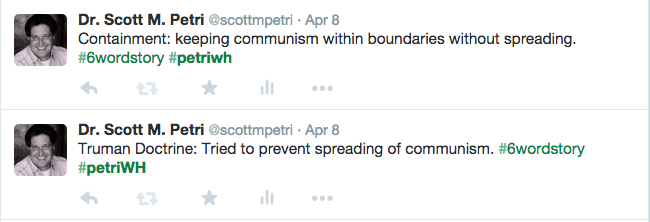
These two definitions from the book and subsequent student simplifications illustrate the concept.  Containment: The U.S. strategy of keeping communism within its existing boundaries and preventing its further expansion (p. 509). Truman Doctrine: United States policy, established in 1947, of trying to contain the spread of communism (p. 491).

6 word CW Vocab

Hyland & Tse (2007) report that many teachers regard helping students develop specialist [content] vocabulary as an important part of their role and many lists of key terms have been assembled. Marzano & Pickering (2005) offer a manual with 7,923 terms so school and district teams can choose the most important vocabulary words to teach their students. The terms were extracted from national standards documents, across eleven subject areas, and organized into grade-span intervals for: K–2, 3–5, 6–8, and 9–12 writers.

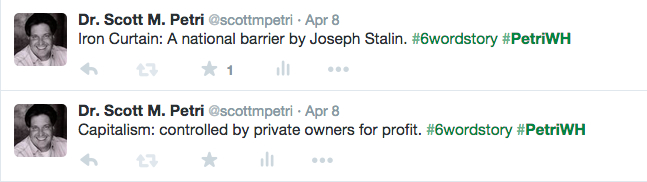
Here are examples of online definitions, along with student six-word definitions.  Iron Curtain:  The political, military, and ideological barrier erected by the Soviet Union after World War II to seal off itself and its depended eastern and central European allies from open contact with the West and other noncommunist areas (Encyclopedia Britannica). Capitalism: An economic and political system in which a country’s trade and industry are controlled by private owners for profit, rather than by the state (Google). Interestingly this term is not defined in the World History textbook, instead capital is defined as “money or wealth used to invest in business or enterprise” (p. 175).

6 word vocab

The majority of my students mastered this task and defined all seven terms in 15 minutes. I find that quantifying and charting how many terms a student completed within the allotted time helps me get a better picture of their engagement and alerts me to any comprehension problems that may be brewing.

Here some additional examples of student work:
Communism: Form of socialism advocated by Marx; Community has all power in society; All wealth and property owned collectively.
Capitalism: Private owners rather than the state; Prices are based on supply and demand; Individuals make decisions, not the government.
Cold War: Tension and hostility between two nations; Competition between U.S & Soviet states.
Iron Curtain: Prime Minister accuses Soviets of aggression. Soviets create a buffer in Europe.
Containment: Keeping communism within boundaries without spreading; America’s policy toward communist countries.
Truman Doctrine: Tried to prevent spreading of communism; 1947 USA policy stopping Soviet Socialism.

6 word stories

Kinsella (2013) argues that word knowledge is a strong predictor of academic achievement and educators cannot afford to leave vocabulary instruction to chance. She further advises that devoting attention to words that matter most is the first step in responsible lesson planning. I thought these six word definitions demonstrated understanding of Cold War terms and will continue to use it to help students master content vocabulary. It appears that finding activities like creating six-word definitions and re-tweeting favorites enable students to have fun while building their academic vocabulary. What tricks and techniques have been successful in your classroom?

References

Hyland, K., & Tse, P. (2007). Is there an “academic vocabulary”?. TESOL quarterly41(2), 235-253.

Kinsella, K. (2013). Cutting to the Common Core: Making Vocabulary Number One. Language Magazine12(12), 18-23.

Marzano, R. J., & Pickering, D. J. (2005). Building academic vocabulary: Teacher’s manual. Association for Supervision and Curriculum Development. 1703 North Beauregard Street, Alexandria, VA 22311-1714.

Containment Essay

containmentContainment Essay Prompt:

Define the US policy of containment. Discuss three instances of containment from the documents and argue which serves as the best example of containment and which serves the worst example of containment. Evaluate whether containment was an effective or ineffective policy. Be sure that you use in-text or parenthetical citations when you use evidence from the documents.

Thesis Statement Planning

Three examples of Containment are: ____________, _____________, and _______________.

The Cold War lessons in containment have been demonstrated by _________, _________, and _________; when evaluating these lessons, it is clear that…

_________, ___________, and _____________ provide historians with instances of the US Policy of containment, this paper will argue that ____________ is a strong example of containment, while ____________ is a weaker illustration of containment.

Outline

  1. Intro
    1. Background on the Cold War
    2. Definition of Containment
    3. Thesis statement
  2. Strongest example of containment
    1. Evidence from document
    2. Claim
    3. Counter-claim
    4. Explanation of how this supports thesis
  3. Weakest example of containment
    1. Evidence from document
    2. Claim
    3. Counter-claim
    4. Explanation of how this supports thesis
  4. Evaluation was containment a good or bad US policy
    1. Historical factors
    2. Link to thesis
  5. Conclusion
    1. Summarize argument
    2. Recap evidence
    3. Restate thesis

Evidence-based Sentence Starters

Based on this document, it appears that _____________________.

This document suggests that ______________________.

When viewing the map, it is evident that _____________.

This source reveals how US policy makers thought about ________________.

This timeline illustrates how ____________________________.

This quote provides some insight into the nature of __________________________.
Lastly, here are some videos that help you understand the documents better.

Background Essay

http://www.teachertube.com/viewVideo.php?video_id=336174

Document A – Long Telegram

http://www.teachertube.com/viewVideo.php?video_id=336173

Long Telegram Quiz Answers

http://www.teachertube.com/viewVideo.php?video_id=335963

Document B – Berlin Airlift

http://www.teachertube.com/viewVideo.php?video_id=336172

Document C – The Korean War

http://www.teachertube.com/viewVideo.php?video_id=336178

Document D – The Cuban Missile Crisis

http://www.teachertube.com/viewVideo.php?video_id=336177

Video Game Review

Extra-Credit History-based Video Game Review

Valiant Hearts, Mission-US, Call of Duty, Civilization, Age of Empires, Medal of Honor, Soldiers: Heroes of WWII, Axis and Allies, and The Calm and The Storm: these games have sold millions of copies, yet most History teachers have never played even one of them. Are video games a waste of time and energy? Can video games teach us History? Niall Ferguson, a prominent historian thinks so, read his argument, however, please understand that other researchers urge caution about the appropriateness of video games for certain ages and purposes.

Next, identify the state standard involved in the game you have selected. Then review a history-based video game in at least 500 words. Argue that the experience has taught you something meaningful about history. Your review should describe the story at the heart of the game, link the historical content in the game to your textbook, and describe how it confirms or contradicts what we have studied in class.

family-playing-video-game-console

Other ideas to put in your review

  1. Comment on the historical accuracy, or inaccuracies in the game as well as the level of difficulty in playing it.
  2. How many hours did you spend playing it? How many hours will it take to become a good player?
  3. Who would benefit from playing this game? Age? Demographics?
  4. How could the author target that audience?
  5. Report on who published the game. What other games have they made? How many copies have been sold?
  6. How much does the game retail for?  Where can you get the best deal on it?

Make sure this review follows the traditional essay format. Your teacher will submit the best reviews for publication in the school newspaper.

Outline of traditional essay format to use in your review

  1. Catchy title
    1. Grabber
    2. Background
    3. Definition of key terms
    4. Grand Thesis & roadmap
  2. Mini-thesis #1 (The best part about this game is…)
    1. evidence
    2. argument – explain
    3. link back to thesis
  3. Mini-thesis #2 (The worst part about this game is…)
    1. evidence
    2. argument – explain
    3. link back to thesis
  4. Mini-thesis # 3
    1. evidence
    2. argument – explain
    3. link back to thesis
  5. Conclusion
    1. Restate main idea
    2. Summarize key points.

You have between April 8 – May 1, 2015 to submit your review to http://www.PaperRater.com and you can improve it as many times as you want.

I will review your final draft along with the PaperRater report. You may submit them electronically to scottmpetri@gmail.com or print them out and hand them in during class.

Speech Non-Completers

After reading through all of the reflections my students wrote after their WW2 speech projects, I found their responses fell into three general categories: (1) falling on my sword, (2) recognizing our class culture, and (3) the laziness factor. Although an alarming number of student refused to read their speech in class, approximately, two-thirds of my students delivered in front of an audience. They saw good speakers, they saw nervous speakers, and they saw several awe-inspiring, incredibly charismatic speakers.

All students were asked to complete a 30-minute reflection describing how they approached the project.  A colleague, Bill Chapman (@classroomtools), asked me to analyze the reflections of the students who did not complete their speeches. I did not want to do this. I was ready to move on. After conducting this exercise, I am so grateful that Bill nudged me because I was ready to give up on some of these students. However, the act of reading and classifying the reflections pushed my thinking and I am ready to double-down on engaging these students (and parents) over the last few months of the school year.

Falling On My Sword

Deserve a 0

The “I deserve a zero” appeal was utilized by many students who had completed all of necessary the components for the speech, but then lacked the confidence to go up and perform it.  Quite a few of my students fell into this category. Many openly stated that they would rather earn the 100 extra-credit points for a Courage to Care essay assignment than go up and deliver their speech. In retrospect, perhaps these students deserve an A for cost-benefit analysis skills.

Falling on my sword

This student utilized what I call the “falling on my sword” approach. Perhaps by accepting blame, the teacher will have mercy on me? This brown-nosing skill will no doubt prove valuable later in life, but it is unlikely to help the student pass classes with firm deadlines. I am glad the student recognizes that it is still not too late to improve his grade. The consequence for not delivering the speech in class means that students now have to deliver the speech to me outside of classroom hours (at lunch or after school). At some point, this 9th grader will learn that it is easier to finish his work on time than to chase me all over campus.

Recognizing Our Class Culture

Partial Credit

This student has listened to my mantra of… turn in something, anything… most teachers will be forgiving and allow you to revise a poor assignment, but they will not allow you to do that if you miss the deadline and turn NOTHING in.  I have experienced this many times in my academic career. Teachers don’t want to hear excuses why you couldn’t do it, but show us you cared enough to put in some effort and we may just give you the benefit of extra time.

Acknowledging Time Factor

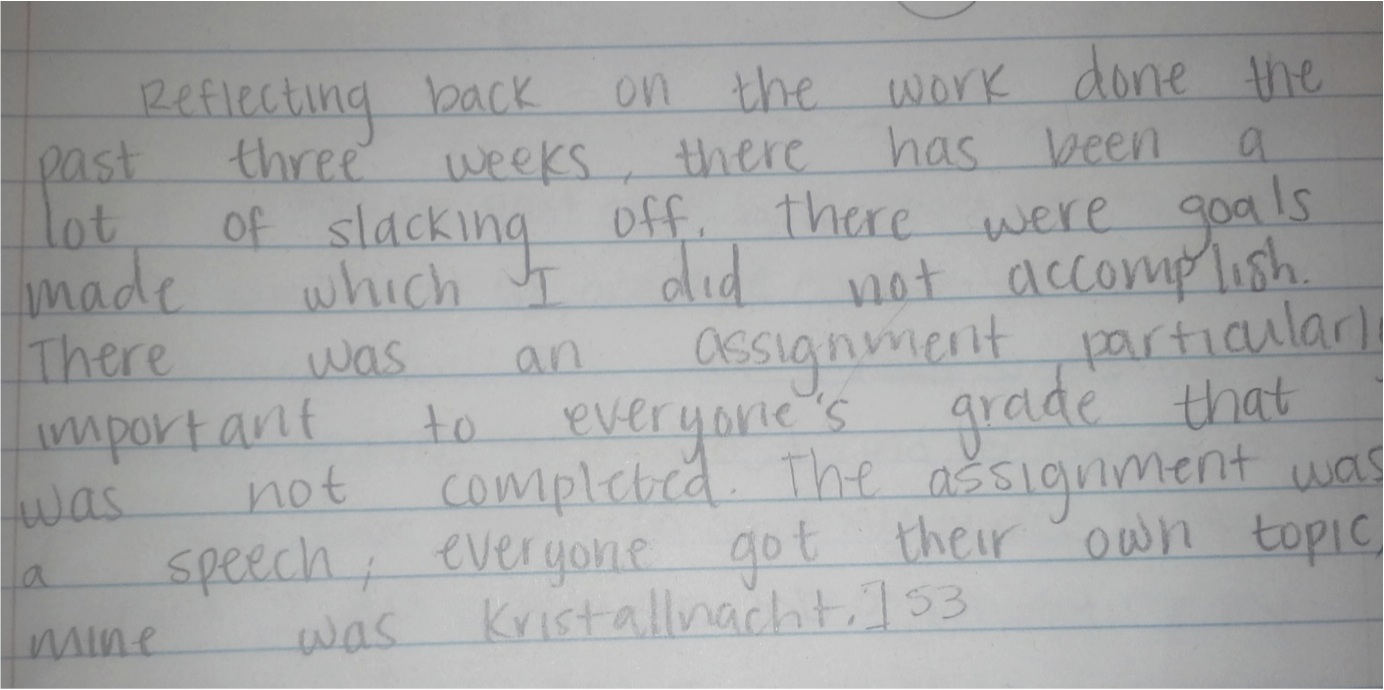
This student gets some bonus points for recognizing that we spent three weeks of class time on this project. They acknowledge that the assignment was important to everyone’s grade, yet despite this keen insight, they still didn’t do it. I guess admitting you have a problem is always the first step. This brings us to our next category.

The Laziness Factor

Laziness Cont

“Laziness is something that I am trying to permanently remove from my system” leapt off the page. A cogent thought from an articulate student capable of doing thoughtful, grade-level work.  A couple of things haunt me about this statement: (1) I have sat across from failing students and their parents countless times over the last decade of my teaching career. “He’s lazy,” say the parents, hoping I know the cure. The student nods “I’m lazy,” and adds a smile as if he’s now got an excuse for never doing any work. He has met and exceeded the parents’ low expectations. In truth, neither party knows how to solve the laziness question, which as it turns out is simply poor time management skills.  (2) Both the student and their parents seem to be equally powerless in solving the laziness problem. How can students learn that hard work leads to opportunity if the parents have not committed themselves to addressing this issue?

Procrastination

Here, the procrastination proclivity pops up again and reminds me that teaching time management is just as vital as teaching content. Assigning project-based work where the students have a degree of control over what and when they produce may do this type of student a disservice. Explicitly showing students (and some parents) how to use a calendar, how to block out time, and how to reward oneself with cell phone, computer, and/or video game time after steps in a project have been completed may be a starting point. Sending home phone call/text reminders through an automated service like Remind may reinforce time management skills and create habits that students could use for the rest of their lives. Does anyone else have ideas for solving this vexing problem?

Outstanding Speech

1389.8 Holocaust C

The speech below was one of 126 delivered in my World History class this spring. The student gave a forceful and emotional reading that enthralled the audience and effectively placed them at the scene of Kristallnacht. At 487-words, this speech took the student 3:47 to deliver. It was a tour de force. I wish more than 40 people had been in my class to witness it.

The Night of Broken Hearts

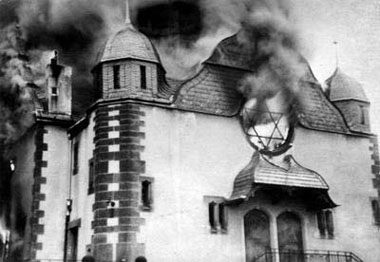
We went out into the street. The crowd of people became the street, all tripping over each other towards a nearby synagogue, all shouting angrily. We had followed. As we reached the synagogue and halted, silent and angry, we could see at the end of the building, flames rise. The crowd rushed forward and their greedy hands tore seats and woodwork from the building to feed the flames coming from the east of them.

Behind us we heard more shouts. We turned, and saw a part of the mob start along the road to Israel stores. During the days the store’s held granite cubes ostensibly used for repairing roads. Youths, men, and women, screaming deliriously, hurled these blocks of granite through anything glass. Within a few minutes the doors gave away and the indignant mob rushed inside to pillage and loot.

By then the streets were chaotic, filled with bloodthirsty people screaming for the death of Jewish people. A man tried to protect an aged Jewess who had been dragged from her home by a gang. Provided, I pushed my way through to help him and, between us, we managed to heave her through the crowd to a side street and safety.

The center of their hate was a hospital for sick Jewish children, many of them cripples or immobilized. In minutes the windows had been smashed and the doors forced. We arrived when, the swine were driving the wee mites out over the broken glass, bare-footed. The nurses, doctors, and others were being kicked and beaten by the mob leaders.

This was the personal story of Michael Bruce, a non-Jewish Englishman. He had watched this horrid act along with many others would had stood by while it occurred. This event is known as “Kristallnacht,” where Nazis and their supporters in Germany engulfed synagogues in flames, vandalized Jewish homes, schools and businesses, in addition to killing close to 100 Jews, but what had caused this event?

In 1938, Herschel Grynszpan, a 17-year-old Polish Jew learned that the Nazis had exiled his parents to Poland from Hanover, Germany. As retaliation, on November 7, the teenager shot Ernst Vom Rath, a German diplomat in Paris. Rath died two days later, and Hitler attended his funeral. Joseph Goebbels, who was the Nazi minister for public enlightenment and propaganda, immediately seized on the assassination to rile Hitler’s supporters into a rage that would cause a terrifying wrath.

The Night of Broken Glass was the result of that rage. After all these atrocities, little action was taken by neither Europe nor the United States. Even if President Roosevelt instructed that refugees already in the U.S. could stay, that does not excuse the fact that we did NOTHING to stop it.

Therefore, we must honor the people who died. We must honor the people we did not save. We must remember the innocent people whose lives were stolen.

kristallnacht-burning-380

Works Cited

“Kristallnacht Eyewitness Accounts and Reminiscences – Simon Wiesenthal Center Multimedia Learning Center.” Kristallnacht Eyewitness Accounts and Reminiscences – Simon Wiesenthal Center Multimedia Learning Center. N.p., n.d. Web. 22 Feb. 2015. <http://motlc.wiesenthal.com/site/pp.asp?c=gvKVLcMVIuG&b=394831&gt;.

Ballastk, Angela. “Kristallnacht: Background & Overview.” Background & Overview of Kristallnacht. The Holocaust Shoah Page, 2000. Web. 03 Feb. 2015. <http://www.jewishvirtuallibrary.org/jsource/Holocaust/kristallnacht.html&gt;.

Shirvanian, Armen. “The History Place – World War II in Europe Timeline: November 9/10 1938 – Kristallnacht, the Night of Broken Glass.” The History Place – World War II in Europe Timeline: November 9/10 1938 – Kristallnacht, the Night of Broken Glass. The History Place, 1997. Web. 05 Feb. 2015. <http://www.historyplace.com/worldwar2/timeline/knacht.htm&gt;.

Feedback

I have been experimenting with a robo-grader called PaperRater.  It gives the students immediate feedback on (1) originality, (2) spelling, (3) grammar,  (4) word choice,  (5) transitional phrases, (6) sentence length, and (7) academic vocabulary. This enables the students to shore up any weaknesses in their writing before they give it to me. You can read the report on this speech HERE.

Speech Feedback

Like I stated in my previous post, 64% of my students delivered a speech in front of the class. Of the 71 students who elected not to deliver their speeches in front of the class, not one chose to video themselves making the speech privately. The range of students who chose not to deliver a speech (1, 13, 16, 17, 24) varied significantly from class to class. This surprised me.  The fact that many students who completed each component of the speech did not want to give a speech in front of the class made me speculate that: (1) public speaking in front of their peers is something students do not want to do and (2) other teachers aren’t assigning individual speaking tasks to their classes. I loved this criteria chart from the MT blog.

Speeches

My feedback centered on speaking style, physical presence, and then content. After the student finished their speech, the class would grade it on a scale of 6-10 in terms of how much the speech interested them. I tried to provide warm feedback. Next time, do less reading and try to make more eye contact with the audience.  Don’t play with your hair or tap your foot as you are speaking. Then, I had the students write for 30 minutes assessing their performance. These reflections provided me with a great deal of insight into who had taken the project seriously and who did not. There are four student examples in italics below followed with my interpretation of their comments.

Exemplar 1 

For this kind of work, I know I have gotten better in at least three ways. One way I’ve gotten better is because I now know how to grab the attention of the audience with my introduction. The second way is that I connected with my topic in an emotional way that helps make my speech more interesting. Lastly, I found out how to put the right amount of facts and information so it was at least a three-minute speech.

Berlin, Boykott-Posten vor jüdischem Warenhaus

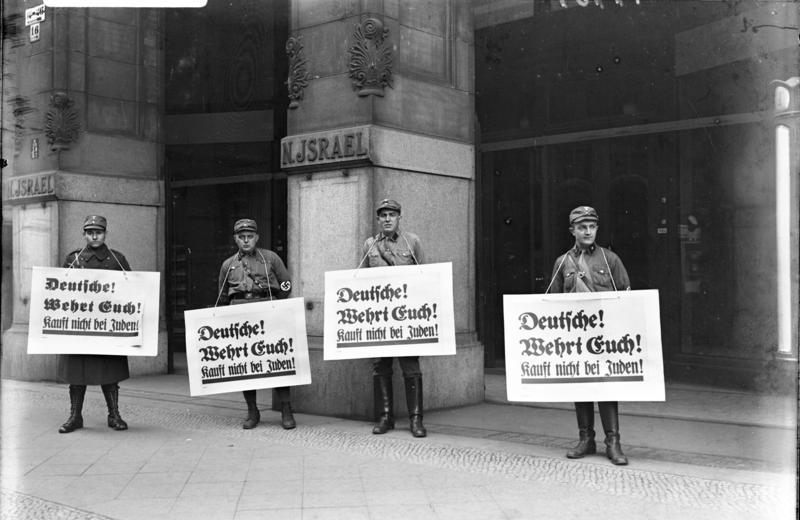
This student wrote a 230 word reflection that indicated how good she felt about her speech, which opened with a personal story about the demise of her family’s business and then segued into The National Boycott of Jewish businesses. This student made the audience care about when happened to her family and, in turn, the audience thought about all of the hard work and effort that German Jews had put into their family businesses, which were ruined after the boycott. It was a great example of how to connect with an audience.

Exemplar 2

In my opinion, I did a very good job on my work. I specifically like that I had a good opening and closing. One thing I did not like was that there were not many facts. I could have put more information on some of the children in the Kindertransport. I enjoyed that many people liked my speech.

kindertransport

This student wrote a 368 word reflection that described how she wanted the audience to feel when they heard her speech. She wanted the audience to develop an emotional attachment to the children of the Kindertransport and did that superbly by asking the audience to imagine what it would be like to lose your parents at four years of age.

Exemplar 3

Throughout the year, I have written multiple speeches. Each time I write one and say it in front of a group of people, I see a change in myself. Especially at the beginning of the year, the first speech I had written was lengthy and it had too much detail. The changes that I see from the speech are the ability to connect to the audience, create a purpose, and the ability to speak in front of people in general.

Kristallnacht

This student wrote a 558 word reflection that detailed how she had learned to craft her speaking style after participating in our school’s Academic Decathlon program. Our school’s Aca Deca coach is a wonderful English teacher who brings medals back to the school, year after year. She is gifted at teaching public speaking, so it didn’t surprise me that this student had a well-developed opening. The student spent the first 90 seconds of her speech putting the audience into the events of Kristallnacht. Through eyewitness accounts, she made the audience visualize Jewish children crawling out of the wreckage of a burning hospital over broken glass while the doctors and nurses trying to save them were beaten to death by vicious, anti-Semitic crowds. Then she layered in the facts that led up the event and concluded by giving the audience clear directions in how they should respond whenever they witness acts of religious or racial intolerance. The audience was putty in her hands. I only wish her parents and the school superintendent were in my class to witness the speech. It was fantastic.

Exemplar 4

My work was a lot different than others because my speech was very unorganized. In my speech I had a lot of names that I couldn’t say and even if I did say then, I would say them wrong or not even say them at all, leaving a dead spot in my speech. Most of the class was reading every word off their paper or their phone and I was one of them. The students who had their speech memorized really stood out. I was very confident and loud reading my speech at home, but got very shaky and nervous in front of the class. My legs were shaking and I couldn’t speak correctly and I would want to correct that.

This student learned more from watching the other speakers than I could have ever taught him. I didn’t need to give him any feedback.

WWII Speech Project

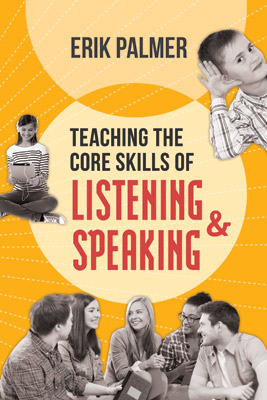
PalmerThanks to a challenge from @erikpalmer, author of Teaching the Core Skills of Listening and Speaking, I was motivated to give my students a speech assignment instead of a research paper when I finished my unit on WWII.  The assignment was fairly straightforward.  Students were allowed to select a topic from a list of 75 WWII topics. Their research was limited to five online sites from within the LAUSD Digital Library. They also needed at least five books in their research. They used http://www.easybib.com/ to create a bibliography. I explained that Google & Wikipedia ARE NOT ACADEMIC SOURCES and could not be cited. After they gathered all 10 sources, they could draft an outline or create note cards of their speech. The first draft of their speech was run through http://www.paperrater.com/ and the report was printed out or emailed to me prior to delivering the speech. The final speech was to be graded by the class based on the following rubric:

Point Structure

  1. Bibliography                  50 pts
  2. Notecards/Outline    50 pts
  3. First Draft                       50 pts
  4. Paper Rater report   100 pts (grades given ranged from 68-92)
  5. Delivering Speech     100 pts (50 pts from me & 50 points from their peers

Students who did not want to deliver their speech in class were given the option to video themselves giving the speech and post it on YouTube so we could grade the speech in class for a reduced number of points (max 80 pts). Students were given three weeks to complete their speeches and then we spent one week listening to all of them.

Interspersed throughout instruction were mini-lectures and examples on giving speeches. I had students stand up and read the first 30 seconds of their speech to see if they had a “hook” and gave them feedback on how they could improve. Additionally, they viewed the following videos:

How to write a speech outline

https://www.youtube.com/watch?v=M4BkVmA0p6Y

Speech Opening

https://www.youtube.com/watch?v=XAaSZ64P8pA

Speech Attention Getter

https://www.youtube.com/watch?v=HK0U0bIN-cw

Components of a Speech

https://www.youtube.com/watch?v=J-aFEgoOEXQ

Speech Closing

https://www.youtube.com/watch?v=YSi7aPR1-pg

Intro to Easybib

https://www.youtube.com/watch?v=SL_ddUHSYC4

Finding Sources

https://www.youtube.com/watch?v=Y4CHIRzlF40

The Final Numbers

Out of 197 students, only 126 (64%) completed their speeches and delivered them in front of the class. Of the 71 students who elected not to deliver their speeches in front of the class, not one chose to video themselves making the speech privately. The speeches ranged from a low of 42 seconds and a high of 5:45 (before I stopped the student, who clearly could have talked for another ten minutes). The average time of all the speeches (N=126) given was 2:59. What I found particularly astonishing was that in one of my classes 24 out of 38, or 63% of the students chose not to give their speech. Whereas in another class, only one student out of 40, or 2% elected not to perform the speech. What a difference classroom culture makes.

I was not sure whether to be happy or sad with these results. My next post will discuss how I provided feedback and how the students reflected on the process. I used this great handout from Edutopia, which contained 40 reflection questions for students.

CCSS Presentation Materials

Goal-setting approaches to student writing

I wrote a paper on the results that happened after implementing this program at two high schools. I give this presentation to inspire teachers to consider alternative grading methods and increase the number of writing assignments they require of their students. I have found that over the course of the year my students can double, if not triple the amount of words they put on a page in one class period. The next trick is to partner with an English teacher, who can help them take the quantity they are now proficient in and turn it into quality writing. I have found that this level of competition really motivates students. This work has borrowed heavily from Chip Brady and the excellent curriculum at The DBQ Project, who provided inspiring professional development and encouraged me along the way.

Peer review with tech

Many high quality studies influenced my decision to start evaluating student writing quantitatively, De La Paz, S. (2005), De La Paz, S., & Felton, M. (2010), Monte-Sano (2008, 2011) and (Monte-Sano & De La Paz, 2012). I strongly feel that History/Social Science departments should report descriptive statistics about their students’ writing in order to derive a common set of writing expectations by age and grade level. Further, recent advances in automated essay scoring may make it possible for students to receive feedback from a computer before approaching the teacher to partner in improving the writing together. See this Lightside Labs Revision Assistant video and feel free to expand on this annotated bibliography tracking the major players in the automated essay scoring market. K12 teachers should provide input to the companies developing these products and the lefty-Liberal in me hopes all of these products will eventually be open source, like the PaperRater product that my students recently used on a speech project.

Peer review without tech

Most of the work I reference here came from O’Toole (2013), Brookhart (2013), and Bardine and Fulton (2008). Learning by evaluation has long been used by English teachers, it is time for history teachers to embrace the practice. If the CCSS are truly able to get us off the breadth vs. depth Historical coverage treadmill, History/Social Studies teachers are going to need tools and strategies to assess the writing they assigned. Having students read each others writing gives them much needed context. Before I wrote my dissertation, I read dozens of others on the same subject. History teachers will need to learn how to use mentor texts and provide general feedback instead of making margin notations on every paper they receive. English teachers have used peer rubrics and criteria charts to help students with their writing. It is time for history teachers to start incorporating those tools into their classrooms.

CCSS Presentation Resources

Free Plagiarism Tools

http://elearningindustry.com/top-10-free-plagiarism-detection-tools-for-teachers

Robo-Readers are Better than Human Readers

http://hechingerreport.org/content/robo-readers-arent-good-human-readers-theyre-better_17021/

Flunk the Robo-Readers

http://www.bostonglobe.com/opinion/2014/04/30/standardized-test-robo-graders-flunk/xYxc4fJPzDr42wlK6HETpO/story.html

Where Does Automated Essay Scoring Belong in K12 Education

https://www.edsurge.com/n/2014-09-22-where-does-automated-essay-scoring-belong-in-k-12-education

Free Robo-Graders

Hemingway App

http://www.hemingwayapp.com/

Revision Assistant

https://www.revisionassistant.com/#/

Paper Rater

http://www.paperrater.com/

Peer Review Tools

LDC Rubrics

http://ldc.org/how-ldc-works/modules/what-task/rubric

Sample Online Rubric

https://docs.google.com/forms/d/13tJkvBuoufBvNB885ZC8BMbGZF5o4XVuw929_i9Lrdc/edit#

Criteria Chart

https://docs.google.com/file/d/0B6qmQLlSxgMyWjRjekIwY3FkTFE/edit

Economic Systems Criteria Chart

https://drive.google.com/file/d/0B6qmQLlSxgMyZ3BnY3ZkX3VzV3M/view?usp=sharing

Peer Review Discussion Guide

https://docs.google.com/forms/d/13tJkvBuoufBvNB885ZC8BMbGZF5o4XVuw929_i9Lrdc/edit#

Economic Systems Argumentative Rubric

https://drive.google.com/file/d/0B6qmQLlSxgMyNWR6OGVlbk82OEk/view?usp=sharing

Providing Effective Feedback

https://historyrewriter.com/2014/11/10/providing-effective-feedback/

Video Tutorials

Changing Weak Writing into Strong Writing

https://www.youtube.com/watch?v=wJMyvwjpm-s