All posts by scottmpetri

Scott Petri has taught social studies for five years at the middle school level and six years at the high school level. He has also served as a coordinator and small school principal in the Los Angeles Unified School District. He holds a Doctorate in Educational Leadership and a Masters in Educational Administration from California State University Northridge, and a B.A. in Political Science from the University of San Diego.

Common Core Shifts

Common Core writing standards require History/Social Science teachers to become writing teachers. Yet many are uncomfortable in this role, they are more accustomed to being experts in their content area and K-12 writing is a foreign language reserved for ELA teachers with their own glossary of terms and acronyms. This post will demonstrate how History teachers can continue delivering content while coaching good writing skills and creating positive classroom attitudes toward writing.

Buck v Bell

This argumentative writing task on eugenics tested students in three ways: (1) interpreting and gathering evidence; (2) developing a thesis, and (3) supporting their thesis. After listening to a lecture on eugenics, students did a quick write where they took a position on whether eugenics was positive or negative, then they conducted a gallery walk where they collected evidence that supported their argument. I was looking to see if any of them changed their position after learning about eugenics research on criminal behavior, ideal families, immigrants, and people with hereditary disorders and mental illness. Lastly, students were asked to take their evidence (notes) back to their desk and explain their rationale to an elbow partner. I have found that having students talk to a partner before beginning their writing gives them more confidence in the subject and lowers the resistance to writing an in-class essay.

Eugenics_Vee_Diagram

My students were asked to complete a Vee diagram, which provides structure for developing an argument. Students write the central question, collect evidence that supports, or argues against it, then they summarize their argument in a thesis sentence at the bottom of the document. I encouraged students to collect six pieces of evidence, so they could include a robust set of claims and counter-claims in their essay. The level of effort they put into the gallery walk was evident in their papers. While only 142 out of 197 or 72% of my students completed this task. These students wrote an average of 292 words with 2.7 claims and 1.6 counter claims.

When using goal-setting strategies to motivate students and develop positive attitudes about writing, it is important to give students attainable goals. I told them that I expected 300-400 words, three claims, and two counter-claims. Most of the students met this bar. Unfortunately, this assignment coincided with a tragedy where a student at our school was killed in a traffic accident walking home. The students who knew him were devastated and unable to focus on this assignment, so for grading purposes, I awarded points to all the students who completed the task, but did not penalize students who performed at a sub-par level or did not complete the assignment. As History teachers increase the number of writing assignments in their classrooms, many of these assignments need to be low-stakes, skill-builders. Teachers cannot read and provide quality feedback on 200 essays per week.

Eugenics_Prompt

The following video showcases a high-level example and a low-level example, plus a paragraph that I asked students to repair (revise) and share with an elbow partner. While many Social Studies teachers object to taking instructional time away from delivering content, the Common Core standards tell teachers stop sprinting through the history standards on the coverage model treadmill and explicitly teach writing skills to our students. Districts and schools need to implement professional development seminars that help teachers shift out of their comfort zones as content-delivery experts into new ones as writing coaches.

Was Eugenics Science or Racism?

Reviewing my exams at the end of my WWII unit made me realize that my students didn’t really understand why Hitler easily rose to power in Weimar Germany. They had no inkling how he used popular science to advance many of his racial theories, nor that Hitler stole most of his theories on racial purity from American scientists in the eugenics movement. These students did not understand that eugenics was the 1900s equivalent to climate change, widely accepted by the mainstream, but vilified by extremist groups.  I blame this, not on my usual frantic sprinting along the historical coverage treadmill, but on our textbook, which doesn’t even mention the word eugenics anywhere in its 793 pages. Instead of re-teaching all of WWII, I put together a quick three-day unit and argumentative writing assignment on eugenics, starting with this wonderful lecture from 15 Minute History.

The next day, my students opened class with a Do Now: (quick write) that asked: Did the eugenics movement benefit or harm society? Then, I gave a short demonstration on how to use a Vee Diagram when writing an argument. After writing their initial argument, the students participated a gallery walk where they collected at least six pieces of evidence. The idea of the gallery walk was to see if their minds changed after examining the evidence. All of the materials in the gallery walk were collected from the Eugenics Archive.

American Eugenics Movement

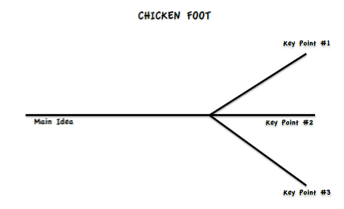
For their Exit Ticket, students discussed which pieces of evidence they had collected with an elbow partner and described how the evidence supported their claims. That night for homework, they were asked to fill out their chicken foot and organize their evidence, so they could write their essay in class the next day.

Chickenfoot

For their in-class essay, students were asked: Was the eugenics movement positive or negative? They were asked to include a brief background on eugenics, as well as their definition of eugenics, and instructed to write in the third person. Lastly, I asked them to use MEAL paragraphs to explain how their evidence supports their claim.  Click here for additional information on MEAL paragraphs.

M – Main Idea: Topic sentence

E – Evidence: Proof found in research

A – Analysis: Describe how the evidence proves the main idea

L – Link: Explain how the paragraph fits into what the paper is trying to argue.

The students (N=142) who completed this task, wrote an average of 292 words with 2.7 claims and 1.6 counter claims. At this point in the year, they should be writing between 300-400 words in a class period. To my horror, I discovered many examples of the Jane Schaffer method thriving in my class after a whole semester of trying to break them of the habit. I suppose I should be grateful that they had some writing instruction in middle school, but in high school and in college this type of writing doesn’t work.

Jane Schaffer Method

My next post will show students how to use the third person and help them learn how to turn bad writing into good writing.

#TeachWriting Chat on Historical Writing.

On Tuesday, February 10, 2015, I was the Guest moderator for the Twitter Chat #TeachWriting on Historical Writing. You can read an archive of the chat. The questions and resources I shared are posted below.

Welcome to tonight’s #TeachWriting chat on Historical Writing. Please introduce yourself, including subject and grade level.

Q1. What type of writing do you typically include in your classroom? (Argumentative, informative/explanatory, and/or narrative) #TeachWriting

Q2. Do your students have a preference for any particular writing tasks? #TeachWriting

Q3. What is the biggest challenge for your Ss writing a thesis, developing an argument, or assessing evidence? #TeachWriting

Q4. How can History teachers share the burden of writing instruction with other teachers? #TeachWriting

Q5. How can writing assignments be increased in History classes without interfering with coverage, or pacing plans? #TeachWriting

Q6. Should automated essay scorers be used to grade student writing? #TeachWriting

Q7. What tools and resources do you use that help students with argumentative writing? #TeachWriting

Q8. Why isn’t SRSD writing instruction taught to History teachers? #TeachWriting

Resources

A1. LDC Rubric http://ldc.org/sites/default/files/LDC-Argumentation-Rubric-2.0.pdf #TeachWriting

A1. BATREECS argumentative graphic organizers starting at pp. 62-65 http://www.nancyfetzer.com/pdf/writing/AtaGlance7-12.pdf #TeachWriting

A2. LDC’s Gr 6-12 Informative/Explanatory Writing Rubric http://ldc.org/sites/default/files/LDC-InfoExplanatory-Rubric-2.0.pdf #TeachWriting

A2. This graphic organizer helps students with outlining http://www.saylor.org/site/wp-content/uploads/2014/01/K12ELA7-3.3.2-InformativeEssayFrame-BY-SA.pdf #TeachWriting

A2. Elementary graphic organizers https://walch.com/samplepages/050078.pdf

A3. LDC Rubric http://ldc.org/sites/default/files/LDC-Narrative-Rubric-2.0.pdf #TeachWriting

A3. Argument graph org for elementary students on pp. 26-27 https://michelleleba.wikispaces.com/file/view/Social+Studies+Graphic+Organizers.pdf #TeachWriting

A4. Mix in some newswriting http://www.edutopia.org/blog/news-writing-teaches-history-writing-david-cutler #TeachWriting

A5. Don’t increase your reading, req Ss to use http://www.paperrater.com/ #TeachWriting Provides plag detect & grade

A5. Revision Assistant https://www.edsurge.com/n/2014-09-22-where-does-automated-essay-scoring-belong-in-k-12-education #TeachWriting

A6. https://historyrewriter.com/2014/12/02/detecting-plagiarism/ #TeachWriting

A6. http://elearningindustry.com/top-10-free-plagiarism-detection-tools-for-teachers #TeachWriting

A7. Teaching students to write historical arguments http://www.literacyinlearningexchange.org/sites/default/files/ncss_what_makes_a_good_history_essay_for-posting.pdf #TeachWriting

A7. Guide to writing an argument from the U of Iowa. http://clas.uiowa.edu/history/teaching-and-writing-center/guides/argumentation #TeachWriting

A8. https://historyrewriter.com/2014/12/04/srsd-instruction/ #TeachWriting

A8. https://historyrewriter.com/2014/12/09/srsd-writing-in-history/ #TeachWriting

A8. All things SRSD. Great resources. www.thinkSRD.org #TeachWriting

Writing About The Holocaust

Participating in Chapman University’s Holocaust Art & Writing Contest is always the highlight of my year. I get inspired by the amount of deep thought and hard work that my students put into their projects. This year, students were required to watch and submit notes on three separate survivor testimonies. Then, they created a piece of art, an essay, and a poem based on each testimony, and provided statements for the art and poetry pieces that described how their entry addressed the contest prompt. I assumed that their essays would address the prompt, which was not always the case. Too many students disregarded the prompt and simply summarized the survivor’s testimony without making any meaningful connections to the survivor, which disqualified them from the contest. My mood was foul.

2015 CONTEST PROMPT

LISTEN. As you listen to the testimony, choose a moment of discovery for the survivor or rescuer. Give careful attention to the historical context in which this discovery occurs. Consider the effects of this discovery on the person and his or her actions. INTERPRET. From your own history, recall a moment when a discovery sparked in you the decision to act, to find your voice or to approach a situation differently. CONVEY. Drawing upon both your history and the history provided in the testimony, convey in an original work of art, film or writing the relationship between discovery and action.

This was a difficult prompt for my 9th and 10th grade students to understand. I simplified it as: 1) What impacted you from the survivor’s testimony? 2) How did this make you think differently about the Holocaust? and 3) Will this change the way you think about racial and/or religious discrimination?

Here is an example of a student who addressed the prompt in her artist’s statement.

This picture is based on the life of Bertha Haberfield. She explained how once her family and her had arrived at Auschwitz, there was no time to say goodbye. When she had turned around they were already gone. This picture shows the many lost spirits that did not get a goodbye.

2015-02-05 13.22.28

Students displayed maturity and great empathy for Jewish holocaust victims, including one who made a heart-breaking connection with a survivor who gave testimony about losing her childhood home. The testimony resonated with this student because her family had recently lost their home due to financial hardship. These young students wrote with great passion and emotion about how much family, friends, pets, and religious freedom mean to them. One student was horrified that Jewish families were required to euthanize their pets five years before they were sent to the concentration camps. Several students wrote about Jewish resistance and declared they would have also resisted even though almost every resistance story ended in death for the Jewish people.

The second place art winner (with 64 votes) was a graphic, yet tastefully done drawing of a survivor who endured Nazi eugenics experimentation and forced sterilization. This picture does not really capture all of the fine detail and hard work this student put into the project. These two entries went back and forth all day in the voting.

2015-02-03 15.02.22

All of the entries were judged by myself and two other English teachers. We picked the top seven in each category. I displayed those on my classroom whiteboards and students walked through this gallery and voted for the top entry in each category. This year’s first place art winner (with 66 votes) was an anime-inspired version of life in a concentration camp. The survivor described pre-war happy, colorful Jewish people practicing their faith and the artist juxtaposed this image with the grim concentration camp inmates. The artist did not draw faces because the Nazi’s did not see their victims as humans, but the survivor who inspired this piece (in the foreground) was admired greatly by this student.

2015-02-03 15.02.11

Sometimes it is easy to focus on the negative. Teachers are great at this. We beat ourselves up while grading… these kids didn’t get it… they didn’t put enough work into this… these kids don’t care… After reflecting on this project, I realized that the majority of my students do care. They engaged with the subject and created something personal and powerful that displayed great historical empathy. Standardized tests won’t capture how many students made bona fide connections to victims of the Holocaust, but their work speaks for itself. Today, I am proud to be a teacher.

Argumentative Writing Bonus Links

Hi MOOCers,

I have been worried that this week’s unit didn’t have enough how to and that many of you would not find it as useful as I would like. It’s amazing how when you are pondering something in your subconscious and then the universe responds and fills the vacuum. The links below were all sent to me from the Twitterverse. I hope they will fill any gaps in argumentative writing instruction.

HHTBWT Badge horizontal

I am very pleased with the amount of sharing and connecting that is happening on the discussion boards. So far only ten of you have taken the quiz, which has an average of 6.56 questions right and takes ten minutes of time. Consider this a gentle nudge to finish up the module so you can enjoy Super Bowl Sunday.  The informative writing module opens on Monday morning. Have a great weekend. — Scott

Bonus Links

ACRE (Argument, Clarity, Repetition, Evidence)

http://benthamorfoucault.blogspot.com/2014/06/how-to-write-almost-anything-argument.html

http://benthamorfoucault.blogspot.com/2014/07/how-to-write-almost-anything-part-2.html

Claims, Evidence, Reasoning

https://www.youtube.com/watch?v=vCJacUvo778&list=PLij2XTFgmBSTKjftUzmkRmR0WxFfUpg6o

Erik Palmer video on Argumentation

http://my.hrw.com/content/hmof/language_arts/hmhcollections/resources/common/videoPlayer/index.html?shortvid=V_FLLIT_0301

Good Speaking & Listening

Eric Palmer’s quality work inspired me to give my students a speech project.

http://www.stenhouse.com/html/well-spoken.htm?r

http://www.ascd.org/Publications/Books/Overview/Teaching-the-Core-Skills-of-Listening-and-Speaking.aspx

Free webinar on Deepening & Widening the Way we teach writing in K-5.

https://vts.inxpo.com/scripts/Server.nxp?LASCmd=AI:4;F:QS!10100&ShowKey=23625&partnerref=EBLAST

Reinventing Writing chat on Twitter this Saturday morning: The nine tools that are changing writing, teaching, and learning. Mark your calendars for a great #satchatwc 1/30 at 7:30 am PST w/ guest host, Vicki Davis, aka @coolcatteacher

Making Sense of Evidence

http://historymatters.gmu.edu/browse/makesense/

MOOC Week Three

Hello Everyone, all 423 MOOC participants.

As we finish up Week Two and begin Week Three, I want to remind everyone that this is an ungraded class. The actual grades that you get on the quizzes do not count, all that matters is that you complete them and participate in all of the discussion forums in order to earn your completion certificate. Also, even though the courses are arranged into weekly modules, you do not need to complete everything during that week. All of the required elements need to be completed by February 22. Then on Monday, February 23, the last module containing the certificates will open. So if you started the course late, don’t panic, there is still plenty of time to get through everything.

Quiz Results: Many of you aren’t using the full 30 minutes to search for the reading to find the answers. That is the best way to increase your scores.

Quiz Results

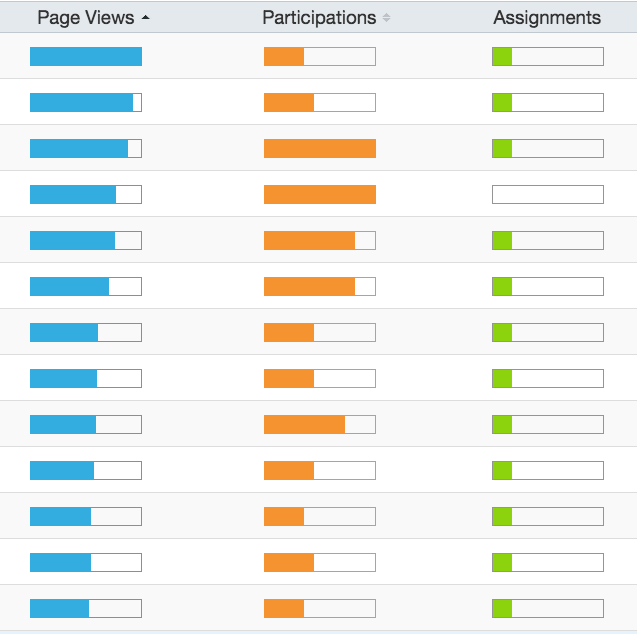
No shout-outs, or brownie points this week, but I loved the discussions on the robo-graders. I thought that everyone was able to articulate his or her opinions professionally and courteously. Regardless of how passionate someone felt pro or con, there were no personal attacks and petty bickering. I guess that is the difference in teaching teachers versus teaching high school students. I am noticing a little participation fatigue between Week One and Week Two. Week One had an average of 47 participations per day and 798 page views per day. During Week Two this slipped to 29 participations per day and 522 page views per day. Both weeks have had the lowest activity on Saturdays. It’s almost like teachers think they deserve a day off.

Analytics

As we venture into argumentative writing this week, I would like to share a current assignment that my 9th & 10th grade World History students have been assigned. This is a culminating essay for our unit on the Holocaust. Students must argue which humanitarian deserves an award for saving Jewish lives during the Holocaust. It relates to the essential question for this unit, Would you risk your life to save others? What would influence your decision? I am borrowing a format I saw used by @Pomme_Ed. I’ve seen it called a Video Based Question, or Digital Based Question and it can easily be shared with students via Google Drive. I welcome your comments and feedback. Feel free to make a copy of the assignment and modify it for use with your students.

This week we have four readings, a quiz on the featured reading, three resources, three pages of videos, and three discussions. Again, I’d like to discourage you from binge viewing. I think letting yourself reflect for a day results in better discussions. Also on Twitter, we have a small, but mighty group of 20 students of 423 students. . Use #HistRW to share resources with MOOC participants. Consider following your classmates on Twitter. A lot of great ideas are shared during #sschat, #TeachWriting, #WHAPchat, and #sstlap.

  1. Tips and resources that were shared last week were:
  2. Prewriting: Why Should Students Go It Alone? http://p.ost.im/LY2mUb via @Catlin_Tucker #HistRW
  3. Special Journal Issue on #MOOC Read all about it. http://ln.is/scholarworks.umb.edu/dDQCG … #edtechchat #edchat #HistRW
  4. Historical Thinking – Teaching with Primary Sources http://ln.is/www.loc.gov/teachers/uEiNM … #HistRW
  5. Three lessons from the science of how to teach writing | Education By The Numbers: http://ln.is/educationbythenumbers.org/SgtQG … #HistRW
  6. Three lessons from data on the best ways to give feedback to students http://ln.is/p.ost.im/DSVNo  #HistRW
  7. Peer Review: 5 Tips and a Bunch of Tools to Make It Work When It Doesn’t. http://ln.is/angelastockman.com/Jkk3c … #HistRW

Please consider following your classmates on Twitter. A lot of great ideas are shared during #sschat, #TeachWriting, #WHAPchat, and #sstlap.

@nuriabrs

@grabgcab

@SecondaryEDUSF

@KHCoban

@MondaFason

@ACPGilbertson

@Dontworryteach

@maxlambmo

@egiapharas

@mrshistorylee

@KellyALew5

@arshiaunis

@gary_masters

@edmcgovern

@HTERCUMANP

@historytechie

@russelllindsey

@Asley88

@englishbeat8

Providing Feedback

Hi Everyone,  

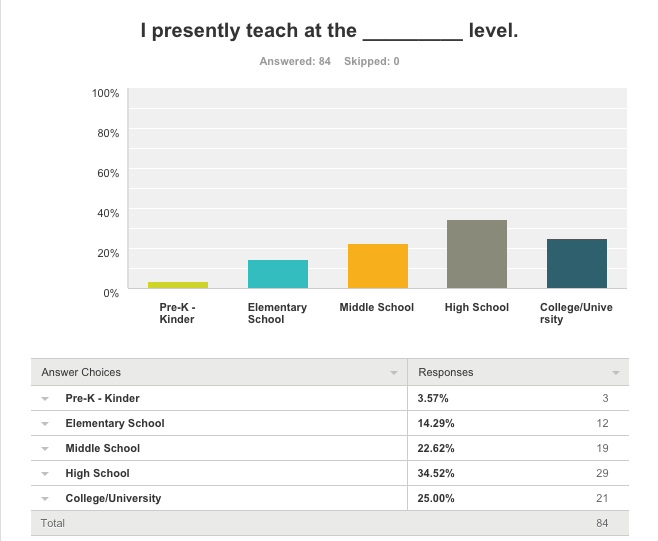
This post is for the 411 participants in the MOOC Helping History Teachers Become Writing Teachers.  Thanks to many of you that filled out my TEO Survey. Here are the results so far.

Participants

We start module two on a high note wrapping up some great conversations from Week 1. We had 119 introductions; 76 conversations posted in writing about writing, 41 discussions about SRSD instruction, and about 51 discussions about detecting plagiarism. I use the number of active discussions to tell me how many of the 411 teachers enrolled in the class are actually participating.

This week, we will start with some videos on providing feedback. These videos are tagged elementary, secondary, and college. Feel free to view the one that would be most helpful to your subject. Don’t feel obligated to watch all three.

We will continue our dialogue about the difficulty in providing effective feedback. There are some short pro and con articles about robo-graders, or automated essay scoring systems, which I hope will spark a spirited, yet civil debate on our discussion boards. Our featured reading is followed by a short, 10-question quiz. Dr. Christian Schunn, who offers a guest lecture on a web-based peer review program has offered to give us complimentary access to Peerceptiv during the course of the MOOC.  However, in order to use it we would need to generate some mentor texts and conduct multiple peer reviews as an assignment. I am worried about assigning too much work and scaring people off.

A couple of highlights on the discussion board were from Jennifer Brown, who is trying to wrap her head around why students plagiarize, librarian Lorraine Saffidi who asked “How can students be expected to express in their own words a complex idea they only partially understand?”  And Wesley Lohrman, who wrote: “History teachers can work to eliminate plagiarism by requiring students to incorporate a variety of text and push students to analyze what they are reading, compare and contrast text, and build opportunities with the classroom for students to discuss ideas and build their own concepts related to the current history learning targets.”

Overall, I am very impressed with the quality of the participation and I have enjoyed chiming in.  It is not too late for anyone to log in and participate in the Week One discussions. Remember, you need to participate in all of the course discussions to earn the certificate at the end of the course.

Tweeted in Class.

Here are some of the interesting items I found on Twitter this week and shared with MOOC participants under #HistRW. These pieces were authored or shared by course participants. Feel free to follow me @scottmpetri and connect with participants from the course.

Why do I have to teach writing in my 8th Grade American History?

http://historywithcj.blogspot.com/2015/01/why-do-i-have-to-teach-writing-in-my.html?spref=tw

World History Teachers Blog: M.A.I.N. Causes of WWI Video

http://worldhistoryeducatorsblog.blogspot.com/2015/01/main-causes-of-whi-video.html

How do students regard feedback from their teachers

http://www.turnitin.com/assets/en_us/media/favorite-feedback/

Interesting Summer PD Seminars

https://www.gilderlehrman.org/programs-exhibitions/2015-teacher-seminars

Charts that help writers distinguish idea generation from idea execution

http://makewriting.com/2014/12/01/charts-that-help-writers-distinguish-idea-generation-from-idea-execution/

A non-freaked out approach to the core

http://www.teachingthecore.com/non-freaked-approach-common-core-01/

Revising bit by bit

http://makewriting.com/2014/11/23/revising-bit-by-bit/

That’s it for now. I hope you are enjoying the course.  Cheers. Dr. P.

MOOC Launches Jan 12

Hello Course Participants, all 345 of you,

I have noticed that many of you have been signing up for blog updates before the course starts on Monday, January 12th. Yay! I am excited about the launch of the course. I am Dr. Scott Petri, your instructional co-host for Helping History Teachers Become Writing Teachers. I want to welcome you to the MOOC and describe the overall format of the course.

Canvas Network

As schools and districts implement the Common Core, we know that all teachers need to become writing teachers. Unfortunately many History & Social Studies teachers have not had sufficient instruction or practice in historical writing. Very few teacher professional development seminars focus on this topic. I hope this MOOC demystifies the writing process and encourages you to increase the amount of writing you assign in your classroom.

Each week, there will be an introductory lecture explaining the theme of the module. A featured reading, or series of readings on the topic. A quiz on the reading. Then outside video lectures and resources that will elaborate on the topic and assist you with implementation. Lastly, discussion board prompts will help you apply the content to your classroom practices.

Please understand, I am a classroom teacher, not a professional broadcaster. You are not going to get top-end production values in my video lectures. The resources in this MOOC were collected on the journey I have taken over the last five years as I have moved from fill in the bubble testing to assigning more authentic writing tasks as assessments. I do not consider myself “the expert” on this subject and the resources curated here are a mere fraction of what is available on the internet to help you introduce more writing into your classroom. A Japanese proverb states “one of us is not as smart as all of us” This sums up a key benefit of the MOOC format. It is participatory and collaborative. With several hundred participants contributing, you are bound to find something that moves your thought process and improves your practice.

HHTBWT Badge horizontal

I encourage you to share your resources, techniques, and systems with our course participants. It has been my experience that teaching is all too often a solitary act. Connecting with a supportive community of educators that encourages experimentation and innovation is, quite frankly, what is missing from many school site or district professional development programs. I hope we can create that type of community within this course. Thanks for joining us. I look forward to meeting you on the discussion boards.

SRSD Writing in History

This post is a follow up to my earlier lecture on SRSD writing instruction. Although, these lectures are meant for course participants in the MOOC Helping History Teachers Become Writing Teachers that will take place between January 12, 2015 – February 24, 2015, feel free to make comments, or join our Twitter conversations under the #HistRW.

Students writing

Purpose

Studies of history classrooms reveal that writing instruction of any kind is uncommon, even among exemplary teachers. Thus, student essays tend to list facts rather than argue claims, leave arguments unexplained, and only draw on evidence sporadically. A majority of adolescent writers struggle in writing a simple argument in history. Recently, research has focused on the discipline-specific demands of history writing. Most specifically, how students construct a complex argument from smaller arguments from historical documents that reflect how they read, understand and cite evidence from multiple sources.

Previous research suggests that students do not learn to explain quotations or other types of evidence in their papers. Students do not develop interpretations that are supported with evidence. DBQ instruction may help students improve their persuasive essays, but not their ability to write evidence-based arguments. Explicit methods and direct instruction are needed for this. These researchers developed a Self Regulated Strategy Development (SRSD) intervention. This study measured the effectiveness of the intervention on students’ abilities to write evidence-based arguments using a cognitive apprenticeship model for instruction.

Thinking w hist docs

Hypotheses

H1 Students who receive instruction in analyzing sources and planning argumentative essays will demonstrate greater use of evidence from documents than students in the comparison group.

H2 Students will write more advanced claims and rebuttals, after instruction.

H3 Students will write longer and qualitatively better essays with greater factual accuracy and overall persuasiveness.

Methods

160 11th-grade students received instruction from four US history teachers at two schools. Scores on the written expression subtest of the Wechsler Individual Achievement Test, administered before the study began, were compared to determine whether the two groups differed in initial writing ability. The students initially performed at the same levels. Argumentative essays that involved historical interpretation were used for the writing task in this study.

Instructional Framework

(1) develop background knowledge, (2) describe it, (3) model it, (4) support it, and (5) independent performance (Harris & Graham, 1996).

The mnemonic STOP reminded students to consider and generate ideas on both sides of an argument before deciding which side to support in their essay. The steps of the mnemonic prompted them to Suspend judgment, Take a side, Organize (select and number) ideas, and Plan more as you write. Teachers modeled self-regulatory statements such as, ‘‘Since I decided to put my thesis statement first, I will write it as the beginning of my introductory paragraph.”

Student essays were coded to identify all claims in favor of or against the position. The study counted the total number of claims, but controlled for the length of essay. The researchers counted and analyzed the number of rebuttals that students wrote, then explored their level of development by ranking rebuttals according to degree of sophistication.

Doc Use Means

Results

In comparison to a control group (N = 79), essays written by students who received SRSD instruction (N = 81) were longer, were rated as having greater historical accuracy, were more persuasive, with detailed claims and rebuttals. This study suggests that with explicit instruction, teachers can shape new understandings for what students expect to write and how they perform in history classrooms. Thus, numerous writing from sources assignments, paired with direct instruction in historical thinking processes, appears to move low to average high school writers to demonstrably higher levels of writing proficiency.

The big takeaway is that History instructors now have a framework for how to compare measures of quality in student essays across grade levels. Effective writing instructors will concentrate on one or two elements per assignment, give students regular feedback, and report their growth.

Source

Reading and writing from multiple source documents in history: Effects of strategy instruction with low to average high school writers (2010). By Susan De La Paz, Ph.D., Associate Professor, University of Maryland, College Park 
& Mark Felton, Associate Professor, San Jose State University.