Category Archives: Paraphrasing

Diving Deeper with ParaFLY

The ParafLY EduProtocol (Chapter 6) helps students paraphrase complex text and simplify it to show a clear understanding of the subject. This post features examples of a 10th-grade World History class practicing interpreting literary criticism. This was a part of a large, interdisciplinary project that required the collaboration of an ELA teacher, a History teacher, and a Spanish teacher. The students used their knowledge from all three classes to write children’s books on historical figures from the Mexican Revolution. The books are archived here

As part of this project, I asked students to write their narratives at a sixth-grade reading level. They used the Hemingway App to check their text and revise it until they hit the target. For practice, I gave them some post-graduate literary criticism from Yisela Maria Padilla of the novel they were reading in class. Students had 15 minutes to paraphrase the original 360-word paragraph, which was written at the post-graduate or 16th grade level. I collected their work via Pear Deck and color-coded it as A=Green, B=Yellow, C=Red. Everyone who made an effort got the points. NOTE: This is not the way to smart start ParaFLY! Always use a low-cognitive lift when starting a new EP. Here are three student responses and the feedback I provided to the whole class.

On the left-hand side of the slide below is the original text and on the right-hand side is my paraphrased attempt. Numerous studies demonstrate that student self-assessment is a major factor in academic improvement. Asking students to identify strengths and weaknesses in their own work yields powerful insights. Increased metacognition and problem-solving with advanced social studies concepts and academic vocabulary leads to deeper learning.

The next day, I asked students to evaluate their work after reading my sample. They posted to a discussion board answering the following questions: Add up how many of the ideas you were able to put into your own words. On a scale of A, B, & C, what would you have given yourself on this assignment? What was the hardest part? What did you find easy? Two student responses are followed by their paraphrasing samples below.

Student A
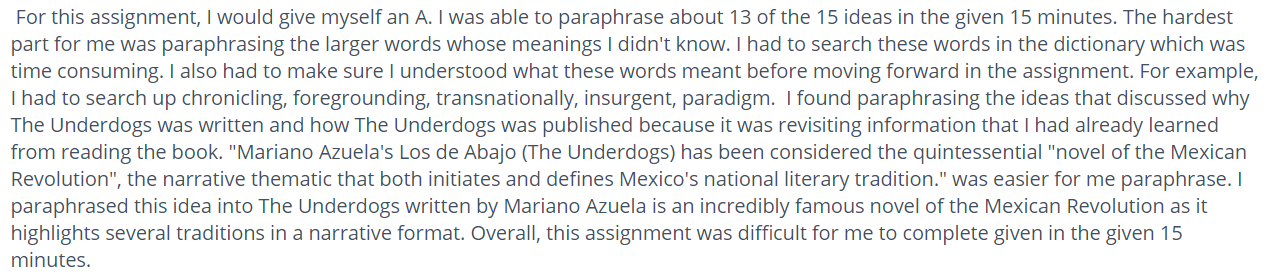
The Underdogs written by Mariano Azuela is an incredibly famous novel of the Mexican Revolution as it highlights several traditions in a narrative format. Mexican Literature became reinvented by The Underdogs since its appearance in 1915. Literature that was once filled with European tradition now contains Mexican events, culture, tradition, and history. The Underdogs has a hyper national status and was published by Los de abajo’s. This publication left the novel open to not just becoming popular in areas surrounding where the Mexican Revolution occurred (such as Mexico) but to also become popular and reach all around the world. Mariano Azuela documents when he joined Pancho Villa’s men in 1914 in an effort to write a novel that is from the peasants perspective of the revolution.  As Azuela writes about several defeats and then he flees to El Paso, Texas where he finishes his novel and publishes it in a small newspaper (El Paso Spanish-lanugage newspaper). During this time Mariano is starving and poor and ironically published his book on the US-Mexico borderlands. According to Juan Pablo Dabove, the Underdogs is a “nation-state identity paradigm.” This simply means that the story has hidden meanings. It involves several pertinent events and people of the revolution with different protagonists and antagonists.

Student B
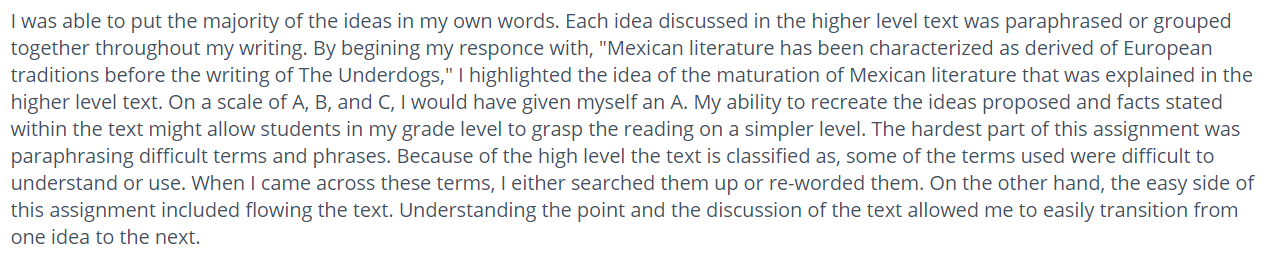
Mexican literature had been characterized as derived of European traditions before the writing of The Underdogs. When Azuela released his novel, Mexican literature was changed as we know it. He documented his time as member of a band of Pancho Villa’s men, writing a novel about war and everyone behind it. Villa used the names of important historical figures included in the revolution, but added characters in addition to present ones in attempt to add dimension to his novel. When the Villistas began suffering defeats, Azuela fled across the border to El Paso, Texas, where he finished his novel. The initial release of his novel was not brought much attention to, leaving Azuela penniless. As more publishers were drawn into the attention of the novel, it was celebrated. The success was celebrated for many reasons including the modernization and newfound interpretations of Mexican literature. This modernization was seen through the centralization of the Mexican government and post revolutionary antics, which ultimately allowed political and literary advancements. Despite the self-actualization displayed throughout The Underdogs, the ideas Azuela engaged were sometimes characterized as backward and violent.

Gallery walks are a great way to debrief student self-assessments. Repeated exposure to high-quality reflections helps students improve their metacognitive skills. Pair-share peer reviews can also be helpful.

After receiving whole-class feedback and self-assessing with an exemplar, it is important for students to do another rep immediately. This time, I asked them to select a passage from their research, record the grade level, and then document that they could bring it down to the sixth-grade level. Some were more successful than others.

The ParaFLY can be a challenging EduProtocol to provide feedback on especially if you use the jigsaw method and give every student or group different chunks of text. When using this EP, it is important to do a low-cog smart start and make your students feel proud of their first few reps. Otherwise, they will conclude that they aren’t good at paraphrasing and give up on this essential academic writing skill. These students had used ParaFLY more than a dozen times prior to this and were unafraid to tackle challenging text. I was very pleased with their efforts. They confirmed what Jon Corippo says in his EduProtocol seminars, “More reps mean more confidence!” 

If you are interested in diving deeper with EduProtocols, please pick up our book The EduProtocol Field Guide: Social Studies Edition. You can also catch The Social Studies Show live or on-demand every month on EduProtocols Plus.

Writing in Social Studies

Integrating Listening, Speaking & Writing in the Social Studies Classroom
Los Angeles County of Education
Day Two: Friday, February 23, 2018

Workshop Slides

8:30 – Reading in Social Studies

  • Loop Writing
  • Bob Bain video
  • Increasing Student Reading in class
  • text sets
  • historical fiction & non-fiction

9:00 – Daily Writing Tasks

  • Calendar Conversations
  • SEL Quickwrites & Student Reflections
  • Summarizing & Paraphrasing
  • Corroborating
  • Annotated Bibliographies (mini-research projs)
  • Self-Regulated Strategy Development (SRSD)

9:45 – 10:00 Break

10:00 – Narrative Writing

  • The Power of Narrative
  • First Person Research Papers
  • Vietnam Veteran Interviews

11:00 – Informative/Explanatory Writing

  • Timeline Transitions
  • Twitter as a pre-writing summarization tool
  • RAFT writing

11:30 – 12:30 Lunch

12:30 – Argumentative Writing

  • LOOP Writing
  • Believing & Doubting Game
  • MEAL paragraphs

1:45 – 2:00 Break

2:00 – Giving Feedback on Student Writing

  • Self-Review
  • Peer Review
  • Rubric Calibration
  • Road test the Robo-readers

Other Resources

Workshop materials posted on www.HistoryRewriter.com Collaborative Notes:  

So Cal Social Science Association events http://www.socalsocialscience.org/events.html

CCSS Spring Conference https://ccss.org/page-1861180

Six Word Definitions

Thanks to #TeachWriting, my rockin’ PLN on Twitter, I was apply to apply a new technique in my World History classroom this week. Several ELA teachers were discussing #6wordShakespeare and some of the other six-word story exercises that had been done in their classrooms. Hemingway wrote one of the most famous six word stories: For sale. Baby shoes. Never worn. These teachers described the technique as a fast brainstorming tool that gets students writing and playing with language immediately. I thought it could be used in the vocabulary-intensive unit I am currently teaching about the Cold War.

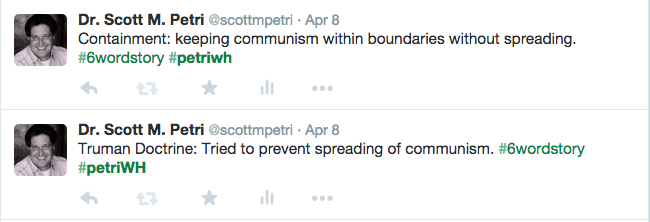
These two definitions from the book and subsequent student simplifications illustrate the concept.  Containment: The U.S. strategy of keeping communism within its existing boundaries and preventing its further expansion (p. 509). Truman Doctrine: United States policy, established in 1947, of trying to contain the spread of communism (p. 491).

6 word CW Vocab

Hyland & Tse (2007) report that many teachers regard helping students develop specialist [content] vocabulary as an important part of their role and many lists of key terms have been assembled. Marzano & Pickering (2005) offer a manual with 7,923 terms so school and district teams can choose the most important vocabulary words to teach their students. The terms were extracted from national standards documents, across eleven subject areas, and organized into grade-span intervals for: K–2, 3–5, 6–8, and 9–12 writers.

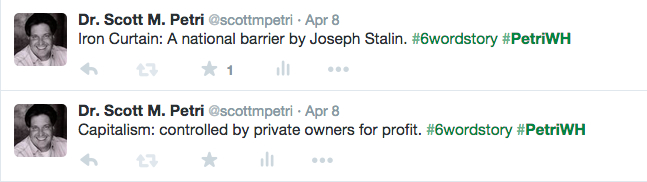
Here are examples of online definitions, along with student six-word definitions.  Iron Curtain:  The political, military, and ideological barrier erected by the Soviet Union after World War II to seal off itself and its depended eastern and central European allies from open contact with the West and other noncommunist areas (Encyclopedia Britannica). Capitalism: An economic and political system in which a country’s trade and industry are controlled by private owners for profit, rather than by the state (Google). Interestingly this term is not defined in the World History textbook, instead capital is defined as “money or wealth used to invest in business or enterprise” (p. 175).

6 word vocab

The majority of my students mastered this task and defined all seven terms in 15 minutes. I find that quantifying and charting how many terms a student completed within the allotted time helps me get a better picture of their engagement and alerts me to any comprehension problems that may be brewing.

Here some additional examples of student work:
Communism: Form of socialism advocated by Marx; Community has all power in society; All wealth and property owned collectively.
Capitalism: Private owners rather than the state; Prices are based on supply and demand; Individuals make decisions, not the government.
Cold War: Tension and hostility between two nations; Competition between U.S & Soviet states.
Iron Curtain: Prime Minister accuses Soviets of aggression. Soviets create a buffer in Europe.
Containment: Keeping communism within boundaries without spreading; America’s policy toward communist countries.
Truman Doctrine: Tried to prevent spreading of communism; 1947 USA policy stopping Soviet Socialism.

6 word stories

Kinsella (2013) argues that word knowledge is a strong predictor of academic achievement and educators cannot afford to leave vocabulary instruction to chance. She further advises that devoting attention to words that matter most is the first step in responsible lesson planning. I thought these six word definitions demonstrated understanding of Cold War terms and will continue to use it to help students master content vocabulary. It appears that finding activities like creating six-word definitions and re-tweeting favorites enable students to have fun while building their academic vocabulary. What tricks and techniques have been successful in your classroom?

References

Hyland, K., & Tse, P. (2007). Is there an “academic vocabulary”?. TESOL quarterly41(2), 235-253.

Kinsella, K. (2013). Cutting to the Common Core: Making Vocabulary Number One. Language Magazine12(12), 18-23.

Marzano, R. J., & Pickering, D. J. (2005). Building academic vocabulary: Teacher’s manual. Association for Supervision and Curriculum Development. 1703 North Beauregard Street, Alexandria, VA 22311-1714.

Detecting Plagiarism

This post summarizes the Turnitin.com white paper on Plagiarism and the Web, which will culminate in a lecture for course participants in the MOOC Helping History Teachers Become Writing Teachers that will take place between January 12, 2015 – February 24, 2015. Regardless of if you are participating in the course or not, feel free to make comments, or click on the links for the original sources.

Turnitin Sources

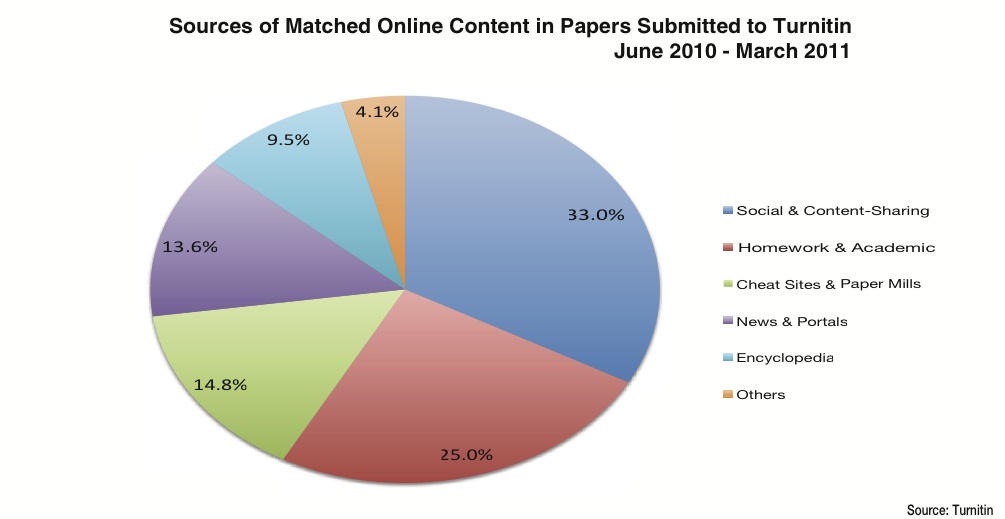
Blum (2011) reported that more than 75 percent of college students have admitted to cheating and 68 percent have admitted cutting and pasting material from the internet without citing it. Over the last 15 years, almost 40 million student papers have been submitted to Turnitin. This study examined and classified 140 million content matches to discover which web sources students rely on for unoriginal content in their written work. The vast majority of students who have matched content in their work do not rely on cheat sites or paper mills. Many use legitimate homework, academic and educational sites as research sources. Students rely on social networks and user-generated content sites such as content sharing and question-and-answer (Q&A) sites to find content for their papers. Turnitin detects patterns of matching text to help instructors determine if plagiarism has occurred. The text in the student’s paper that is found to match a source may be properly cited, making it legitimate academic work. Social and content sharing web sites comprised the highest percentage of all matched content over the course of the study. Legitimate homework and academic help sites were second, followed by cheat sites/paper mills and news and portals a close third and fourth. The fifth most popular category was encyclopedia. The top eight matched sites for matched content were: 1) www.en.wikipedia.org 2) www.answers.yahoo.com 3) http://www.answers.com 4) http://www.slideshare.net 5) http://www.oppapers.com 6) http://www.scribd.com 7) http://www.coursehero.com 8) http://www.medlibrary.org. Only one of the top eight sites is dedicated to helping students cheat by providing unoriginal content. Out of the twenty-five most popular sites, fourteen are legitimate student resources. While close to fifteen percent of unoriginal content comes from cheat sites and paper mills, the majority of students are frequenting legitimate academic or educational web sites. Educators can guide students in proper citation procedures. With digital tools, educators can show students how much of their paper lacks attribution. Showing students a detailed report on the originality of their written work creates a teachable moment. Turnitin offers a collection of white papers on student writing and plagiarism that teachers may find beneficial. Although most students understand that quoting word for word requires a citation, they are often confused about the need to cite someone else’s paraphrased ideas. Professional authors like Stephen Ambrose,  Doris Kearns Goodwin, and Stephen Glass have had problems in this area too. Turnitin claims that academic institutions adopting their service see a reduction in unoriginal content of 30-35% in the first year. By the fourth year, many institutions see levels of unoriginality in student writing falling by 70 percent. This claim, when applied to the assertion that the rate of serious cheating on written work remained stable between 1963 and 1993 (Blum, 2011, p. 2) indicates that electronic plagiarism detection tools could be beneficial to teachers and help increase the amount of writing assigned in high school and college. I am interested in hearing about your experiences using plagiarism detection tools. Do you think students are genuinely confused about the rules of paraphrasing and citing? Or are the vast majority of students deliberately copying other writer’s works? What motivates this? Does cutting and pasting happen from poor research skills or laziness? How can you create assignments that reduce the amount of plagiarism from your students? Please make a comment, or send me your questions via Twitter to @scottmpetri #HistRW. For those interested in experimenting with plagiarism detection tools, there are several free options.

References

Blum, S., D. (2011). My word: Plagiarism and college culture. Cornell University Press. Ithaca, NY.

Plagiarism and the Web: Myths and Realities. An Analytical Study on Where Students Find Unoriginal Content on the Internet. Retrieved from http://turnitin.com/static/resources/documentation/turnitin/company/Turnitin_Whitepaper_Plagiarism_Web.pdf on November 25, 2014.