Please join us on April 18, 2024, at 6 PT/9ET on The Social Studies Show when we talk about writing instruction with Josie Wozniak, the host of the ELA EduProtocols show and creator of the 3XPOV & 3XGENRE EduProtocols. Bring some student work examples, and your favorite templates, and be ready to learn a new writing strategy with some friendly teachers. We look forward to seeing you on EduProtocols Plus.
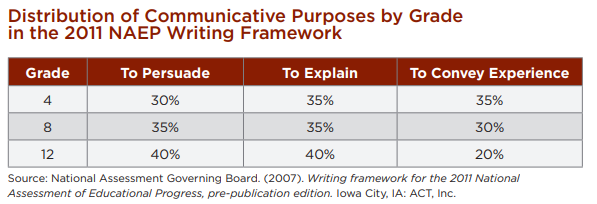
As we head into testing season, many Social Studies teachers start to second guess the amount of instructional time they have devoted to writing instruction. Has it been enough? Has it been too much? What is the appropriate balance between teaching writing skills and Social Studies content? The writing framework for the NAEP offers the following advice:
When students are asked to write about what they are reading, their comprehension of what they have read goes up 24 percentile points (Gabriel, 2023, p. 61). Social Studies teachers typically rotate writing tasks around narrative, explanatory, and persuasive text types, however, students benefit from perspective-taking when they interpret primary and secondary sources. The 3XPOV or 2XPOV EduProtocol gives students practice writing with different points of view and then engages them in a small group discussion over what elements in the writing are most aligned with individual perspectives.
If you missed the first season of the Social Studies Show, all 12 episodes are available at any time for members of EduProtocols Plus. You can listen to the EduProtocols podcast for free.
The ParafLY EduProtocol (Chapter 6) helps students paraphrase complex text and simplify it to show a clear understanding of the subject. This post features examples of a 10th-grade World History class practicing interpreting literary criticism. This was a part of a large, interdisciplinary project that required the collaboration of an ELA teacher, a History teacher, and a Spanish teacher. The students used their knowledge from all three classes to write children’s books on historical figures from the Mexican Revolution. The books are archived here.
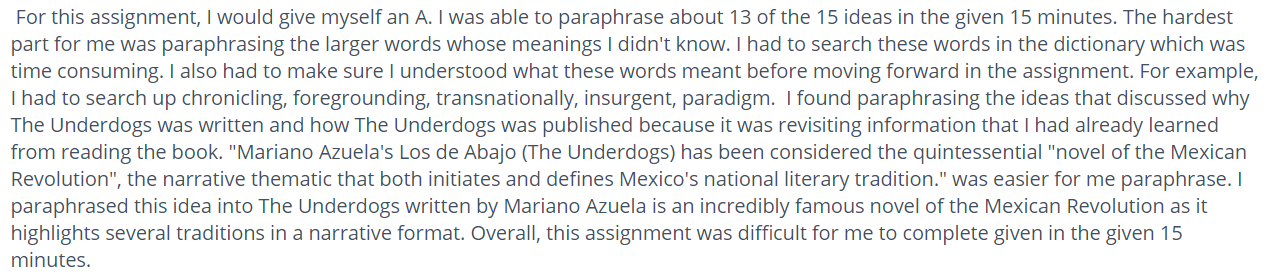
As part of this project, I asked students to write their narratives at a sixth-grade reading level. They used the Hemingway App to check their text and revise it until they hit the target. For practice, I gave them some post-graduate literary criticism from Yisela Maria Padilla of the novel they were reading in class. Students had 15 minutes to paraphrase the original 360-word paragraph, which was written at the post-graduate or 16th grade level. I collected their work via Pear Deck and color-coded it as A=Green, B=Yellow, C=Red. Everyone who made an effort got the points. NOTE: This is not the way to smart start ParaFLY! Always use a low-cognitive lift when starting a new EP. Here are three student responses and the feedback I provided to the whole class.
On the left-hand side of the slide below is the original text and on the right-hand side is my paraphrased attempt. Numerous studies demonstrate that student self-assessment is a major factor in academic improvement. Asking students to identify strengths and weaknesses in their own work yields powerful insights. Increased metacognition and problem-solving with advanced social studies concepts and academic vocabulary leads to deeper learning.
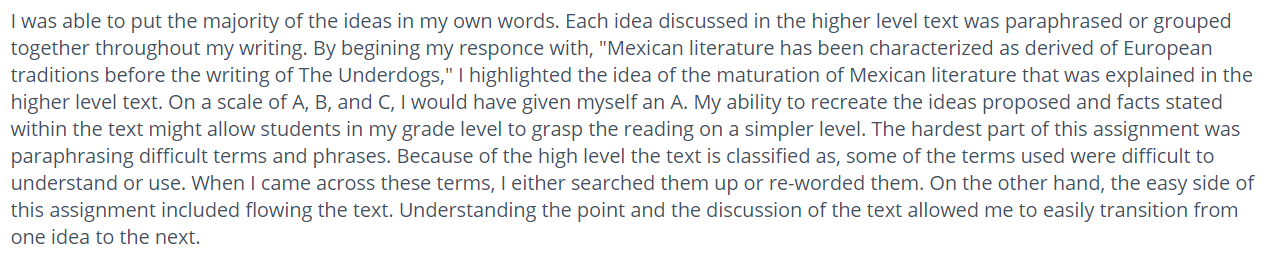
The next day, I asked students to evaluate their work after reading my sample. They posted to a discussion board answering the following questions: Add up how many of the ideas you were able to put into your own words. On a scale of A, B, & C, what would you have given yourself on this assignment? What was the hardest part? What did you find easy? Two student responses are followed by their paraphrasing samples below.
Student A
The Underdogs written by Mariano Azuela is an incredibly famous novel of the Mexican Revolution as it highlights several traditions in a narrative format. Mexican Literature became reinvented by The Underdogs since its appearance in 1915. Literature that was once filled with European tradition now contains Mexican events, culture, tradition, and history. The Underdogs has a hyper national status and was published by Los de abajo’s. This publication left the novel open to not just becoming popular in areas surrounding where the Mexican Revolution occurred (such as Mexico) but to also become popular and reach all around the world. Mariano Azuela documents when he joined Pancho Villa’s men in 1914 in an effort to write a novel that is from the peasants perspective of the revolution. As Azuela writes about several defeats and then he flees to El Paso, Texas where he finishes his novel and publishes it in a small newspaper (El Paso Spanish-lanugage newspaper). During this time Mariano is starving and poor and ironically published his book on the US-Mexico borderlands. According to Juan Pablo Dabove, the Underdogs is a “nation-state identity paradigm.” This simply means that the story has hidden meanings. It involves several pertinent events and people of the revolution with different protagonists and antagonists.
Student B
Mexican literature had been characterized as derived of European traditions before the writing of The Underdogs. When Azuela released his novel, Mexican literature was changed as we know it. He documented his time as member of a band of Pancho Villa’s men, writing a novel about war and everyone behind it. Villa used the names of important historical figures included in the revolution, but added characters in addition to present ones in attempt to add dimension to his novel. When the Villistas began suffering defeats, Azuela fled across the border to El Paso, Texas, where he finished his novel. The initial release of his novel was not brought much attention to, leaving Azuela penniless. As more publishers were drawn into the attention of the novel, it was celebrated. The success was celebrated for many reasons including the modernization and newfound interpretations of Mexican literature. This modernization was seen through the centralization of the Mexican government and post revolutionary antics, which ultimately allowed political and literary advancements. Despite the self-actualization displayed throughout The Underdogs, the ideas Azuela engaged were sometimes characterized as backward and violent.
Gallery walks are a great way to debrief student self-assessments. Repeated exposure to high-quality reflections helps students improve their metacognitive skills. Pair-share peer reviews can also be helpful.
After receiving whole-class feedback and self-assessing with an exemplar, it is important for students to do another rep immediately. This time, I asked them to select a passage from their research, record the grade level, and then document that they could bring it down to the sixth-grade level. Some were more successful than others.
The ParaFLY can be a challenging EduProtocol to provide feedback on especially if you use the jigsaw method and give every student or group different chunks of text. When using this EP, it is important to do a low-cog smart start and make your students feel proud of their first few reps. Otherwise, they will conclude that they aren’t good at paraphrasing and give up on this essential academic writing skill. These students had used ParaFLY more than a dozen times prior to this and were unafraid to tackle challenging text. I was very pleased with their efforts. They confirmed what Jon Corippo says in his EduProtocol seminars, “More reps mean more confidence!”
Project Based Learning (PBL) is a teaching method in which students gain knowledge and skills by working for an extended period of time to investigate and respond to an authentic, engaging, and complex question, problem, or challenge. EduProtocols are versatile lesson frames that streamline teacher planning and maximize student creativity, critical thinking, communication and collaboration. Can educators purposefully rack and stack or sequence EduProtocols to simplify PBL for students?
This post will describe a seven-day EduProtocol sequence that resulted in 10th-grade World History students making public service announcements to salute important women who served in World War II for Women’s History month. These projects will be displayed for our high school’s Open House, which is open to prospective 9th graders and the general public.
Day One: Students were asked to read a Children’s Book that had been created by previous classes, then use the Frayer Model to break down this service member’s contributions.
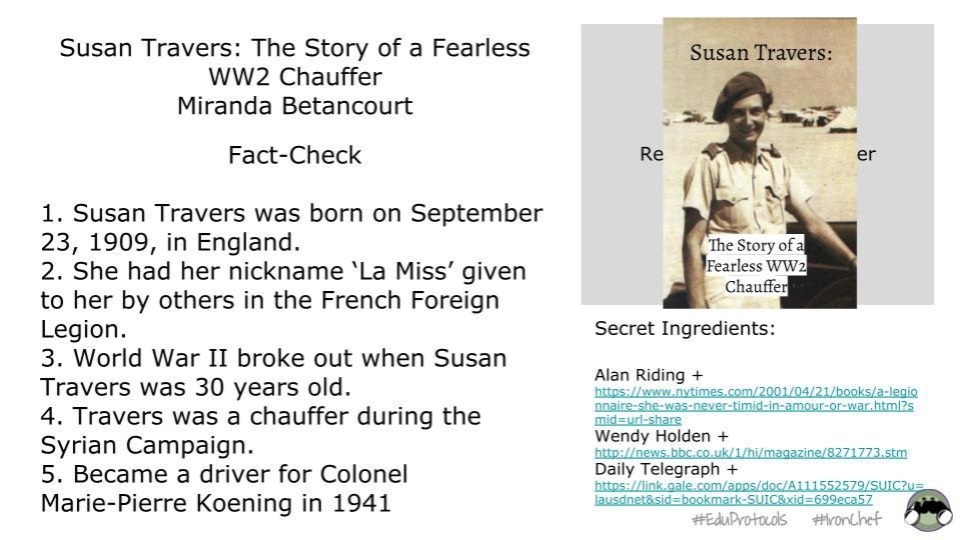
Day Two: We did a fact-checking Iron Chef that taught students the importance of lateral reading and vetting multiple sources when becoming an academic writer.
Day Three: We looked for more sources in the Digital Library so that students could produce 25 facts from five different sources. This was the most challenging activity of the week.
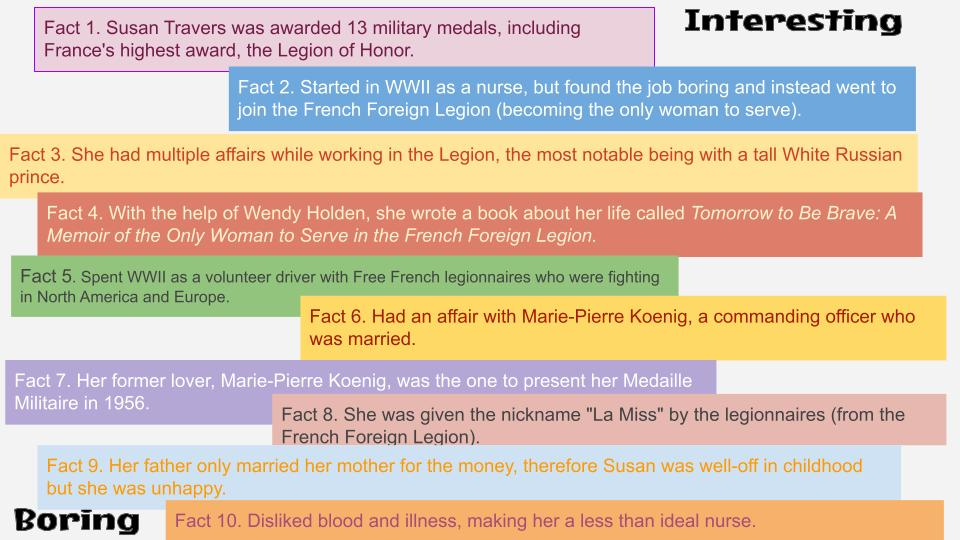
Day Four: Students did a concept sort, consolidating the number of facts from 25 to ten and organizing them on a scale from Interesting to Boring. I have found this helps them come up with an interesting hook to begin their writing. Without it, too many students resort to the stock “So and So was born on this date and died on this date…” approach to historical writing.
Day Five: Students write a first draft of their PSA script and color-code their facts. This shows them the value of using multiple-sources to develop a well-researched fact pattern. Good academic writers go beyond Google & Wikipedia.
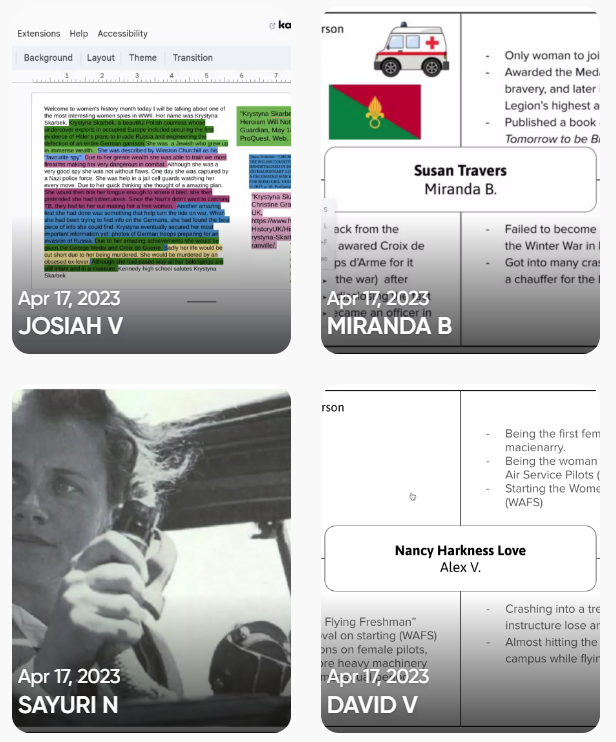
Day Six: Students record a two minute Flip video honoring their woman who served in WWII. They set their slides to change every 15-30 seconds so the viewer can see all of the work they put into the project. Here is a link to the work flow if you want to take a closer look at this student’s project.
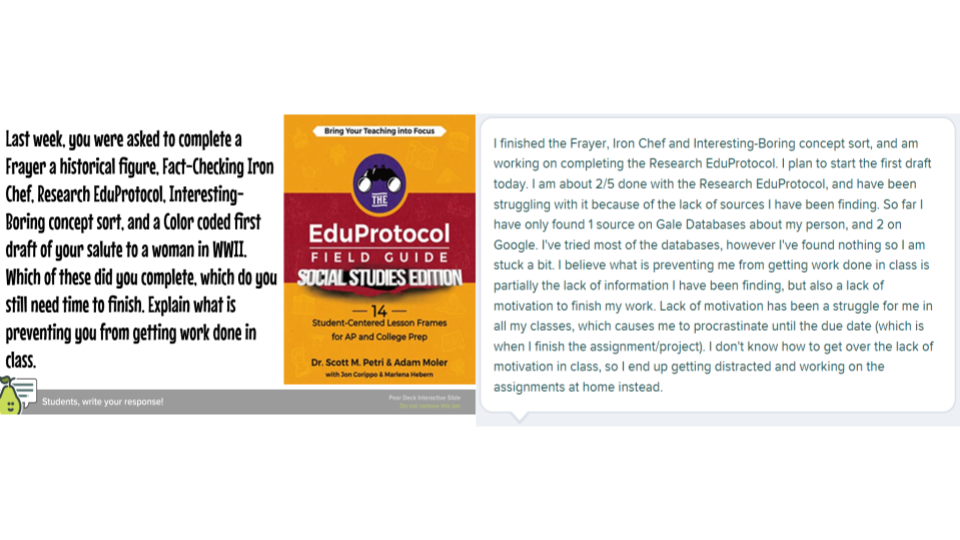
Day Seven: A personal reflection on what parts of this project were helpful and which parts were hard to finish. Most students explained that finding academic sources and using the digital library were the most difficult. I need to have my awesome librarian come in and show them her tips and tricks for becoming savvy researchers.
Overall, I was thrilled with the quality of the work put into these PSAs. I look forward to sharing them with the school community and will show one per day to all of my classes for Women’s History month next year. Here’s the archive.
If you are interested in learning more about sequencing EduProtocols in order to create more meaningful projects in your Social Studies classroom, consider picking up our book or attending one of our Summer Academies in July.
Corroboration is a discipline-specific skill in Social Studies, but it can be used in all subjects to teach students how to analyze or explain data from multiple sources. This post will smash a corroboration activity with Nacho Paragraph using an I do-We do-You-do format to improve student writing with EduProtocols.
For this activity, I asked my 10th-grade World History students to pull some facts from the movie Marie Antoinette by Sofia Coppola and compare them to the facts that are presented in their textbook. My students can typically make 5-10 corroborations in one class period. The more complicated next step is showing them how to select multiple facts to create a line of reasoning.
I selected the above as a mentor text and modeled a think-aloud strategy with it where I showed students how to elaborate on the fact pattern and add page numbers with in-text citations. There were two learning objectives: 1) Students will learn how to create in-text citations for authors & academic sources. 2) Students will strengthen their line of reasoning by using evidence from multiple sources.
Not bad, but you don’t want to say “they” in academic writing. You should clearly be citing your sources in MLA or APA format and it should be an academic source. Let’s try – try again. Instead of saying “source one” and “the movie”, let’s give them some more formal attribution.
Much better. Notice how the in-text citations position the writer as an expert. By creating a fact pattern about King Louis using multiple sources, this author has established themselves as ready for the academic writing demanded by AP or other college-level classes. If your students struggle to craft academic or even grade-level writing, EduProtocols can save those who suffer when paraphrasing, citing their sources, or completing a paragraph. Your students won’t rely on ChatGPT if you rotate ParaFLY, Nacho Paragraph, and 3XCER into your regular instruction. You can give your students more writing practice with less prep and grading time on your part.
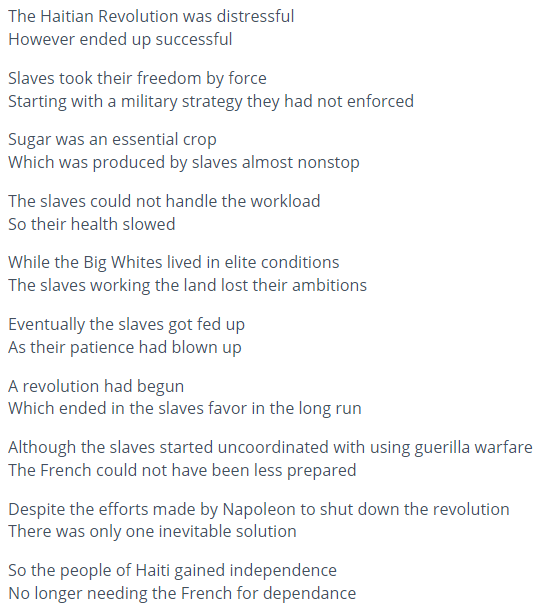
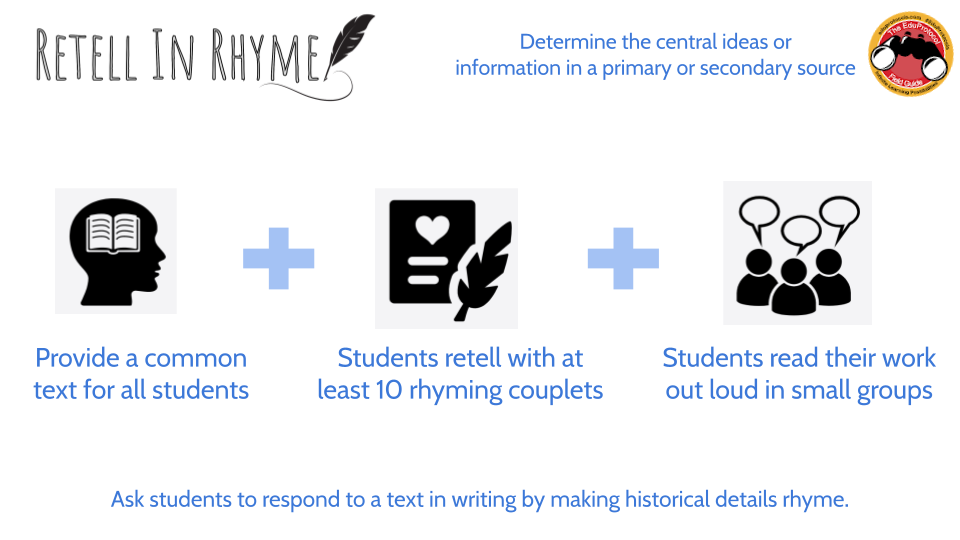
One of my go-to EduProtocols this year has been Retell in Rhyme. The act of responding to a text in writing has a very large, positive ( .77) effect on reading comprehension. Sometimes it is not easy for teachers to tell if a student has selected historical details because they are important, or because they are easy to rhyme. Adding a self-assessment follow-up activity with a rubric and/or a success chart can give teachers more insight as to what students got out of the learning event.
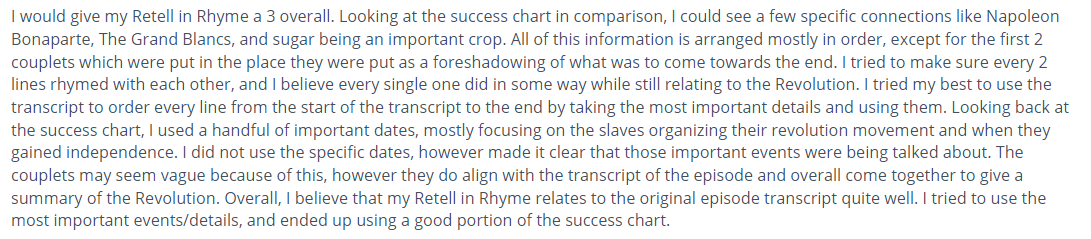
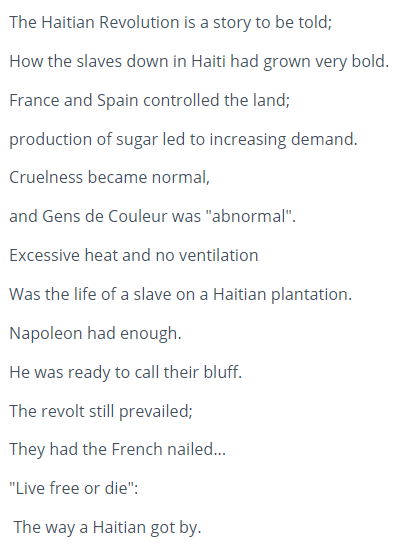
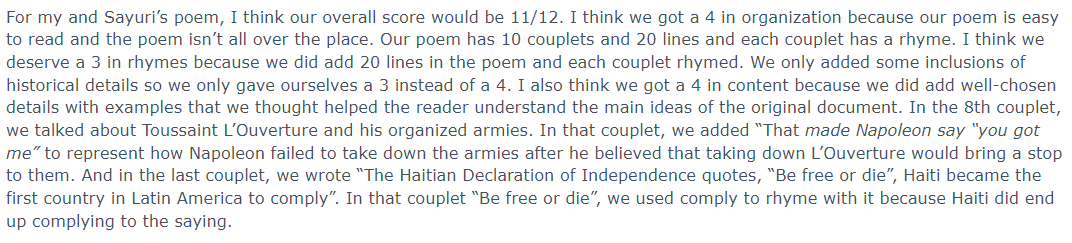
This post will look at three samples of student work and examine their self-assessments. These tenth-grade students listened to a podcast from 15 Minute History and were allowed one class period (50 minutes) to listen, take notes, and create 10 rhyming couplets with a partner. The next day, they were given 10 minutes, this rubric, and a success chart to do a self-assessment. I asked them to write at least ten sentences.
Sample A
Self-Assessment 1
Self Assessment 2
Clearly, self-assessment 1 is effective at aligning their work with the language in the rubric. They identify four key terms that are on the success chart. They justify why they omitted important dates. They could be better at identifying how many events from the success chart they included. Is it 25%? 50%? 75%? In this case, a “good portion” is hard to measure. Self-assessment 2 only mentions that they met the 20-line requirement. They cite no evidence from the rubric or success chart. If I were to grade these reflections, assessment 1 would get an A, and assessment 2 would get a D.
Sample B
Self-Assessment 1
Self-Assessment 2
Both of these self-assessments would be in the B range. I like how #1 acknowledges that they needed more details. I like how #2 includes Napoleon & Gens de Couleur, but they could have been more specific when saying “Some lines had key summarized details.” This is your chance to convince your teacher you deserve an A. Don’t blow the opportunity with soft, non-specific language.
Sample C
Self-Assessment 1
Self-Assessment 2
Both of these assessments would be in the A category. Teachers can extend learning by asking students to compare their work to a success chart and/or a rubric. Andrade (2018) analyzed 76 empirical studies on self-assessment and concluded that “self-assessment is the act of monitoring one’s processes and products in order to make adjustments that deepen learning and enhance performance. Although it can be summative, the evidence… strongly suggests that self-assessment is most beneficial, in terms of both achievement and self-regulated learning, when it is used formatively and supported by training.” This means students self-assess to give themselves feedback and gain clarity on their performance guided by academic advisors. Students will improve their self-assessment abilities with coaching and reps over time.
I look forward to seeing your results with Retell in Rhyme. Please tag me on Twitter and use the #EduProtocols hashtag. If you want to learn more about #RTR you can listen to this podcast.
I wrote a paper on the results that happened after implementing this program at two high schools. I give this presentation to inspire teachers to consider alternative grading methods and increase the number of writing assignments they require of their students. I have found that over the course of the year my students can double, if not triple the amount of words they put on a page in one class period. The next trick is to partner with an English teacher, who can help them take the quantity they are now proficient in and turn it into quality writing. I have found that this level of competition really motivates students. This work has borrowed heavily from Chip Brady and the excellent curriculum at The DBQ Project, who provided inspiring professional development and encouraged me along the way.
Peer review with tech
Many high quality studies influenced my decision to start evaluating student writing quantitatively, De La Paz, S. (2005), De La Paz, S., & Felton, M. (2010), Monte-Sano (2008, 2011) and (Monte-Sano & De La Paz, 2012). I strongly feel that History/Social Science departments should report descriptive statistics about their students’ writing in order to derive a common set of writing expectations by age and grade level. Further, recent advances in automated essay scoring may make it possible for students to receive feedback from a computer before approaching the teacher to partner in improving the writing together. See this Lightside Labs Revision Assistant video and feel free to expand on this annotated bibliography tracking the major players in the automated essay scoring market. K12 teachers should provide input to the companies developing these products and the lefty-Liberal in me hopes all of these products will eventually be open source, like the PaperRater product that my students recently used on a speech project.
Peer review without tech
Most of the work I reference here came from O’Toole (2013), Brookhart (2013), and Bardine and Fulton (2008). Learning by evaluation has long been used by English teachers, it is time for history teachers to embrace the practice. If the CCSS are truly able to get us off the breadth vs. depth Historical coverage treadmill, History/Social Studies teachers are going to need tools and strategies to assess the writing they assigned. Having students read each others writing gives them much needed context. Before I wrote my dissertation, I read dozens of others on the same subject. History teachers will need to learn how to use mentor texts and provide general feedback instead of making margin notations on every paper they receive. English teachers have used peer rubrics and criteria charts to help students with their writing. It is time for history teachers to start incorporating those tools into their classrooms.
Common Core writing standards require History/Social Science teachers to become writing teachers. Yet many are uncomfortable in this role, they are more accustomed to being experts in their content area and K-12 writing is a foreign language reserved for ELA teachers with their own glossary of terms and acronyms. This post will demonstrate how History teachers can continue delivering content while coaching good writing skills and creating positive classroom attitudes toward writing.
This argumentative writing task on eugenics tested students in three ways: (1) interpreting and gathering evidence; (2) developing a thesis, and (3) supporting their thesis. After listening to a lecture on eugenics, students did a quick write where they took a position on whether eugenics was positive or negative, then they conducted a gallery walk where they collected evidence that supported their argument. I was looking to see if any of them changed their position after learning about eugenics research on criminal behavior, ideal families, immigrants, and people with hereditary disorders and mental illness. Lastly, students were asked to take their evidence (notes) back to their desk and explain their rationale to an elbow partner. I have found that having students talk to a partner before beginning their writing gives them more confidence in the subject and lowers the resistance to writing an in-class essay.
My students were asked to complete a Vee diagram, which provides structure for developing an argument. Students write the central question, collect evidence that supports, or argues against it, then they summarize their argument in a thesis sentence at the bottom of the document. I encouraged students to collect six pieces of evidence, so they could include a robust set of claims and counter-claims in their essay. The level of effort they put into the gallery walk was evident in their papers. While only 142 out of 197 or 72% of my students completed this task. These students wrote an average of 292 words with 2.7 claims and 1.6 counter claims.
When using goal-setting strategies to motivate students and develop positive attitudes about writing, it is important to give students attainable goals. I told them that I expected 300-400 words, three claims, and two counter-claims. Most of the students met this bar. Unfortunately, this assignment coincided with a tragedy where a student at our school was killed in a traffic accident walking home. The students who knew him were devastated and unable to focus on this assignment, so for grading purposes, I awarded points to all the students who completed the task, but did not penalize students who performed at a sub-par level or did not complete the assignment. As History teachers increase the number of writing assignments in their classrooms, many of these assignments need to be low-stakes, skill-builders. Teachers cannot read and provide quality feedback on 200 essays per week.
The following video showcases a high-level example and a low-level example, plus a paragraph that I asked students to repair (revise) and share with an elbow partner. While many Social Studies teachers object to taking instructional time away from delivering content, the Common Core standards tell teachers stop sprinting through the history standards on the coverage model treadmill and explicitly teach writing skills to our students. Districts and schools need to implement professional development seminars that help teachers shift out of their comfort zones as content-delivery experts into new ones as writing coaches.
Reviewing my exams at the end of my WWII unit made me realize that my students didn’t really understand why Hitler easily rose to power in Weimar Germany. They had no inkling how he used popular science to advance many of his racial theories, nor that Hitler stole most of his theories on racial purity from American scientists in the eugenics movement. These students did not understand that eugenics was the 1900s equivalent to climate change, widely accepted by the mainstream, but vilified by extremist groups. I blame this, not on my usual frantic sprinting along the historical coverage treadmill, but on our textbook, which doesn’t even mention the word eugenics anywhere in its 793 pages. Instead of re-teaching all of WWII, I put together a quick three-day unit and argumentative writing assignment on eugenics, starting with this wonderful lecture from 15 Minute History.
The next day, my students opened class with a Do Now: (quick write) that asked: Did the eugenics movement benefit or harm society? Then, I gave a short demonstration on how to use a Vee Diagram when writing an argument. After writing their initial argument, the students participated a gallery walk where they collected at least six pieces of evidence. The idea of the gallery walk was to see if their minds changed after examining the evidence. All of the materials in the gallery walk were collected from the Eugenics Archive.
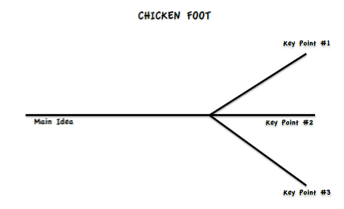
For their Exit Ticket, students discussed which pieces of evidence they had collected with an elbow partner and described how the evidence supported their claims. That night for homework, they were asked to fill out their chicken foot and organize their evidence, so they could write their essay in class the next day.
For their in-class essay, students were asked: Was the eugenics movement positive or negative? They were asked to include a brief background on eugenics, as well as their definition of eugenics, and instructed to write in the third person. Lastly, I asked them to use MEAL paragraphs to explain how their evidence supports their claim. Click here for additional information on MEAL paragraphs.
M – Main Idea: Topic sentence
E – Evidence: Proof found in research
A – Analysis: Describe how the evidence proves the main idea
L – Link: Explain how the paragraph fits into what the paper is trying to argue.
The students (N=142) who completed this task, wrote an average of 292 words with 2.7 claims and 1.6 counter claims. At this point in the year, they should be writing between 300-400 words in a class period. To my horror, I discovered many examples of the Jane Schaffer method thriving in my class after a whole semester of trying to break them of the habit. I suppose I should be grateful that they had some writing instruction in middle school, but in high school and in college this type of writing doesn’t work.
My next post will show students how to use the third person and help them learn how to turn bad writing into good writing.
As we finish up Week Two and begin Week Three, I want to remind everyone that this is an ungraded class. The actual grades that you get on the quizzes do not count, all that matters is that you complete them and participate in all of the discussion forums in order to earn your completion certificate. Also, even though the courses are arranged into weekly modules, you do not need to complete everything during that week. All of the required elements need to be completed by February 22. Then on Monday, February 23, the last module containing the certificates will open. So if you started the course late, don’t panic, there is still plenty of time to get through everything.
Quiz Results: Many of you aren’t using the full 30 minutes to search for the reading to find the answers. That is the best way to increase your scores.
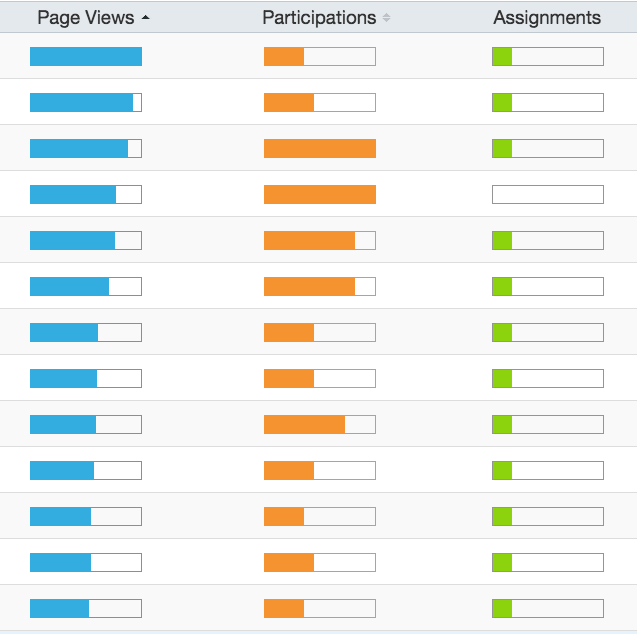
No shout-outs, or brownie points this week, but I loved the discussions on the robo-graders. I thought that everyone was able to articulate his or her opinions professionally and courteously. Regardless of how passionate someone felt pro or con, there were no personal attacks and petty bickering. I guess that is the difference in teaching teachers versus teaching high school students. I am noticing a little participation fatigue between Week One and Week Two. Week One had an average of 47 participations per day and 798 page views per day. During Week Two this slipped to 29 participations per day and 522 page views per day. Both weeks have had the lowest activity on Saturdays. It’s almost like teachers think they deserve a day off.
As we venture into argumentative writing this week, I would like to share a current assignment that my 9th & 10th grade World History students have been assigned. This is a culminating essay for our unit on the Holocaust. Students must argue which humanitarian deserves an award for saving Jewish lives during the Holocaust. It relates to the essential question for this unit, Would you risk your life to save others? What would influence your decision? I am borrowing a format I saw used by @Pomme_Ed. I’ve seen it called a Video Based Question, or Digital Based Question and it can easily be shared with students via Google Drive. I welcome your comments and feedback. Feel free to make a copy of the assignment and modify it for use with your students.
This week we have four readings, a quiz on the featured reading, three resources, three pages of videos, and three discussions. Again, I’d like to discourage you from binge viewing. I think letting yourself reflect for a day results in better discussions. Also on Twitter, we have a small, but mighty group of 20 students of 423 students. . Use #HistRW to share resources with MOOC participants. Consider following your classmates on Twitter. A lot of great ideas are shared during #sschat, #TeachWriting, #WHAPchat, and #sstlap.
Tips and resources that were shared last week were:
With the implementation of the Common Core State Standards, writing instruction will become distributed throughout the school. Writing from sources require students to respond to the ideas, events, facts, and arguments presented in texts they are assigned. Teachers can improve student literacy skills by increasing writing assignments, yet some teachers have expressed a reluctance to assign more frequent writing tasks because they fear it will increase their workload.
Implementing an effective peer review program with free online polling tools like surveymonkey, polleverywhere, and google forms can transfer the burden of grading from teachers to students. The grading process becomes a student-centered, learning by evaluation collaborative activity. O’Toole (2013) suggested peer assessment should be structured, with a learning design that includes “phases of activity, peer assessment, reviewing and reflecting” (p. 5). Brookhart (2013) recommended student-generated rubrics to allow for highly effective peer grading systems. Bardine and Fulton (2008) advocated using revision memos to have students explicitly address weaknesses in drafts and develop confidence in academic writing.
Peer review programs give students practice in developing the skills necessary to recognize effective thesis statements, use textual evidence, and refine arguments. Learning by evaluation significantly improves a student’s self-assessment abilities and lays the groundwork for self-improvement. Thus, learning by evaluation programs should focus on one or two aspects of effective writing, include student discussion to drive reflection about writing as an iterative process, and allow increased instructional time for student revision.
I polled English teachers at my school and found that 39% were confident in their ability to teach students how to write a thesis. After surveying our students, however, only 9% were confident in their ability to develop a thesis statement. This gap suggests teachers need to give students more practice in developing, identifying, and assessing thesis statements. Further, teachers can showcase student exemplars and improve weak thesis statements via thinkalouds. Once students gain more confidence and proficiency in writing thesis statements, teachers can move on and address other factors in effective academic writing, such as claims, rebuttals, argumentative strategies, document usage, and citations.
References
Bardine, B., & Fulton, A. (2008). Analyzing the benefits of revision memos during the writing and revision process. The Clearing House, 81(4), 149-154.
Brookhart, S. M. (2013). How to create and use rubrics for formative assessment and grading. Teacher Librarian, 40(4), 52.
O’Toole, R. (2013) Pedagogical strategies and technologies for peer assessment in Massively Open Online Courses (MOOCs). Discussion Paper. University of Warwick, Coventry, UK: University of Warwick. (Unpublished).


























 HistoryRewriter