Category Archives: Historical Writing

Marie Antoinette Speech Assignment

I operate a flipped classroom where my content lectures are delivered online, this allows my World History students to spend class time readiMarie Antoinetteng Marie Antoinette: The Journey by Antonia Fraser. Four days per week, we have 30 minutes of sustained silent reading (SSR) where students maintain an unfamiliar word log, then one day per week, we have small group discussions where they practice using the words in their logs. To master Common Core speaking and listening standards, my students will need to give a three minute speech on (1) Marie Antoinette’s childhood, (2) her marriage to Louis XVI, (3) her role as a mother, (4) her performance as Queen of France, or (5) her overall historical legacy. Students will be divided into groups at random and assigned one of these general topics. Speeches will be given over the next month as we complete the book and study the French Revolution.
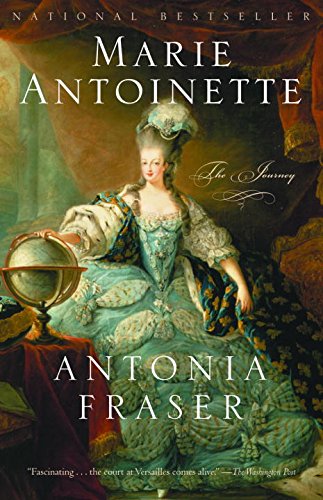
This post covers how students will brainstorm in small groups to choose a topic, a purpose, and create a roadmap for their speeches. The advice comes from a combination of our school’s Academic Decathlon coach, the awesome Ms. Kerry Sego and the inspiring work of Erik Palmer and his excellent book Well Spoken: Teaching Speaking To All Students.

Topic: This is the subject of your speech. In this case, it is about Marie Antoinette. Will it focus on her relationship with her father, mother, siblings, husband, children, her subjects, or other royals? Will the speech be about growing up a Habsburg, Marie Antoinette’s schooling, or the role of music in her life?

Purpose: This is the point your speech will be making. Was Marie Antoinette was a victim of her mother’s ambitions? Do you want to call attention to her philanthropic gifts? Should she be remembered as the greatest Queen of France? Or for never maturing beyond her selfish, teenage indulgences?

Provide a Road Map: Give your listeners an overview of your topic and purpose. Make sure your main points are clearly stated. Use transitions such as first, another example, next, and finally. Refer back to your main point so the examples seem connected to it. This is where you demonstrate that you can move beyond merely possessing knowledge to creating something meaningful that can inspire an authentic audience.

Introduction: Does it state your topic? Does it clearly state your purpose? Do you begin with an attention-grabber?

Body Paragraphs:  Do you have interesting examples? Quotes? Statistics? People? Does your speech progress from point to point clearly? How can you move evenly from one idea to another?

Conclusion: Does the ending of the speech summarize what you have said rather than merely restate or repeat it? Does the speech end with a strong or interesting point? What should the audience do with the information you have given them?

Tone: Your speech is not a formal expository essay. Spice it up with stories, imagery, humor, and background knowledge that your audience will appreciate. There are sensitive and fascinating insights in this book that offer a thoroughly nuanced picture of the queen. How do you want them presented?

After you have written your speech:

  1. Read it aloud, slowly, pausing for emphasis (remember your audience is listening, without being able to read what you have written), so you must present your information slowly.
  2. Time your speech. It must be between 2:30 – 3:00 minutes.
  3. Type it (if you can) double-spaced.
  4. Save it on your computer. This way you can make changes easily.

speech-writing

Delivery:

  1. Memorize your entire speech. This is a must.
  2. Present your speech, do not read it, or act it out. Use a senator’s voice.
  3. Look your audience in the eyes, glancing now and then to your written copy.
  4. Stand still. Do not play with your papers, sway back and forth, or twirl your hair.
  5. Revise your speech. Make necessary changes for an easier delivery.
SPAWN Writing Prompts

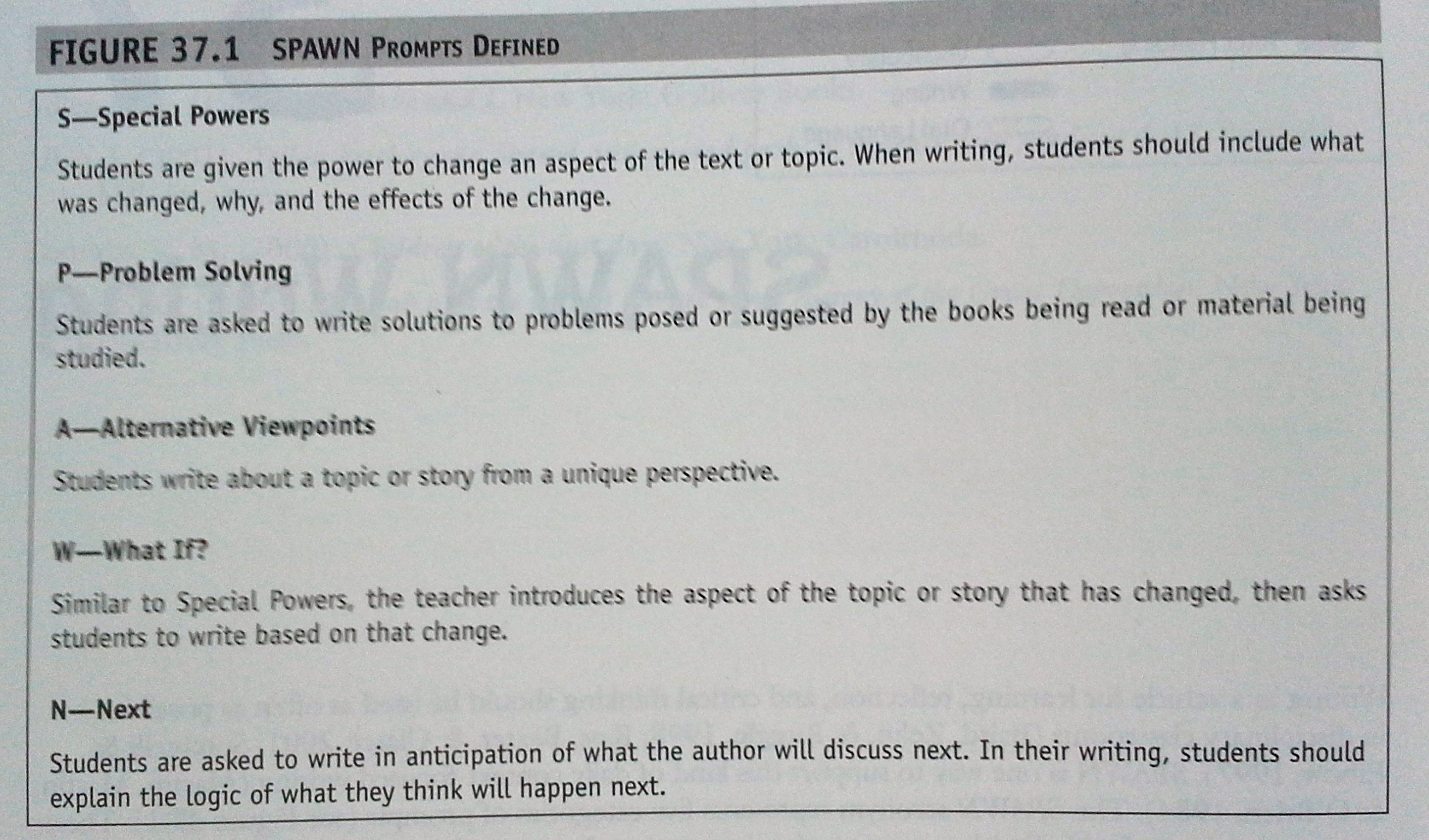
Students need content-focused writing opportunities in Social Studies classrooms. Writing across the curriculum can be supported with SPAWN prompts. SPAWN stands for five types of writing prompts (Special Powers, Problem Solving, Alternative Viewpoints, What If?, and Next). They can be used to prepare students to learn new information about the topic or reflect on what has been learned. Fisher et al explain more below:

Spawn Acronym

WWI SPAWN Prompts

S – Special Powers
You have the power to change an important event leading up to America’s entry into World War I. Describe what it is you changed, why you changed it, and the consequences of the change.
P – Problem Solving
We have been reading about how most people in the United States were isolationists at the start of World War I. How do you think President Wilson can convince his country to enter the war?
A – Alternative Viewpoints
Imagine you’re the commander of the Lusitania. Write an accurate description in a letter format of your ship’s being torpedoed.
W – What If?
What might have happened if the Turks hadn’t entered the war on the side of the Germans?
N – Next
We learned yesterday that Germany has decided to use poison gas as part of trench warfare. What do you think the Allies will do next?

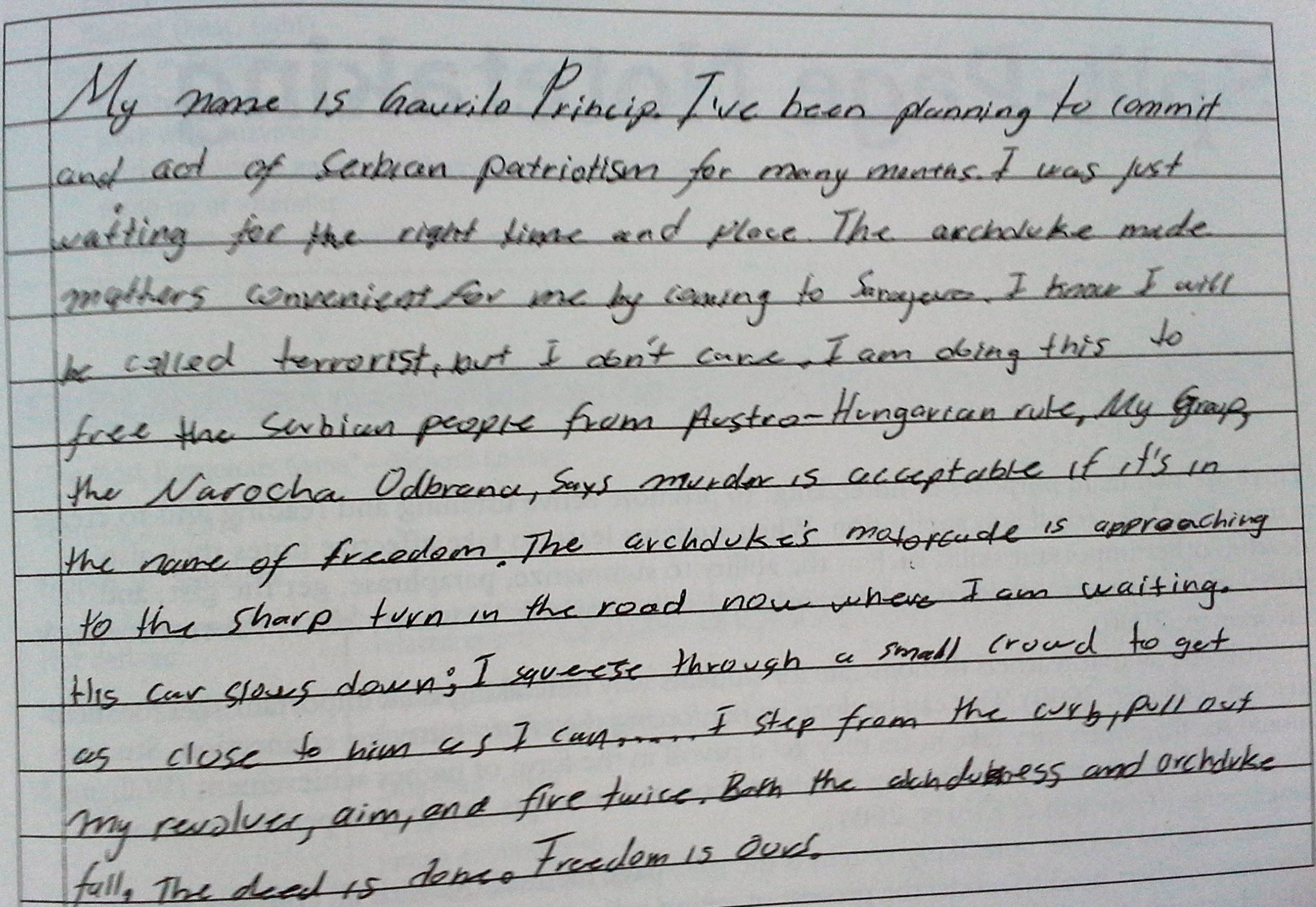
The response below is a student writing about the assassination of Archduke Franz Ferdinand from a unique perspective.

Spawn Example

The above SPAWN example from Fisher et al (2014) demonstrates how students can be factually accurate when engaging in historical writing. Please practice developing SPAWN writing prompts by contributing five in the comments section.

References

Fisher, D., Brozo, W. G., Frey, N., & Ivey, G. (2014). 50 Instructional Routines to Develop Content Literacy. Pearson Higher Ed. http://www.pearsonhighered.com/educator/product/50-Instructional-Routines-to-Develop-Content-Literacy-3E/9780133347968.page

Graham, S., & Hebert, M. (2010). Writing to read: Evidence for how writing can improve reading: A report from Carnegie Corporation of New York. Carnegie Corporation of New York.

Graham, S., & Perin, D. (2007). Writing next: Effective strategies to improve writing of adolescents in middle and high schools. New York/Washington, DC: Carnegie Corporation. Alliance for Excellent Education.

http://www.pearsonhighered.com/assets/hip/us/hip_us_pearsonhighered/samplechapter/0133347966.pdf

https://teacherhelpdesk.wikispaces.com/file/view/SPAWN.pdf 

https://sites.google.com/site/louisianatltcs/home/move-over-mr-spielberg-avatars-for-the-21st-century-learner/spawn-writing 

RAFT Writing Prompts

Graham & Herbert demonstrate the necessity of daily writing activities in Social Studies content classes. My students demonstrate their understanding of History standards via MEAL and RAFT writing assignments. As a general rule, a MEAL prompt is designed to help students analyze evidence to support an argument, while a RAFT prompt requires students to inform/explain a historical topic to an audience. This post will feature examples from an 11th grade US History class. See Dare to Differentiate’s wiki for more examples and instructions.

Role of the writer – helps the writer decide on point of view and voice.
Audience for the piece of writing – reminds the writer that he must communicate ideas to someone else and helps the writer determine content and style.
Format of the material – helps the writer organize ideas and employ the conventions of format, such as letters, interviews, and story problems.
Topic or subject of the piece of writing – helps the writer focus on main ideas.

For this in-class writing assignment, students chose one out of four RAFT writing prompts. Students were allowed to use the book to complete this assignment, in fact it was designed to help them read the text. After a certain amount of time usually 20 minutes, students swapped papers, read each other’s work, then underlined the number of facts from the book included in the RAFT and reported out those numbers. I used this as a goal-setting strategy and it may or may not be used a factor when grading.

RAFT Facts

You are a 1950’s Police Officer warning a white church group about the dangers of Juvenile Delinquency.

50s Police Officer

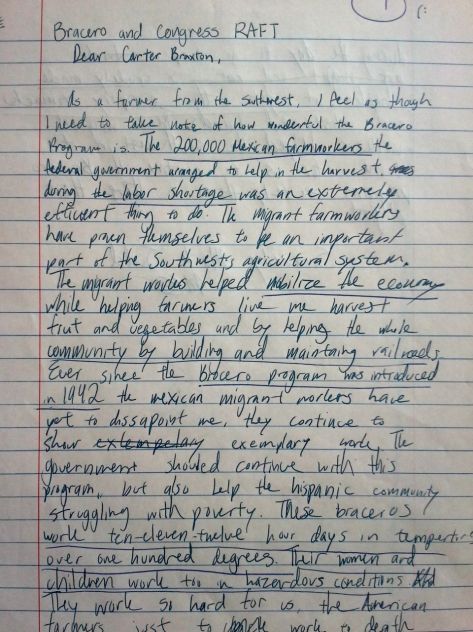
You are a farmer, in favor of the Bracero program. Write a letter to your Congressman persuading him to continue the program, even though the American public is against it.

Bracero RAFT

You are an African American inner-city resident speaking to the NAACP about the assistance needed for the city’s poorest residents.

Black Power You are a Native American WWII veteran testifying before Congress. Describe how and why the US Government should make life better for Native Americans.
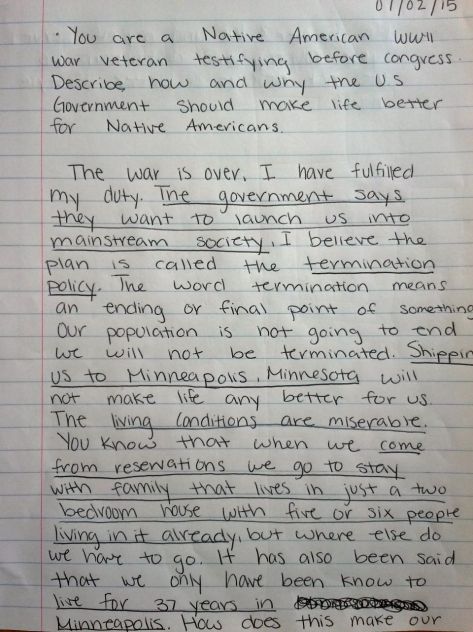
Native Amer RAFT

RAFT assignments can be used regularly to get students writing about texts, responding to texts, and summarizing texts. As a bonus, these writing assignments all have a significant correlation with improving reading comprehension. Please share examples of RAFT prompts, noting the grade level and subject it was used for in the comments section.

References

Fisher, D., Brozo, W.G., Frey, N., & Ivey, G. (2011). Fifty Instructional Routines to Develop Content Literacy. 2nd Ed. Pearson. Boston, MA.

#SSchat on RoboReaders

Rise of The Robo-Readers

July 13 @ 4pm PST/7pm EST #sschat
co-mods: @scottmpetri & @DavidSalmanson

A primer on auto essay scoring

https://historyrewriter.com/2015/07/03/role-of-robo-readers/

Q1 What is your definition of AES, robo-reading, or robo-grading? #sschat

Q2 What is greatest hope and/or your worst fear about technology-assisted grading? #sschat

Q3 When is it ok for a computer to assign grades on student work? #sschat

Q4 How can classroom teachers test & evaluate a robograder without disrupting learning? #sschat

Q5 What would parents think if Ts required Ss to use robo-graders before submitting work? #sschat

Q6 What would school admins say if you used a robograder in your classes? #sschat

Q7 How would you use a robograder in your History-Social Science class?

Q8 How could robo-readers help teachers gamify the art and process of writing?

Shameless plug: https://www.canvas.net/browse/ncss/courses/improving-historical-writing has a module on writing feedback & AES. Course is free and open til Sept. 22. #sschat

Teaser Tweets (to promote the chat after Monday – 7/6).

Are robo-graders the future of assessment or worse than useless? http://wp.me/4SfVS #sschat

Robo-readers are called Automated Essay Scorers (AES) in education research. http://wp.me/4SfVS  #sschat

In one study, Ss using a robo-reader wrote 3X as many words as Ss not using the RR. http://wp.me/4SfVS #sschat

Robo-readers produce a change in Ss behavior from never revising to 100% revising. http://wp.me/4SfVS #sschat

Criticism from a human instructor has a negative effect on students’ attitudes about revisions. http://wp.me/4SfVS #sschat

Comments from the robo-reader produced overwhelmingly positive feelings for student writers. http://wp.me/4SfVS #sschat

Computer feedback stimulates reflectiveness in students, something instructors don’t always do. http://wp.me/4SfVS #sschat

Robo-graders are able to match human scores simply by over-valuing length compared to human readers. http://wp.me/4SfVS #sschat

None of the major testing companies allow open-ended demonstrations of their robo-graders http://wp.me/4SfVS #sschat

Toasters sold at Walmart have more gov. oversight than robo-readers grading high stakes tests. http://wp.me/4SfVS #sschat

What is the difference between a robo-reader & a robo-grader? http://wp.me/4SfVS #sschat

To join the video-chat follow @ImpHRW, sign into www.Nurph.com. Enter the #ImpHRW channel. Note you will still need to enter #sschat to your tweets.

Resources

https://www.grammarly.com/1

http://www.hemingwayapp.com/

http://paperrater.com/

http://elearningindustry.com/top-10-free-plagiarism-detection-tools-for-teachers

http://hechingerreport.org/content/robo-readers-arent-good-human-readers-theyre-better_17021/

http://www.bostonglobe.com/opinion/2014/04/30/standardized-test-robo-graders-flunk/xYxc4fJPzDr42wlK6HETpO/story.html#

http://www.newscientist.com/article/mg21128285.200-automated-marking-takes-teachers-out-of-the-loop.html#.VZYoNEZZVed

Promo Video for a forthcoming Turnitin.com product

https://www.youtube.com/watch?v=aMiB4TApZa8

A longer paper by Shermis & Hamner
www.scoreright.org/NCME_2012_Paper3_29_12.pdf

Perelman’s full-length critique of Shermis & Hamner

http://www.journalofwritingassessment.org/article.php?article=69

If you are really a hard-core stats & edu-research nerd

http://www.journalofwritingassessment.org/article.php?article=65

https://www.ets.org/research/policy_research_reports/publications/periodical/2013/jpdd

http://eric.ed.gov/?q=source%3a%22Applied+Measurement+in+Education%22&id=EJ1056804

National Council of Teachers of English Statement

http://www.ncte.org/positions/statements/machine_scoring

For Further Research

Williamson, D. M., Xi, X., & Breyer, F. J. (2012). A framework for evaluation and use of automated scoring. Educational Measurement: Issues and Practice, 31(1), 2-13.

Role of Robo-Readers

Grammarly

I have increased the amount of writing in my high school World History classes over the last five years. At first, I required two DBQs per semester, then I increased that to four DBQs per semester. Next, I added a five-page research paper at the end of the school year. Now, I assign research papers during each semester. If I were to allot ten minutes of reading/grading time for each DBQ that would be 80 minutes of grading per student, multiplied by last year’s total student load of 197 for a total of 263 hours of reading and grading. Assuming I spent 30 minutes correcting each research paper, an additional 197 hours of  grading would be added to my workload. Where do I find those extra 460 hours per year? Do I neglect my family and grade non-stop every weekend? No. I use a combination of robo-readers, or automated essay scoring (AES) tools and structured peer review protocols to help my students improve their writing.

Hemmingway App

As AES has matured, a myriad of programs has proliferated that are free to educators.  Grammarly claims to find and correct ten times more mistakes than a word processor. The Hemmingway App makes writing bold and clear. PaperRater offers feedback by comparing a writer’s work to others at their grade level. It ranks each paper on a percentile scale examining originality, grammar, spelling, phrasing, transitions, academic vocabulary, voice, and style. Then it provides students with an overall grade. My students use this trio of tools to improve their writing before I ever look at it.

PaperRater

David Salmanson, a fellow history teacher and scholar, questioned my reliance on technology. The purpose of these back and forth posts is to elaborate on the continuum of use that robo-readers may develop in the K-12 ecosystem. Murphy-Paul argues a non-judgmental computer may motivate students to try, to fail and to improve more than almost any human. Research on a program called e-rater confirmed this and found that students using it wrote almost three times as many words as their peers who did not. Perelman rebuts this by pointing out robo-graders do not score by understanding meaning but by the use of gross measures, especially length and pretentious language. He feels students should not be graded by machines making faulty assumptions with proprietary algorithms.

Both of these writers make excellent points, however, classroom teachers, especially those of us in low SES public schools are going to have a difficult time improving their discipline-specific writing instruction, increasing the amount of writing assigned, not to mention providing feedback that motivates students to revise their work, prior to a final evaluation. We will need to find an appropriate balance for giving both computerized and human feedback to our students.

Mayfield maintains that automated assessment changes the locus of control, making students enlist the teacher as an ally to help them address the feedback from the computer. I have found that students in my class reluctantly revise their writing per the advice of a robo-reader, but real growth happens when students have discussions in small groups in regards to what works and what doesn’t. Asking students to write a revision memo detailing the changes they have made in each new draft helps them see writing as an iterative process instead of a one and done assignment.

Read David’s post and participate in our #sschat on this topic on July 13th at 7pm EST/4pm PST.

Robo-Readers

WWII MEAL Paragraphs

MOOC Logos

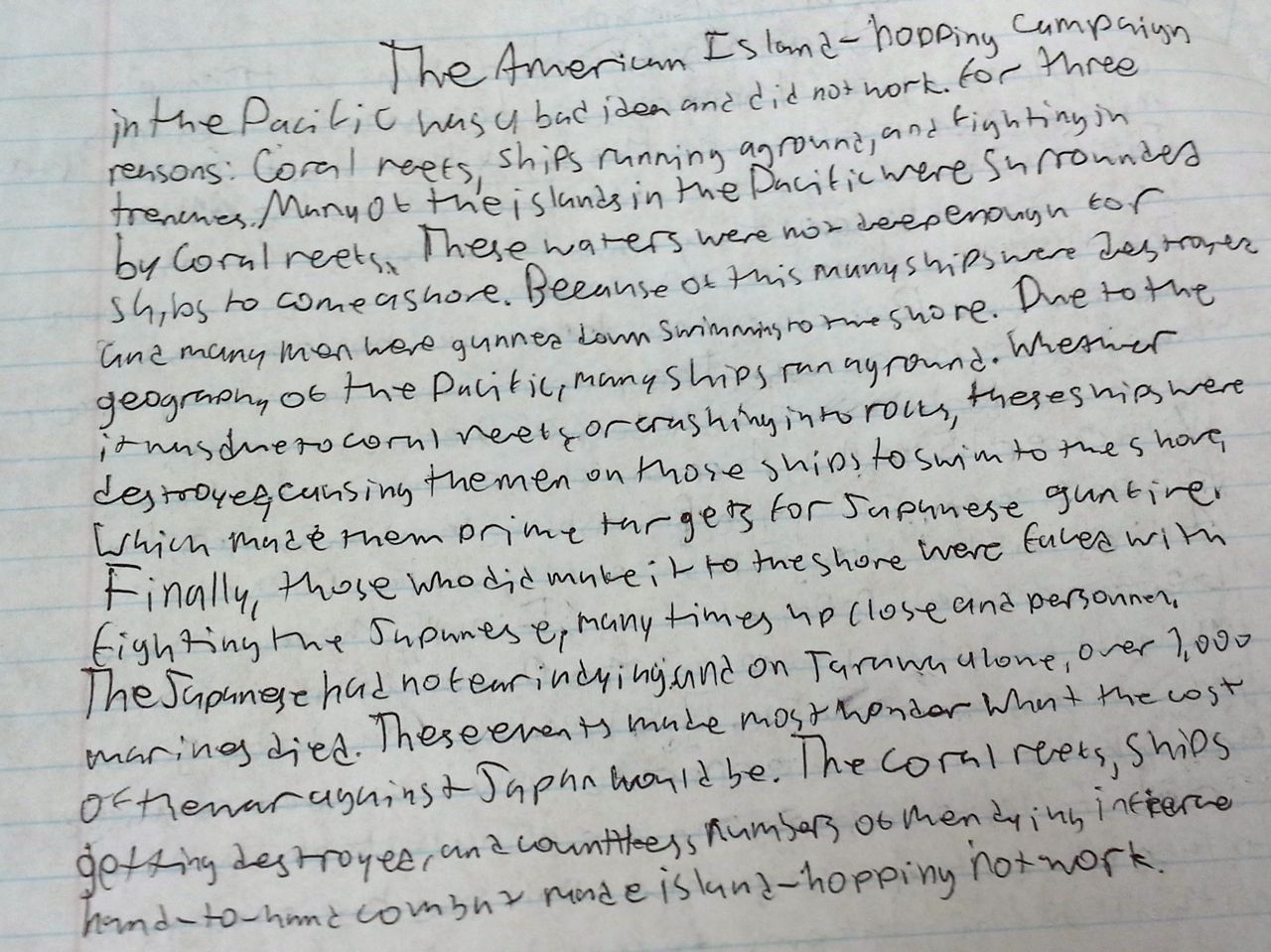
This is a follow-up from an earlier post and video lecture explaining how to use MEAL paragraphs as routine writing tasks that help students build stronger body paragraphs. Many classes start with a  “Warm Up” that is used to hook students into the lesson, or in this case textbook. In order to use MEAL paragraphs in this fashion, the instructor merely needs to pose an arguable question that requires students to take a position, then find three pieces of textual evidence and explain how the evidence supports their main idea. Finally, they link their evidence and analysis back to the main idea of the paragraph. For these examples, my questions were: (1) Was Operation Overlord a triumph of planning or a lucky break? and (2) Should island hopping be considered a success or failure?

Op Overlord_MEAL

This student does an adequate job with the MEAL format, below you can see their main idea highlighted in yellow. It is indeed a thesis that takes a position on the question and provides three reasons. I am eager to read on. Unfortunately, when highlighting the evidence in turquoise, I realize this writer only provides two pieces of evidence for their thesis. I hunt for textual evidence that the allies have succeeded in completing the first part of their plan, but I can’t find any. Therefore, I stop reading. This is not the perfect MEAL paragraph.

So unfortunate. This student had a strong thesis, solid analysis, and even restated their thesis at the end of their paragraph. They just needed to include one more piece of evidence to get the points on this quickwrite.

Ovrlrd Evidence

Island Hopping_MEAL

The next student sample on island-hopping is similarly well-organized. The main idea is highlighted in yellow. The evidence is highlighted in turquoise. The analysis is in green and the thesis is restated at the end of the paragraph in purple. Aside from a slight redundancy in swimming to shore and fighting the Japanese in trenches (not factual), this author has created a solid MEAL paragraph.

This sample can be used as a mentor text when showing students how to write MEAL paragraphs. I have found some students will copy your model word for word, so it helps to have a supply of examples that aren’t on the topic you are asking your students to write about.

Island Hopping

MEAL paragraphs should be an arrow in every effective educator’s quiver. Students who repeatedly write MEAL paragraphs gain extensive practice in identifying and explaining textual evidence. You will see an immediate improvement in their writing. Please feel free to leave any comments about integrating MEAL paragraphs into your everyday classroom practices.

NCSS MOOC Launches with 1400 Teachers

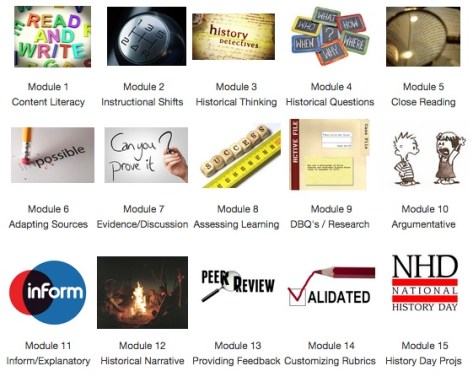
MOOC LogosOn Monday, June 22 the National Council for the Social Studies began its first MOOC with a free 15 module online course on Improving Historical Reading and Writing. After emerging as an educational phenomenon in 2008, a growing body of research has examined Massive Online Open Courses (MOOCs). Recent data from 68 open online courses showed overall participation in MOOCs has remained substantial and growth rates are steady. Further, teachers made up thirty-nine percent (39%) of these MOOC students, which bolsters an argument put forth by Seaton that residential college courses are less likely than MOOCs to attract teachers of the topic, as the cost, time commitments, and geographical constraints are likely to be burdens. In contrast, MOOCs offer nonbinding exploration and content that may be repurposed for a teacher’s classroom.

ImpHRW Badge

In a TED Talk that has been viewed more than 800,000 times, Agarwal (2013) argued that massively open online courses have the potential to reimagine education with: (a) active learning; (b) self-pacing; (c) instant feedback; (d) gamification; and (e) peer learning. The NCSS MOOC helps to leverage its members’ expertise and direct these elements in improving teacher professional development in History-Social Studies. In creating MOOCs for professional development assets, the NCSS can fulfill a need that is not being met by schools or districts and help teachers stay current with their content knowledge and pedagogical trends.

15 Mods

So far in the first 24 hours of the course, there have been over 8,600 page views, 400 participations and 144 discussions started. Teachers are connecting with each other and proceeding through the course at their own pace. It will be interesting to see how those numbers increase by the end of the summer.

References

Agarwal, A. (2013, June). Why massive open online courses still matter. Technology Education & Design. Monterrey, CA. Accessed at http://www.ted.com/talks/anant_agarwal_why_massively_open_online_courses_still_matter/transcript?language=en

Ho, A. D., Chuang, I., Reich, J., Coleman, C., Whitehill, J., Northcutt, C., Williams, J. J., Hansen, J., Lopez, G., & Petersen, R. (2015). HarvardX and MITx: Two years of open online courses (HarvardX Working Paper No. 10). Accessed on April 2, 2015. doi:10.2139/ssrn.2586847

Ashland Credit Option for Improving Historical Reading and Writing MOOC

2014-2015 Online Registration Instructions

Please follow these instructions to use the Ashland University ONLINE registration for your school system.

Go to the Ashland website to register for graduate credit: www.ashland.edu (Links to an external site.)

  1. Click on “University Quick Links.”  (At the top of the website)
  2. In the center column click “Professional Development (Links to an external site.).”
  3. Click on “district login (Links to an external site.).”
  4. Enter the user name (UN) NCSS, and Password:  NCSS
  5. Click the title of the class you want to attend.
  6. Click “register for this course” button.
  7. Check the box for the class (es) you wish to take for graduate credit; press submit, the AU registration form on the next couple of screens will need to be completed.
  8. Complete the pay for classes section of the registration.

2014-2015 Paper Registration Instructions

If you are paying by check please complete the registration form at: http://www1.ashland.edu/founders/professional-development-services/pds-registration-form (Links to an external site.)  Mail the completed registration with payment to the address listed on the form.  If you are using an Ashland University tuition voucher worth $166.00 please include this with your registration.  Please direct questions about this process to wbigelow@ashland.edu  Make sure to also keep a copy for your records.

Your registration will not be finalized until payment is received and processed.  Please contact Ashland University Columbus Center if you have any questions: Toll free 877-557-9497 extension 1108; 614-794-4850 or email our office at:  wbigelow@ashland.edu.

Student Perceptions of Writing Feedback

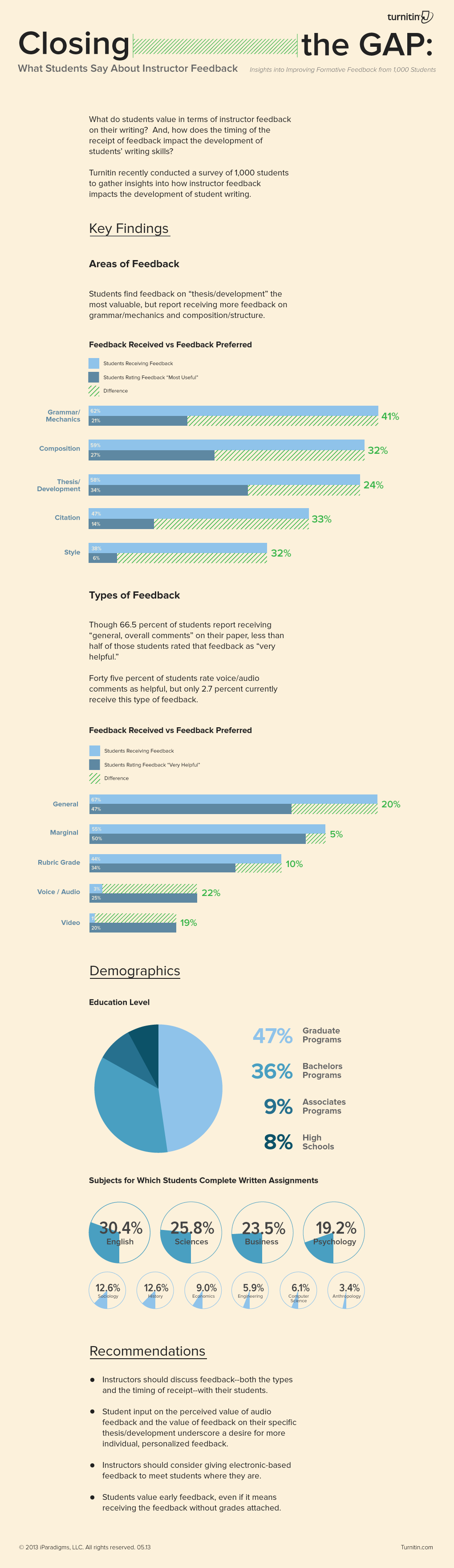
What Students Say About Instructor Feedback was a 2013 study that examined student perceptions of instructor feedback using the Turnitin.com platform. Students wanted timely feedback, but rarely received it: 28 percent of respondents reported that their instructors took 13+ days to provide feedback on their papers. Students preferred feedback about grammar, mechanics, composition, and structure. Students found feedback on thesis development valuable. Despite high rates of electronic submission, students did not report receiving electronic feedback at nearly the same rate.

QuickMark Categories

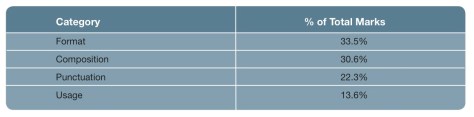
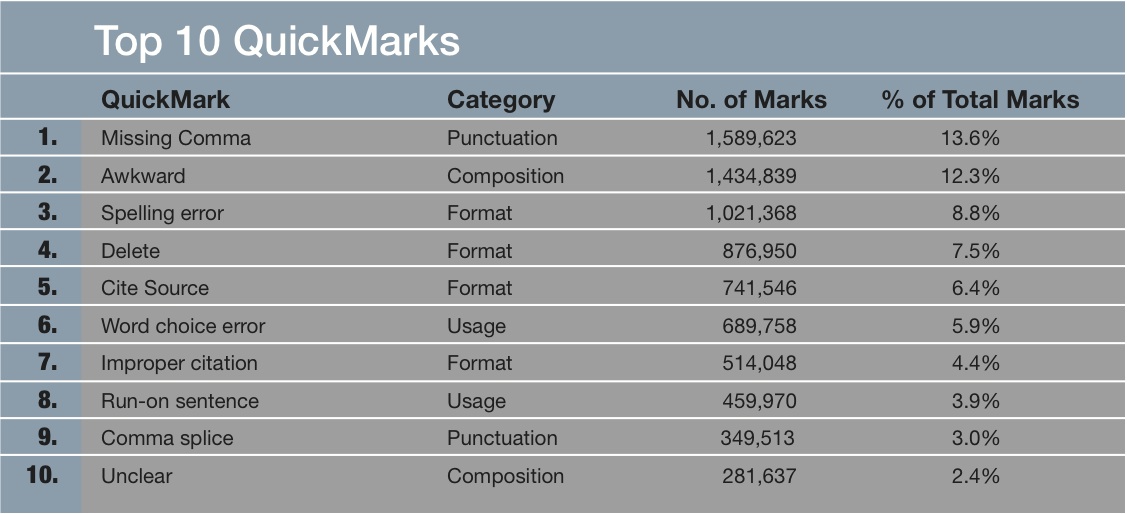
From The Margins analyzed nearly 30 million marks left on student papers submitted to the Turnitin.com’s service between January 2010 and May 2012. QuickMark comments are a preloaded set of 76 comments covering 4 categories that instructors can drag- and-drop onto students’ papers within the Turnitin online grading platform.

This study looked specifically at frequencies and trends teachers employed when providing margin comments. The top 15 are listed below.

Top 10 QuickMarks

This 2014 follow-up study discovered that students found face-to-face feedback “very” or “extremely effective.” 77 percent of students viewed face-to-face comments as “very” or “extremely effective,” but only 30 percent received face-to-face “very” or “extremely often.”

Students perceived general comments on their writing to be “very” or “extremely effective.” However, a smaller percentage of educators felt the same. Even though 68 percent of students reported receiving general comments “very” or “extremely often,” and 67 percent of students said this feedback type was “very” or “extremely effective,” only one-third of educators viewed general comments as “very” or “extremely effective.”

Students preferred “suggestions for improvement” over “praise or discouragement.” The greatest percentage of students found suggestions for improvement “very” or “extremely effective,” while the fewest percentage of students said the same for “praise or discouragement.”

Students and educators differed on what constituted effective feedback.  The gap between educators and students was greater than 15 percent on the majority of areas examined. The biggest difference between educator and student responses occurred with “general, overall comments about the paper” and “specific notes written in the margins.”

Recommendations

Comments recorded by voice or audio may be a time-saving substitute for face-to-face feedback. Only five percent of student respondents reported receiving voice or video comments at the same frequency as that reported by students who report receiving face-to-face feedback “very” or “extremely often” (30 percent). As a way to negotiate time pressures and still be able to provide more personalized feedback, educators might consider leveraging the use of recorded voice or audio comments to provide feedback on student work. Many grading platforms and learning management systems (LMS) offer this feature as part of their services.

This study identified a clear relationship between exposure to feedback and perceived effectiveness of feedback. Thus, it is imperative to provide students with different types of feedback, and evaluate what is helpful for them. Obviously, the more feedback students get, the more valuable it becomes. Teachers should discuss the types of feedback they typically provide to their classes. Then ask students to share what types of feedback they have found most helpful.

The definition of “effective feedback” is going to be modified within your course. Poll your class to find out what types of feedback students think would improve their writing.

Sources

http://go.turnitin.com/What-Instructors-Say-on-Student-Papers

http://go.turnitin.com/what-students-say-about-teacher-feedback

closing_the_gap_infographic