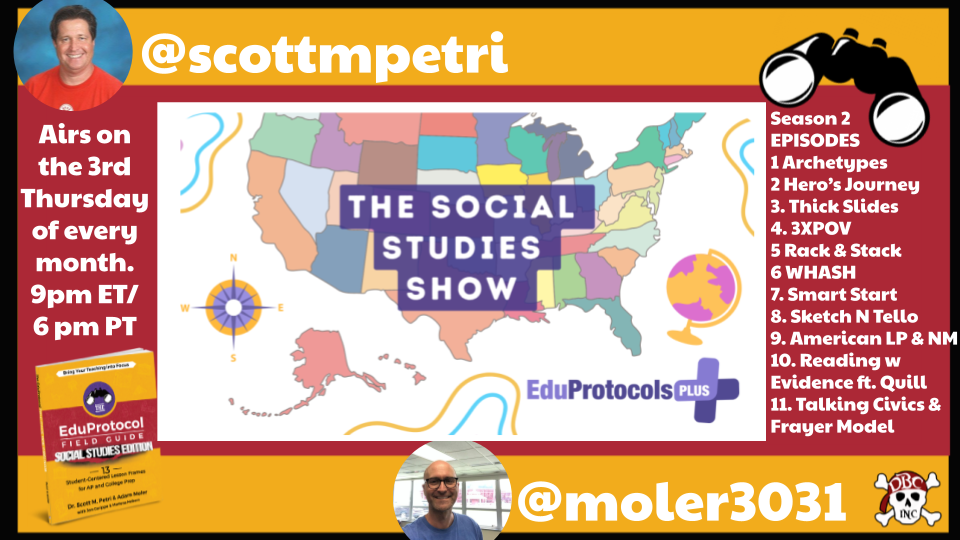
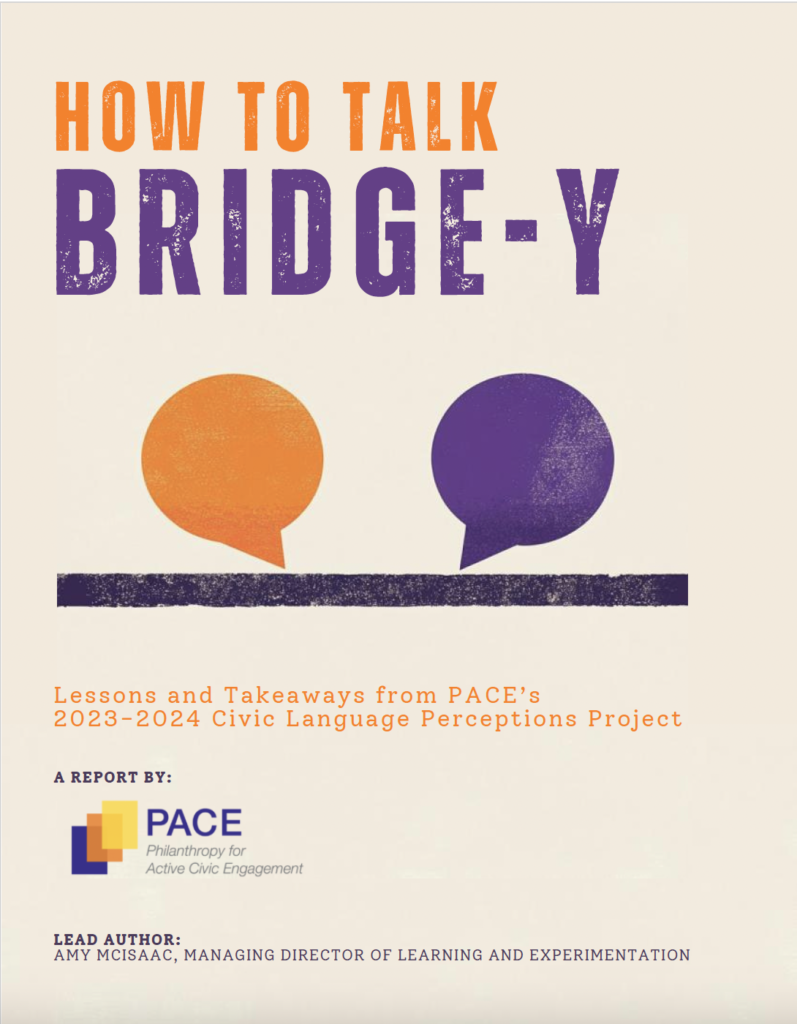
This month on The Social Studies Show Adam and I will talk about “How to Talk Bridgey” – a report that shares lessons for using civic terms without alienating segments of your audience. The guide summarizes five years of research on civic language and can help teachers facilitate more productive classroom dialogue.
Do your students know the coded and loaded words that influencers weaponize to push their buttons? We will use the Frayer Model to understand the signals that different civic terms send. Then we will discuss techniques for building meaningful dialogue and brainstorm strategies for prioritizing connecting over dunking in civil conversations.
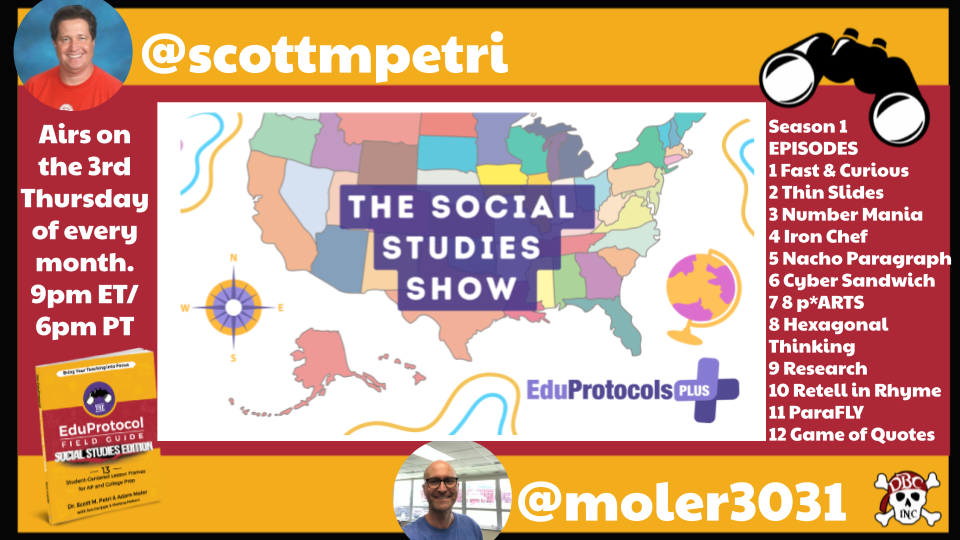
Join us on Thursday, December 19, 2024 at 9 pm ET/6PT as we wrap up our second season on EduProtocols Plus. We promise some tasty virtual eggnog. If you are a new member and want to binge on the show over the Winter Break, don’t forget these episodes from Season One.
Project Based Learning (PBL) is a teaching method in which students gain knowledge and skills by working for an extended period of time to investigate and respond to an authentic, engaging, and complex question, problem, or challenge. EduProtocols are versatile lesson frames that streamline teacher planning and maximize student creativity, critical thinking, communication and collaboration. Can educators purposefully rack and stack or sequence EduProtocols to simplify PBL for students?
This post will describe a seven-day EduProtocol sequence that resulted in 10th-grade World History students making public service announcements to salute important women who served in World War II for Women’s History month. These projects will be displayed for our high school’s Open House, which is open to prospective 9th graders and the general public.
Day One: Students were asked to read a Children’s Book that had been created by previous classes, then use the Frayer Model to break down this service member’s contributions.
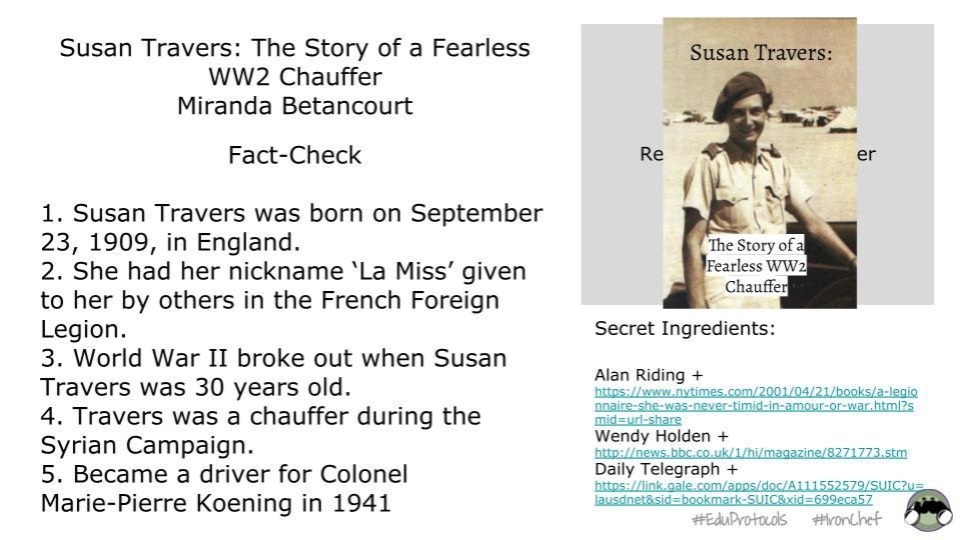
Day Two: We did a fact-checking Iron Chef that taught students the importance of lateral reading and vetting multiple sources when becoming an academic writer.
Day Three: We looked for more sources in the Digital Library so that students could produce 25 facts from five different sources. This was the most challenging activity of the week.
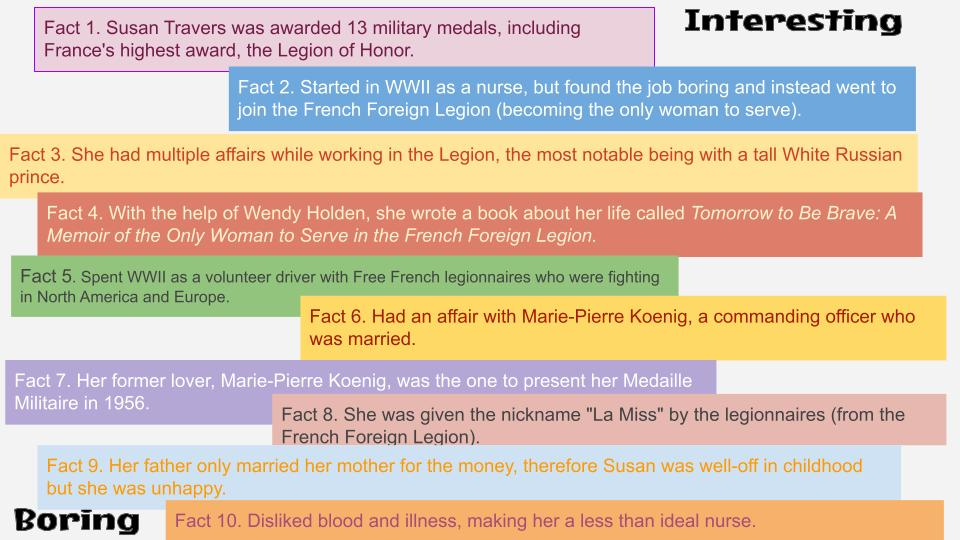
Day Four: Students did a concept sort, consolidating the number of facts from 25 to ten and organizing them on a scale from Interesting to Boring. I have found this helps them come up with an interesting hook to begin their writing. Without it, too many students resort to the stock “So and So was born on this date and died on this date…” approach to historical writing.
Day Five: Students write a first draft of their PSA script and color-code their facts. This shows them the value of using multiple-sources to develop a well-researched fact pattern. Good academic writers go beyond Google & Wikipedia.
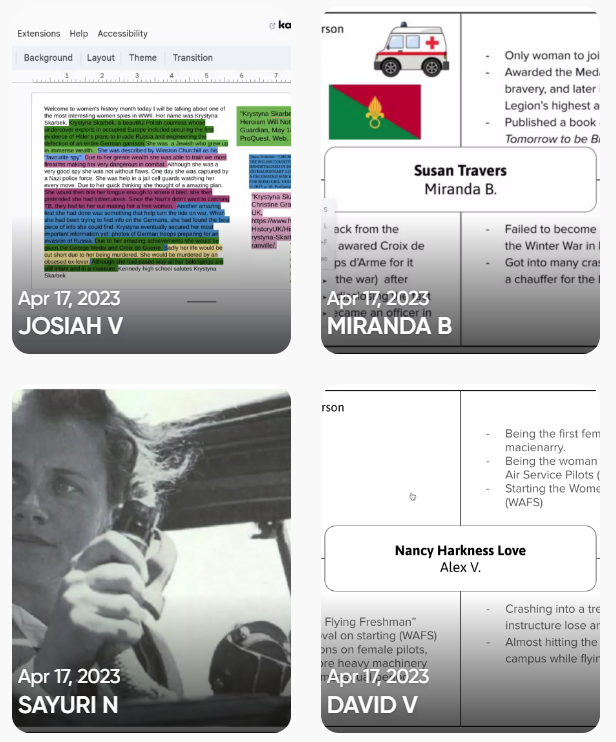
Day Six: Students record a two minute Flip video honoring their woman who served in WWII. They set their slides to change every 15-30 seconds so the viewer can see all of the work they put into the project. Here is a link to the work flow if you want to take a closer look at this student’s project.
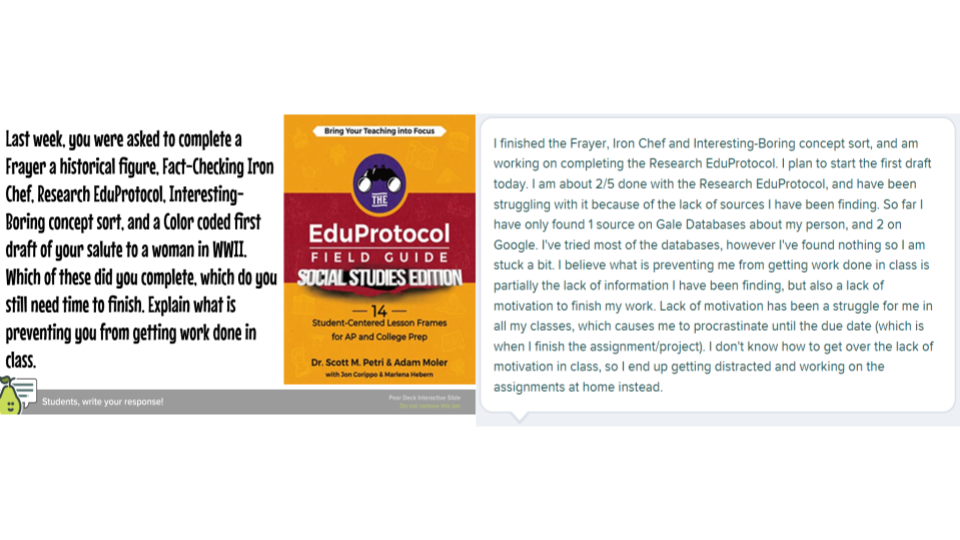
Day Seven: A personal reflection on what parts of this project were helpful and which parts were hard to finish. Most students explained that finding academic sources and using the digital library were the most difficult. I need to have my awesome librarian come in and show them her tips and tricks for becoming savvy researchers.
Overall, I was thrilled with the quality of the work put into these PSAs. I look forward to sharing them with the school community and will show one per day to all of my classes for Women’s History month next year. Here’s the archive.
If you are interested in learning more about sequencing EduProtocols in order to create more meaningful projects in your Social Studies classroom, consider picking up our book or attending one of our Summer Academies in July.
Do your students turn their backs to their audience and read every word off of their slides when it is time to present? If the answer is yes, then Thin Slides are the way to solve this problem.
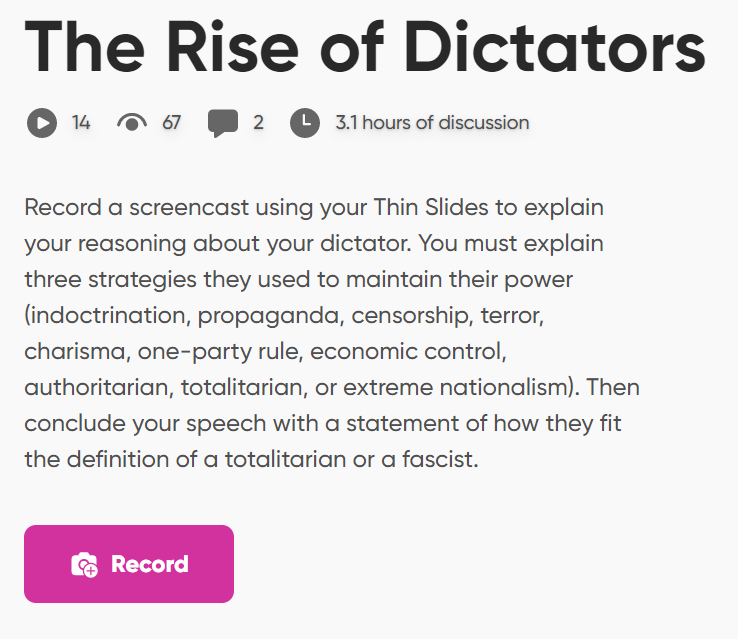
Thin Slides are a creative EduProtocol that limit students to one image and one word or phrase and then ask them to speak for one minute. Repeated reps with Thin Slides have helped my students be more creative whether they are designing museum exhibits, children’s books, or giving Ignite Talks.
This assignment asked students to select three vocabulary words from a list of nine and use them to create a line of reasoning. Then they closed by making a definitive statement. Thin Slides make it easy to see and hear whether or not your students get it.
Join me, Adam Moler, and our special guests on the third Thursday of every month for The Social Studies Show on Eduprotocols Plus. We talk about implementation issues and why we love being History teachers. It’s always a great time.
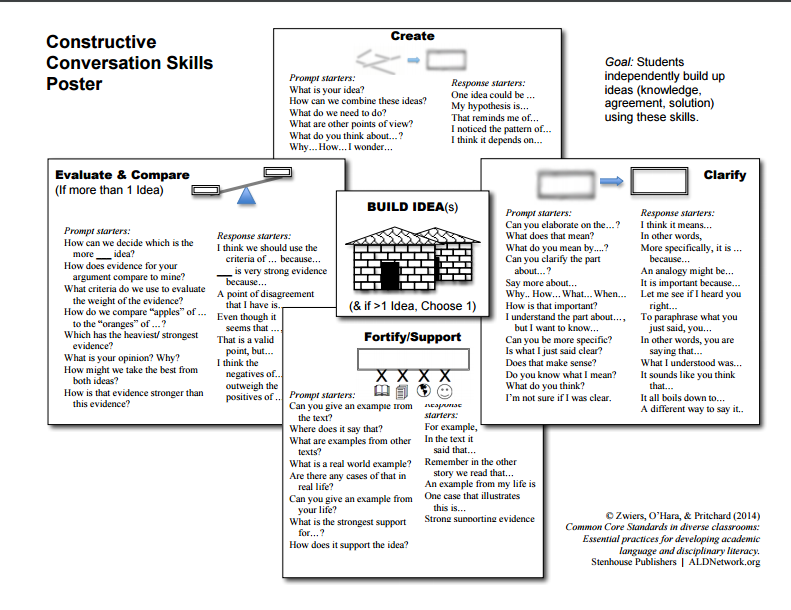
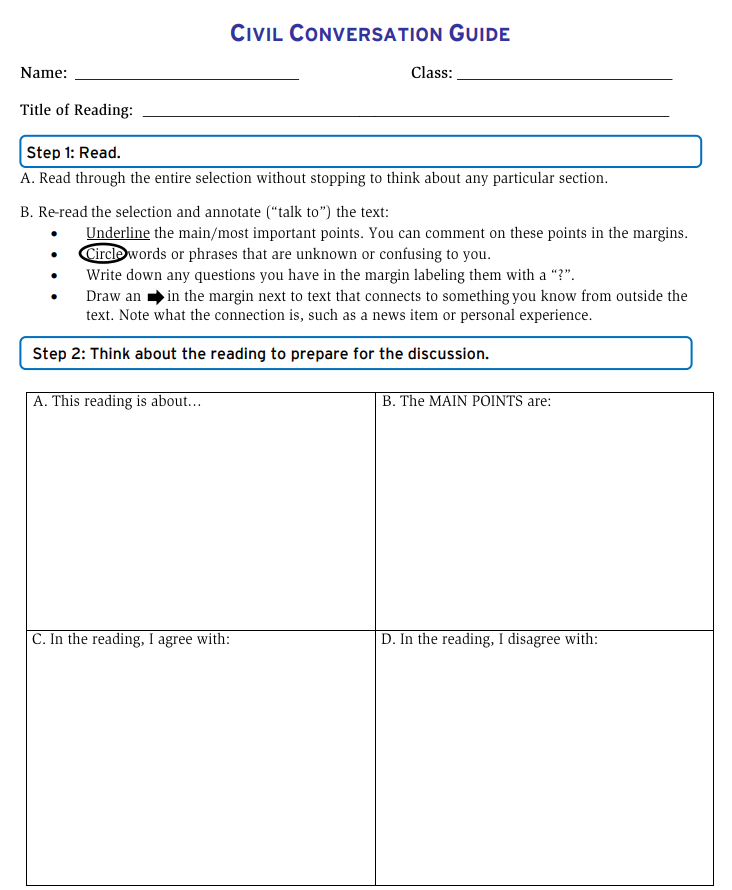
Many teachers have lamented that post-pandemic students do not like to speak in class. Presentations are uninspired. Student podcasts sound robotic and scripted. The in-class speech has become an endangered species. In the hopes of ending this nightmare, I will be presenting the following sequence to re-energize speaking activities in January. We will start with Constructive Conversation Skills, then move to Hexagonal Thinking, next practice The Civil Conversation, and lastly play Socratic Smackdown.
The Constructive Conversation Skills poster or placemat from Zwiers, O’Hara, & Pritchard (2014) can be used as a low stakes, five minute warm-up or cool-down where students discuss the day’s content with a thought partner. I print out the poster and give each student a different colored pen so they can cross out each sentence stem after they practice the four conversational skills. How many practice reps will students need before demonstrating improvement? Walk around the room and monitor their conversations. Offer encouragement.
The Hexagonal Thinking strategy was developed by Betsy Potash and featured on the Cult of Pedagogy blog where there are templates for both paper and digital versions. Here is the three-minute explainer video that I didn’t have time to show. This is another low-stakes activity that will guide your students in discussing academic content. I would recommend trying it with 6-12 terms and names students should know. Give them a short amount of time, maybe five minutes, and see how many hexagons they can connect and explain. To increase rigor you can add more terms and time. I have asked my students to record two-minute Flip videos of these conversations to give them practice explaining their reasoning.
Next the Civil Conversation from the Constitutional Rights Foundation requires students to annotate, question, discuss, track, and reflect on a structured small group discussion. Introverts or observers complete flow or tally maps to track participation. Then they jump in to the next round as active conversationalists. They will have more confidence because they have just watched a session and learned the content. You can provide whole-class feedback after reviewing student reflections and help the class set goals for the next civil conversation.
Lastly the Socratic Smackdown from the Connected Learning Alliance is the most structured of these activities and will require some planning and patience. Think purposefully about grouping and assigning roles. Spend some time selecting your discussion strategies, training your scorers and debriefing with the instant reply and coach cards. You might consider practicing this again with colleagues during some of your planning time before trying it out in your class. This might take several rounds before you are satisfied with the quality of the conversations. Don’t give up.
I look forward to sharing EduProtocol hacks and tools that make speaking instruction inspirational instead of dreadful. Take a deep dive with me at the Los Angeles County Office of Education January 23 & 24, 2023. Sign up here.
This is the fifth year I have had my students participate in The Great Thanksgiving Listen on StoryCorps. Last year, we were not allowed to assign any homework over the break due to COVID. This year students had two days in class to complete a timeline of their interview subject’s life and generate twenty interview questions. They only had to record a ten minute interview and do four pages of transcription over the Thanksgiving Break. When they came back to class, I gave them another two days to complete a corroboration (fact-checking) activity and a reflection.
Forty-nine out of sixty-nine students or 71% completed all six parts of this project. Another six students turned in their work late. Ten students did not complete any part of the project. Over 650,000 Americans have participated in this project which records oral histories for the Library of Congress. This is the second interview that my students have conducted this year and in their reflections I asked them to describe their favorite moments. Their comments are insightful, appreciative, and emotional. I am publishing six of their highlights. If you would like to read your child’s reflection, send me a message and I will send it to you.
With masks on in every classroom, I feel like I don’t really know my students this year. Seeing their smiling faces with their interview subjects was a gift that made my teacher heart smile. I hope families will return to these oral histories again and again. Thank you for sharing the gift of your family with Kennedy High School .
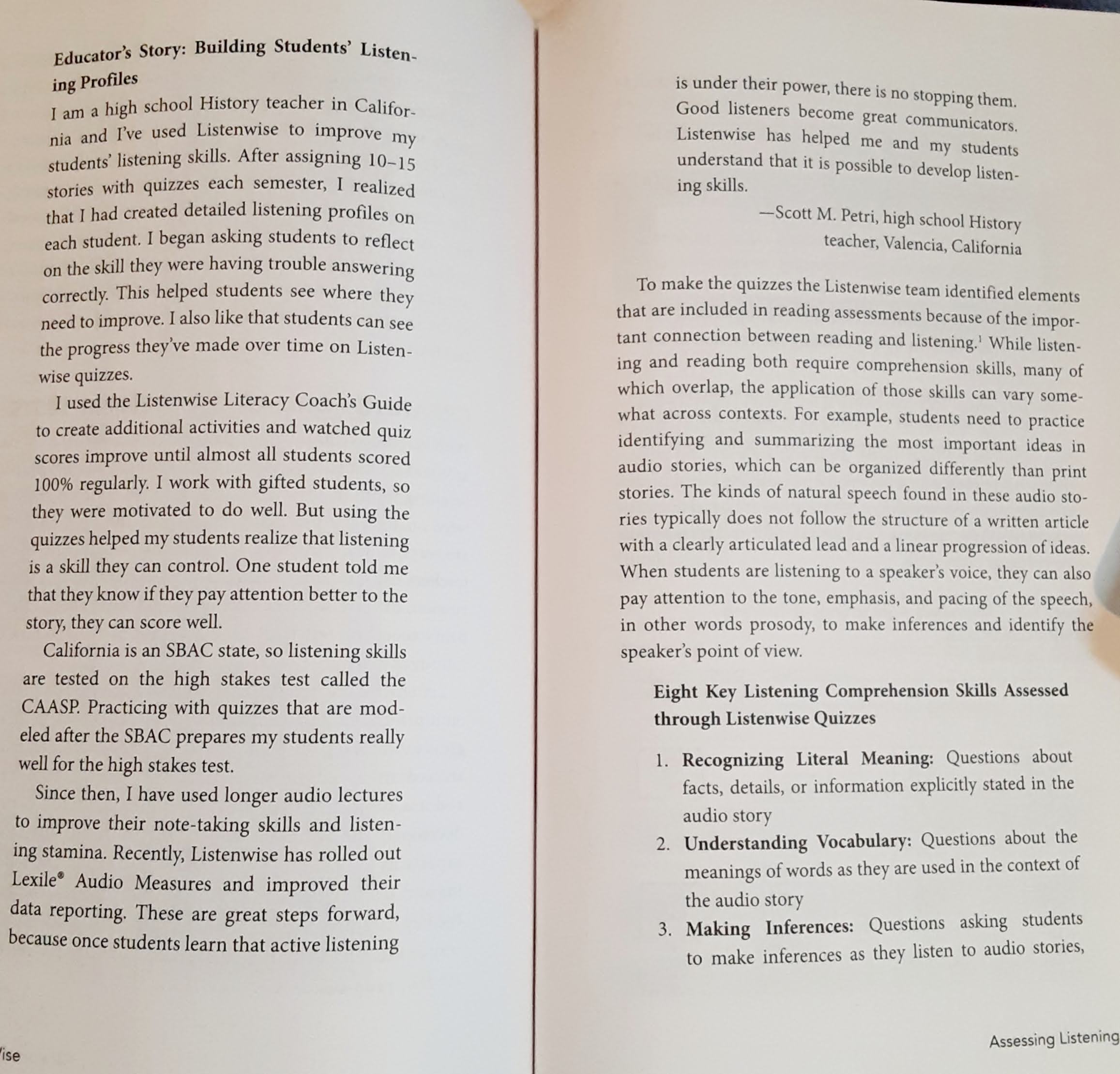
Monica Brady-Myerov has created a wonderful educational platform that teaches students to improve their listening using audio stories that cover content standards in Science, ELA, and Social Studies. She and her team have refined Listenwise over the years to precisely measure students and their progress at mastering eight key listening skills. With the recent inclusion of the Lexile Framework for Listening, I expect this area to increase in educational importance. California is one of 22 states that assess listening on their annual tests. Listening is especially important to English Learners who will make up one out of every four public school students by 2025. The combination of reading and listening builds their second language proficiency faster. Students gain confidence in their pronunciation when they hear the words spoken correctly.
Monica describes what she has learned along the way. She covers topics like storytelling, listening skills, how to teach listening, the connections between listening and reading, the benefits of listening for English Learners, assessing listening, and creating podcasts. In short, good listeners become great communicators. Peppered with personal stories, lessons, activities, reflection prompts, and planning tools; this book is a must for all interested in improving their communication skills. The author shines when she elaborates on her life-long love affair with the intimacy of audio and when advising teachers not to underestimate the impact of using their voices to read to students at any age. What does a future driven by voice-activated artificial intelligence sound like? Alexa, Siri, and Google have all read this book and so should you.
Full disclosure: I contributed an educator’s story on p. 174.
When I first started using Listenwise in my classroom, I noticed that almost every high school student would reach for their phone as soon as I hit play on the audio. However, when I prompted them on how important it was to listen intently and with 100% focus, their test scores started soaring. Typically, I read between 30-40 books per year. During the last year, with the pandemic, I learned how easy it was to get distracted and only read 6 books. This shameful fact reveals how dependent I have become on listening to books in the car. This book is already helping me sit down, tune out distractions, and put my focus back on reading every day. Still, I wish there was an audio version.
Since the Saddleridge Fire caused my school to cancel Parent Conferences in October, I offered students 100 points to record a conversation with a parent about their grade on Flipgrid. I gave them this prompt: Lead a conversation with your parent(s) about your 15 week grades. How many graded assignments did you complete? How many were missing? How many were late? Which assignments did you struggle with? Which did you learn the most from? Describe your work/study habits and explain how you are going to balance assignments in the future with all of your other responsibilities. Share an assignment from this class that you are proud of & describe how you created it.
Overall, 49 students (33%) completed a video and 23 of them (15%) improved by a full letter grade in time for the 15 week marking period. Since I have a total student load of 154 students, this means that five students (3%) went from a B to an A, nine students (6%) went from a C to a B, eight students (5%) went from a D to a C, and one student (.6%) went from an F to a D. All of the videos demonstrated students improving their self-awareness and taking responsibility for their learning with the added bonus of parents figuring out how to better support them. These videos warmed my heart. I will definitely do this again in the Spring before the parents come in for Back to School night. Now I just need to start recording my responses. I’m going to try and do five per day so that I get to them all. Please be patient life outside of work is very hectic right now.
In short, this assignment improved grades for one-third of my students. Fifteen percent of students moved up by a whole letter grade. Further, this assignment reduced my D/F percentages from to 24% to 18%. I need to give more thought as to how I can motivate this group of struggling students to engage and learn how to ask for help. More importantly these videos showed me that even in secondary school where engaging families is difficult, most parents are working hard to help their children succeed academically. Thanks Flipgrid for bridging this communication gap and giving me valuable insight into the families I serve.
One of my favorite videos came from a 10th grade softball player Jazmin and her mother Ana. I loved it because this mother asked her daughter questions about her life in school, i.e., What do you like about this class? & What’s your favorite type of assignment? Plus, at about the 3 minute mark, the Mom actually DABS because she is so proud of her daughter. Jazmin’s reaction made me laugh out loud. The two of them seem more like friends than mother & daughter. I doubt I would have seen this sweet side to their relationship had this been a traditional parent meeting in my classroom. Educators new to Flipgrid can read their blog and check out their Discovery Library for ideas to get them started.
Students in my 11th grade US History class typically read four non-fiction books in addition to their History textbook. I have noticed that their note-taking skills, attention to detail, and recall of historical figures in the text need to improve. As students advance through upper-division work text complexity increases, yet the amount of reading instruction decreases. This can result in real problems in college where professors expect their students to do three hours of reading in the subject-area for every hour they spend in class. This post will describe an instructional sequence that helps students focus on the historical characters in a nonfiction reading using an Iron Chef protocol, a Who Am I? narrative writing technique, and a video response system that improves student speaking and listening skills.
Iron Chef
Eduprotocol authors Marlena Hebern and Jon Corippo developed this tool to help students flex quick research reps in 15 minutes or less. For this pre-reading activity, I listed the historical figures in The Professor and the Madman and assigned them via number on my class roster. Students research the individual, note key details and page number(s) they appeared on in the book, and for the secret ingredient add what we should know/remember about this person. The slide below is an example of what a student can create in less than one class period. Students build their own study guide that they can refer back to and add to as they read.
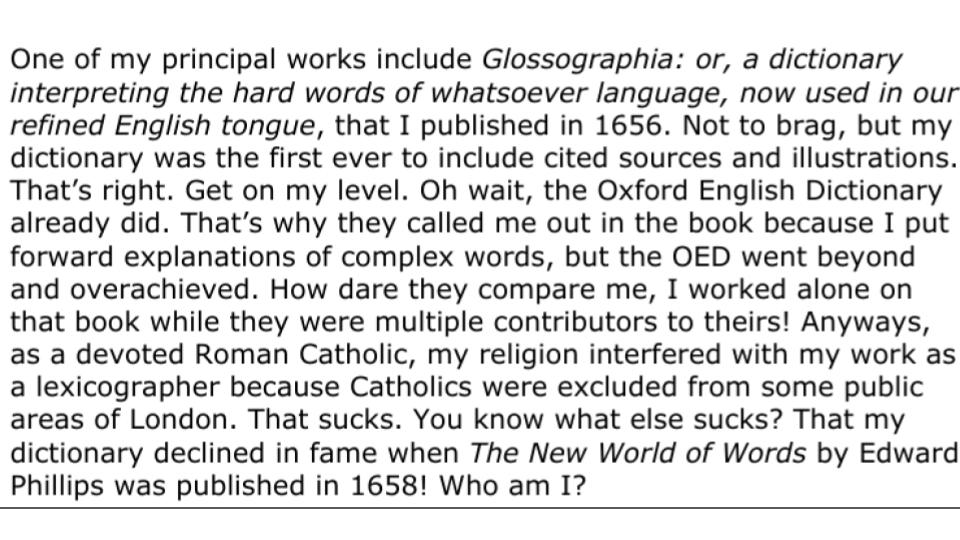
The next step is to have students turn their slide research into a first person narrative. Even if students mostly copied information from Wikipedia into their Iron Chef slide, now they have to do the literary heavy lifting of converting it from the third person into the first person. This student has done an excellent job with a minor historical figure from The Professor and the Madman and has even slipped her own confident personality into her script. I can’t wait to see what she does with her video.
Flipgrid – Engage Your Students in Speaking and Listening
The last step involves using Flipgrid, a free video-response platform that helps students learn via their own videos. For this assignment, the students have to speak for one minute giving the viewer clues as to the historical figure’s identify. As the grid populates with videos, students can view them, take notes, and learn who is who before they take a quiz made up of ten randomly selected videos.
This video shows how students can be creative and have fun when engaged in this instructional sequence. Flipgrid tracks the analytics for each grid, which allowed me to see that my students viewed each others videos a total of 2,764 times prior to the quiz. That adds up to 43 hours of study time on the characters in a book they haven’t read yet. What do you think will happen when they encounter each character in the text?
Big Takeaways
What I like about this instructional sequence is that each day builds on what students created the day before. If they didn’t try very hard with the research they put into their Iron Chef slide, then they will struggle to write a Who Am I? speech. If they didn’t put some effort and creativity into their script, then they will have trouble making an interesting video. If they didn’t review their classmates’ videos, then they probably won’t do very well on the quiz.
Teaching students to show up and work hard every day is the most important work we can do as teachers. I have used this instructional sequence to help my students learn about Historical Eras, Enlightenment Philosophes, and people in the Civil Rights Movement. These activities have increased effort and engagement in my classes. Feel free to remix them for your class and subject matter. All I ask is that you leave a comment or tag me in a tweet @scottmpetri and let me know how they work for you.
This post will showcase 11th grade US History students’ podcasts on a person, place, or event from the Great War.
This WWI Podcast assignment was adapted from an NWP article detailing how to conduct a First Person Research Paper by CindyHeckenlaible (2008). First students listened to a 15 Minute History lecture to understand why the US joined WWI and then they used the resources provided to brainstorm topics. To see the directions for a previous assignment, look at Vietnam War Narrative. You may listen to three earlier student examples: The Orange Mist, Protest Becomes Tragedy, and The Last Moments of Elizabeth Hall.
Decide to work with partners or work solo. Then use this spreadsheet to declare your narrator and story (topic). Each narrative must be at least three minutes for an individual assignment, add 1.5 minutes to your story for each additional person involved in the project. The five components of this project were worth 50 points each.
1) Produce an Annotated Bibliography in MLA format with at least six sources. If a historical detail is not included in your annotation, then you cannot use it in your narrative. 92% of students turned this in on time.
Use the details from your annotated bibliography to write your script. Document the historical details in your story by underlining them and including a (parenthetical citation) immediately after. The theme of your story should be — What is a moment in history that all students should learn about? You may use sound effects and soundscapes, but NO MUSIC!
Make sure you study the tips in this presentation as you plan your narrative and 2) use this format to submit your story in writing. 81% of students turned this in on time. 3) Create an Annotated Timeline that includes maps of where your story takes place. 37% of students used their time well enough to complete this on time. 4) Write a 5 question Quizizz to share after your story has been heard by the class. Emphasize the most important historical details in your questions and include facts that you would expect to see in a history book. 74% of students turned this in on time. 5) Submit your narrative recording to get all the points. 44% of students made this deadline. 65% of students were able to complete all components on time.
Debrief/Reflection
Describe how you managed your time and completed each component of this project? Which of the resources provided did you find most helpful? What does this piece reveal about you as a learner? What would you change if you had a chance to do this project over again?
CA USH Standard: 11.4.5: Analyze the political, economic, and social ramifications of World War I on the home front. CCSS: Write narratives to develop real or imagined experiences or events using effective technique, well-chosen details and well-structured event sequences.











 Overall, 49 students (33%) completed a video and 23 of them (15%) improved by a full letter grade in time for the 15 week marking period. Since I have a total student load of 154 students, this means that five students (3%) went from a B to an A, nine students (6%) went from a C to a B, eight students (5%) went from a D to a C, and one student (.6%) went from an F to a D. All of the videos demonstrated students improving their self-awareness and taking responsibility for their learning with the added bonus of parents figuring out how to better support them. These videos warmed my heart. I will definitely do this again in the Spring before the parents come in for Back to School night. Now I just need to start recording my responses. I’m going to try and do five per day so that I get to them all. Please be patient life outside of work is very hectic right now.



 HistoryRewriter