Semester End Deadlines

The 15 week grades revealed that many of my 9th graders are having time management challenges. The purpose of this post is to provide clear expectations for all semester end projects and deadlines for all of my World History classes.

50 pts The Plot Against America Reading Log Dec. 7
100 pts The Plot Against America Character Time Line Dec. 7
100 pts Holocaust Survivor Poem Dec. 14
50 pts Video Notes Dec. 14
100 pts Holocaust Survivor Art Piece Dec. 14
50 pts Video Notes Dec. 14
100 pts Holocaust Survivor Essay-Speech Dec. 14
50 pts Video Notes Dec. 14
600 points for your final grade. Late work will not be accepted

Students in my class started reading The Plot Against America on Monday, October 26th. For the first week, students listened to the audio book as they read. After five days, I took the training wheels off and asked students to start keeping a daily log of what page numbers they read and to summarize what happened in a reading log.
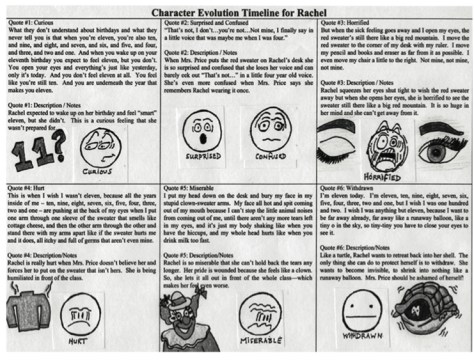
Char Evo Timeline.jpg

A Character Evolution Timeline from Olson, Scarcella & Matuchniak (2015) requires a reader to review the sequence of events that occur in a text and to plot it out graphically, much like a storyboard. However, in the graphic display, the reader can chart a character’s changing emotions by selecting: (1) a facial expression to reveal the character’s emotions during key events; (2) a quote that illustrates why or how the character experiences this emotion; and (3) a symbol to characterize that emotion. Beneath the quote, the reader needs to write an interpretation of the impact of the event on the character in his or her own words. This exercise in character analysis and forming interpretations helps students detect motivation and bias in historical texts. Students must complete a character log on one of the characters from The Plot Against America with at least 10 events. The timeline (at least 10 events) and the reading log (with at least 20 entries) are due on December 72015 at 3:00 pm.

All my World History students will complete their study of the Holocaust by creating entries that commemorate a Holocaust survivor’s eyewitness testimony. Students must turn in annotated notes for the testimony that inspires each poem, essay, and art piece they complete. Some students may find it helpful to use Video Notes to organize their thoughts on each testimony.

PROMPT: As you listen to the oral testimony of a Holocaust survivor or rescuer, you may sense a change in tone that makes you stop and listen again. Something about the way the person speaks tells you that this memory matters in a special way. For the survivor or rescuer, this memory needs telling forward.

All entries and supporting materials are due by 3:00 pm on Monday, December 14th. Poem and Essay entries must be typed and in 12 point Times New Roman Font, single-spaced. Art and poetry entries must include a 100-word artist’s statement containing: the title of the work; the name of the survivor to whose testimony this work is a response, and a statement of how this work addresses the prompt. The name and class period of the person creating the entry should NOT APPEAR on the front of the entry. Keep all identifying information on the back of the entry.

View the contest’s complete rules here:

All entries will be blind judged by a panel of Kennedy teachers who will choose the top three entries that will be entered in Chapman University’s 17th Annual Holocaust Art and Writing Contest. Students will be eligible to win the first prize of $500 and the second prize of $250 in each category in the high school competition. The first place winner in each category, recipient’s parent/guardian and teacher are all invited to participate in an expense-paid study trip June 21-25, 2014, to visit the United States Holocaust Memorial Museum and other sites in Washington D.C.

Websites for Survivor Testimonies

http://www.the1939society.org/projects/

http://sfi.usc.edu/teach_and_learn/student_opportunities/chapman

http://www.youtube.com/uscshoahfoundation

To understand the level of competition in this contest, please review these examples of Previous Winners. Please note that Dr. Petri has been known to generously award bonus points to students who turn in their projects ahead of schedule. Manage your time wisely.

LACOE PD Resources

Common Core Historical Writing Seminar

Scott M. Petri, LACOE

November 17, 2015

8:30 – Introductions

https://www.surveymonkey.com/r/HSSWRITE

9:00 – Using Writing to Increase Reading Comprehension

MEAL https://historyrewriter.com/2015/04/27/meal-paragraphs/ and https://historyrewriter.com/2015/06/24/wwii-meal-paragraphs/

RAFT https://historyrewriter.com/2015/08/03/raft-writing-prompts/

Six Word Stories https://historyrewriter.com/2015/04/13/six-word-definitions/

Tweet-athons https://historyrewriter.com/2015/04/20/great-terror-tweetathon/

Ryhming Tweets https://historyrewriter.com/2014/08/26/twittercide-of-socrates/

Klemp https://historyrewriter.com/2015/05/27/strategies-for-teaching-vocabulary/ and https://historyrewriter.com/2015/05/20/teaching-vocabulary-to-older-students/

Link to shared work: http://tinyurl.com/oykufhe

10:15 – Historical Narrative

Colby – Energizing the Social Studies Classroom

Olson, Scarcella & Matuchniak (2015) Story Mountain

11:00 – Informative/Explanatory Writing

First Person Research Paper

Fitzhugh – Meaningful Work

https://historyrewriter.com/2015/05/05/final-research-papers/

https://historyrewriter.com/2015/03/16/ww2-speech-project/

Link to shared work: http://tinyurl.com/oykufhe

12:00 – Lunch Break 45 min

12:45 – Argumentative Writing

http://tinyurl.com/nl5f3cq

A blank Vee Diagram and a completed Vee Diagram

Thesis Development

Believing/Doubting Game

Monte-Sano – What Makes a Good History Essay?

Link to shared work: http://tinyurl.com/oykufhe

http://www.pearltrees.com/scottmpetri/argumentative-writing/id14650003

2:00 – Providing Feedback

http://www.pearltrees.com/scottmpetri/providing-meaningful-feedback/id14984527

Goal-setting Strategies

Whole Class Feedback

1:1 Conferences

Closing the Gap

Favorite Feedback: Fact & Fiction (Turnitin)

Kaizena – demo

Voxer

Link to shared work: http://tinyurl.com/oykufhe

3:00 – Robo-readers

Grammarly

Hemingway App

Paper Rater

Run student work through

https://docs.google.com/document/d/19ztqLA7LuYJ3bBOtaeSBomgOcJmYMoDN2yIfG22IQ9A/edit?usp=sharing

https://docs.google.com/document/d/1qZT5l_LJ0QCIAVopwSvSeUh9UVqll9dzxzLLs9jeUJs/edit?usp=sharing

Link to shared work: http://tinyurl.com/oykufhe

3:15

Pearl Trees

Blog Tour

Evaluation

#NCSS15 Effective Feedback Presentation

Jackson Square photo

Corbin Moore and I did a presentation on Providing Effective Feedback at the National Council for the Social Studies annual meeting in New Orleans. Our presentation clarified some of John Hattie’s research on feedback.

Here are the slides for the presentation. Here is a list of resources that helped create this presentations.

Clarifying Hattie’s definition: Feedback happens after a student has responded to initial instruction, when information is provided regarding some aspect(s) of the student’s task performance. It is most powerful when it addresses faulty interpretations, not a total lack of understanding. Feedback can be accepted, modified, or rejected.

Feedback in classrooms was evaluated with a meta-analysis examining 196 studies and 6,972 effect sizes. The effect size was twice the average effect. To place this into perspective, feedback has one of the highest influences on student achievement in Hattie’s (1999) synthesis, behind direct instruction and reciprocal teaching.

While direct instruction and reciprocal teaching are complex instructional strategies that require a great deal of professional development, almost anyone can provide effective feedback. We see this on American Idol & The Voice every week. With regular practice all teachers can get better at providing suggestions for improvement, giving specific notes in the margins, and using examples (mentor texts), rubrics and criteria charts.

Turnitin has conducted research on the gap between what teachers and students perceive as effective feedback.

Turnitin_FavoriteFeedback_infographic

There are two short videos below that demonstrate concepts in the presentation.

Rubric Validation

https://www.youtube.com/watch?v=YSLuw4ed2xs

Whole Class Feedback

https://www.youtube.com/watch?v=wJMyvwjpm-s

Make Writing

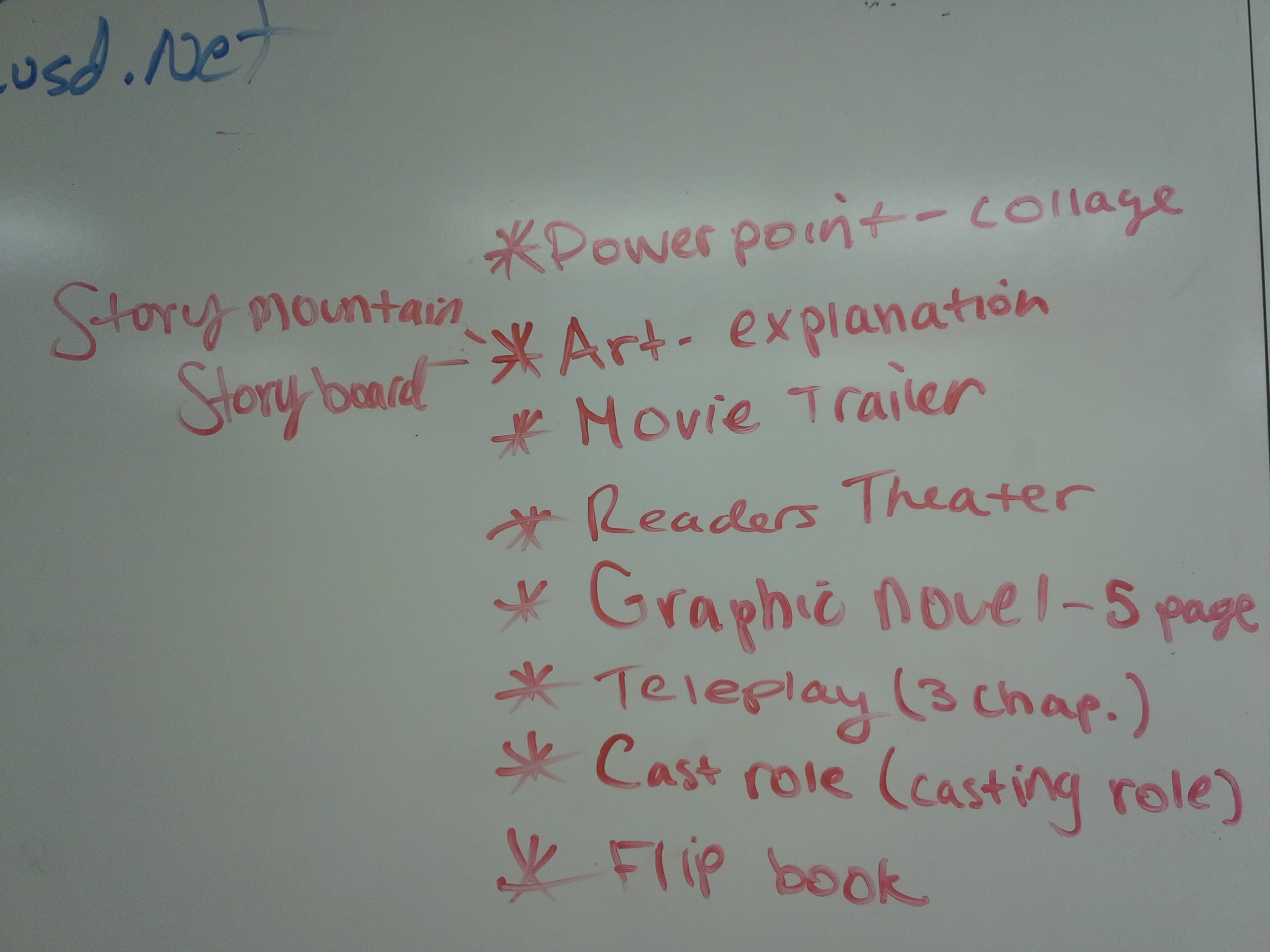
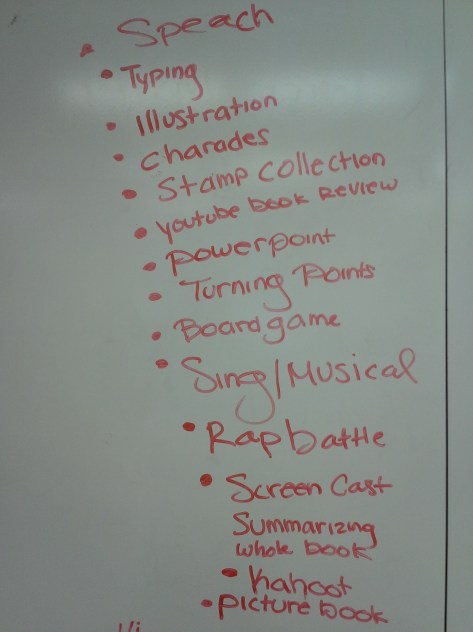
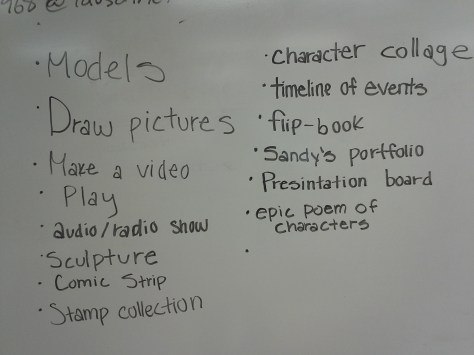
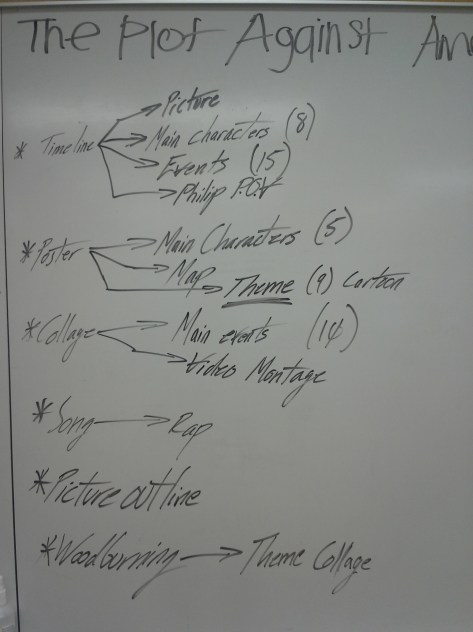
Inspired by Angela Stockman’s new book Make Writing, today my students brainstormed ways they could demonstrate their knowledge of the historical novel The Plot Against America without writing to a prompt that I created for them.

2015-11-09 09.09.00     2015-11-09 14.35.37

Pictures are posted below and my review on Angela’s new book will be published in a couple of days.

2015-11-09 10.06.10

Angela’s book turns conventional writing strategies and teaching upside down. She spills you out of your chair, shreds your lined paper, and launches you and your writers workshop into the maker space! Who even knew this was possible?

2015-11-09 10.06.17

Stockman provides five right-now writing strategies that reinvent instruction and inspire both young and adult writers to express ideas with tools and in ways that have rarely, if ever, been considered.

2015-11-09 13.45.26

Many schools are converting classrooms to maker spaces–vibrant places where students demonstrate learning by constructing things, using newly-acquired skills and applying newly-learned concepts.

2015-11-09 13.45.18

With inspired creativity and ingenuity, Stockman shows you how to bring modern maker moves into your writers workshop, giving birth to new environment  that rockets writers to places that were previously unimaginable.

2015-11-09 14.35.48

We will see how well my students’ projects on the Philip Roth novel turn out.

2015-11-09 09.09.10

#CHSSP25 Presentation

CHSSP

Spending a great day at UCLA for the 25th anniversary California History-Social Science Project. I presented with @raluevanos also known as Ruth Luevanos on Inspiring Reluctant Writers. While Ruth concentrated on word banks, sentence frames and tableaus, my section was devoted to writing strategies that strengthen higher order thinking methods used in argumentative and informative writing. As an added bonus, they are easy to add into your everyday classroom practices. This article describes the tension that History teachers have experienced trying to teach both content and literary skills.

Timeline Transitions

A very simple way to have students write background paragraphs. I used to fall into the lazy teacher trap of having students copy the timeline at the end of the chapter as a pre-reading strategy. I quickly learned that they learn nothing from this even though I positioned it as a pre-reading strategy. Then I added an annotation component, which helped a little. Now I give students the big, fat, hairy timeline and tell them they need to pick the five most important events and use them to write a background paragraph. They have a word bank and get a chance to practice transition words and phrases, which many lack. Then students can pair/share their paragraphs and discuss which events they thought were the most important.

SRSD Writing Strategies

More than 40 studies have validated SRSD as an instructional model for teaching writing to students with writing deficits. Developed by Harris & Graham (1992), this model integrates writing instruction, self-regulation strategies, and the development of positive student attitudes toward writing. https://historyrewriter.com/2014/12/04/srsd-instruction/

Studies of history classrooms reveal that writing instruction of any kind is uncommon, even among exemplary teachers. Thus, student essays tend to list facts rather than argue claims, leave arguments unexplained, and only draw on evidence sporadically. https://historyrewriter.com/2014/12/09/srsd-writing-in-history/

MEAL Paragraphs

M.E.A.L. paragraphs are a method of writing strong paragraphs. This link shows you how to teach students to write a MEAL. https://historyrewriter.com/2015/04/27/meal-paragraphs/ and this link showcases some student work. https://historyrewriter.com/2015/06/24/wwii-meal-paragraphs/

RAFT Paragraphs

https://historyrewriter.com/2015/08/03/raft-writing-prompts/

As a general rule, a MEAL prompt is designed to help students analyze evidence to support an argument while a RAFT prompt requires students to inform/explain a historical topic to an audience.

History Book vs Video Lecture

I operate flipped classroom where students watch video lectures with Zaption questions embedded in them for homework, then we read, practice writing and note-taking drills and complete projects in class. After three years of this work I developed two hypotheses: 1) Students with higher reading scores prefer reading the book to viewing the video lectures; and 2) Students with lower reading scores prefer viewing the video lectures to reading the book.

This week, I asked two samples of students to describe which learning format they preferred. The results soundly debunked my assumptions. While both groups of students preferred the video lectures to the textbook, 36% of students with lower reading levels preferred taking notes from the book rather than viewing video lectures.

Book v VL

Students who favored the video lecture to the book made comments like:

  • I think I am learning more from the videos because they give off more information, they clarify what the topic is about, and I can rewind the video in case I didn’t get that last piece of information.
  • Personally, the video lectures help a lot more than taking notes on the book. I can spend more time on the video, the book is more flat. In the video, main points are emphasized. It’s slightly harder to pick out key points from the book. My brain works better when it comes to listening because when it comes to reading, my eyes tend to skim and I can miss key information.
  • I like the video lecture better because it tells us what to write. You can take your time and you can rewind the video. In the book, it takes a long time looking for what information you are going to write in your notes. When I open the book it’s just like no and it’s not interesting. The book doesn’t capture my attention.

Students who preferred the book to the video lectures made comments like:

  • I think the book helps me better because you can go back and easily find something you missed, you can easily flip through pages to find something, and it is less distracting.
  • Taking notes from the book helps you go at your own pace. You can read as fast or as slow as you want. The book is easier to go back to a sentence or paragraph than the video. The book makes it more simple because you can study and annotate in a way that you will understand.
  • I work better with books, they have less complications. I am a hands-on learner, books get to the point. Video-lectures can have complications. WiFi can go down, you run out of data, problems can happen. Books are always there to be picked up and read.

These results seem to validate the flipped classroom approach. When students view video lectures which preview vocabulary terms, names and events first, they are building background knowledge. Then, when students encounter these terms, names, and events in their reading, they have familiarity with them and it is easier for the new knowledge to “stick.” Regardless of which learning method students prefer when these two methods are paired, the video acts as an anticipation guide priming the pump in a student’s memory and reinforcing the stickiness of the information in the reading. My big takeaway? Remember to listen to your students. It turns out they also are your customers.

SCSSA Presentation

Here is a presentation I did on Saturday, October 17, 2015 for the Southern California Social Science Association in beautiful Burbank, California. I also provided an archive of argumentative writing resources via Pearl Trees.

http://www.slideshare.net/mrpetri/slideshelf

Argumentative Writing Notes

This presentation focused on the work of Hillocks, Fletcher, and Heinrichs. Hillocks offers teachers a common vocabulary to use consistently with students. Fletcher uses Loop Writing and the Believing/Doubting game to get students examine both sides of an argument. I have adapted her methods for a social studies lesson. MEAL paragraphs allow teachers to give students daily practice in argument writing. Teachers who want additional ideas about teaching argumentation should consult Heinrichs’ Thank You For Arguing.

Hillocks

The process of working through an argument is the process of inquiry. At its very beginning is the examination of data, not the invention of a thesis statement in a vacuum.

Claims are almost never substantiated. 4 out of 5 dentists recommend… A literary critic must cite the works discussed and quote from the texts to prove a claim. A historian must carefully note the artifactual or documentary evidence basic to the argument being made.

Without analysis of any data (verbal and nonverbal texts, materials, surveys and samples), any thesis is likely to be no more than a preconception or assumption or clichéd popular belief that is unwarranted at best and, at worst, totally indefensible.

Warrants may be common sense rules that people accept as generally true, laws, scientific principles or studies, and thoughtfully argued definitions. Two claims can be made viewing the Furigay illustration: It was suicide. It was murder.

Approach the teaching of argument from the examination of data, as a first step. Once we have examined data to produce a question and have re-examined the data to try to produce an answer to the question, we may have a claim or thesis worthy of arguing. If the data support our answer to the question, it becomes evidence in support of the claim we make.

  1. Examine data
  2. Ask questions based on data
  3. Reexamine data
  4. Try to answer the questions
  5. Data that supports our answer = Evidence

DBQs do this in a limited way. Most students struggle when characterizing primary sources and don’t understand how to apply the evidence within them. Students need shorter, more frequent, and lower-stakes writing tasks to learn how to write arguments.

Fletcher

Asking students to write the thesis first is putting the cart before the horse. It’s hard to ask a question about an on-going conversation when you don’t listen to the conversation first. – Carol Jago (Fletcher forward).

Loop Writing uses five-minute timed unveilings. Each prompt ups the ante a little. Should burning the flag be protected under the First Amendment? Does the death penalty violate the Eighth Amendment? The “loop method” encourages deeper thinking about a topic as well as intellectual engagement. Purpose of Loop Writing is to examine one issue in depth to move past superficial understandings and develop a sophisticated or new perspective on the issue.

Playing The Believing & Doubting Game

  • We suspend all judgment and give the writer the benefit of the doubt.
  • Most students have this non-critical approach to reading their History book.
  • Listening to a text (close reading – RLH) and postponing judgment requires more effort than analyzing texts. We need to temporarily try the writer’s ideas on for size.

Playing the Believing Game/Doubting Game with the Declaration of Independence might enable students to carefully look through Jefferson’s arguments about separating with England. It would also be interesting to do it with the arguments in Thomas Paine’s pamphlet Common Sense.

Points to Remember

  1. Academic writing begins with academic reading. Most of our students do not have enough background knowledge to write a strong argument. They need help gathering and organizing information.
  2. Argumentation involves asking and answering questions.
  3. A well-developed questioning habit is a key trait of college-ready writers.

Prompts to Deepen Student Thinking

  1. How do you know if something is true or only an opinion?
  2. How do you decide if something is better or worse than something else?
  3. Describe a time when you decided something was more important than something else. How did you reach that decision?
  4. Describe a time when you were able to see something from a different point of view. What helped you to understand a new perspective?

Playing The Doubting Game

The object of this game is disbelief. These questions prompt a mistrust of the text:

  1. Does the writer say anything that bothers me?
  2. Are any of the writer’s claims unsupported?
  3. Does the writer draw any dubious conclusions?
  4. Does the writer contradict him/herself?
  5. Do I disagree with any of the writer’s claims or assumptions?
  6. Are there any reasons not to trust this writer?
  7. Does the writer leave anything out?

History on TV in October

This month’s TV Plus column (p. 26) from The Social Studies Professional features the following films.

Iwo Jima: From Combat to Comrades Tuesday, November 10, 2015, 8:00–9:00pm PST KQED PBS Follow survivors of perhaps the fiercest battle of World War II as they return to Iwo Jima for a Reunion of Honor on the only battlefield where former enemies come together in shared remembrance.

Debt of Honor: Disabled Veterans in American History Tuesday, November 10, 2015, 9:00–10:00 pm PST KOCE PBS/ Steeplechase Films Take an unflinching look at the reality of warfare and disability in this history of disabled veterans. Witness moving interviews with “some of the country’s most prominent disabled veterans.”

American Comandante (American Experience) Tuesday, November 17, 2015, 9:00–10:00pm PST PBS/WGBH Meet William Morgan, the larger-than-life American who rose to power in Cuba during the revolution. His life had it all — adventure and romance, mobsters and spies, and a cast of characters including J. Edgar Hoover, Che Guevara, and Fidel Castro.

Up Heartbreak Hill (POV) November 2015 PBS/ American Documentary Thomas and Tamara are track stars at their rural New Mexico high school. Like many teenagers, they are torn between the lure of brighter futures elsewhere and the ties that bind them to home. For these teens, however, home is an impoverished town on the Navajo reservation, and leaving means separating from family, tradition and the land that has been theirs for generations. Take a moving look at a new generation of Americans struggling to be both Native and modern.

Marie Antoinette Speech Assignment

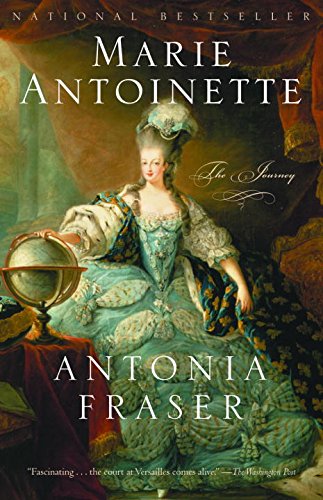
I operate a flipped classroom where my content lectures are delivered online, this allows my World History students to spend class time readiMarie Antoinetteng Marie Antoinette: The Journey by Antonia Fraser. Four days per week, we have 30 minutes of sustained silent reading (SSR) where students maintain an unfamiliar word log, then one day per week, we have small group discussions where they practice using the words in their logs. To master Common Core speaking and listening standards, my students will need to give a three minute speech on (1) Marie Antoinette’s childhood, (2) her marriage to Louis XVI, (3) her role as a mother, (4) her performance as Queen of France, or (5) her overall historical legacy. Students will be divided into groups at random and assigned one of these general topics. Speeches will be given over the next month as we complete the book and study the French Revolution.

This post covers how students will brainstorm in small groups to choose a topic, a purpose, and create a roadmap for their speeches. The advice comes from a combination of our school’s Academic Decathlon coach, the awesome Ms. Kerry Sego and the inspiring work of Erik Palmer and his excellent book Well Spoken: Teaching Speaking To All Students.

Topic: This is the subject of your speech. In this case, it is about Marie Antoinette. Will it focus on her relationship with her father, mother, siblings, husband, children, her subjects, or other royals? Will the speech be about growing up a Habsburg, Marie Antoinette’s schooling, or the role of music in her life?

Purpose: This is the point your speech will be making. Was Marie Antoinette was a victim of her mother’s ambitions? Do you want to call attention to her philanthropic gifts? Should she be remembered as the greatest Queen of France? Or for never maturing beyond her selfish, teenage indulgences?

Provide a Road Map: Give your listeners an overview of your topic and purpose. Make sure your main points are clearly stated. Use transitions such as first, another example, next, and finally. Refer back to your main point so the examples seem connected to it. This is where you demonstrate that you can move beyond merely possessing knowledge to creating something meaningful that can inspire an authentic audience.

Introduction: Does it state your topic? Does it clearly state your purpose? Do you begin with an attention-grabber?

Body Paragraphs:  Do you have interesting examples? Quotes? Statistics? People? Does your speech progress from point to point clearly? How can you move evenly from one idea to another?

Conclusion: Does the ending of the speech summarize what you have said rather than merely restate or repeat it? Does the speech end with a strong or interesting point? What should the audience do with the information you have given them?

Tone: Your speech is not a formal expository essay. Spice it up with stories, imagery, humor, and background knowledge that your audience will appreciate. There are sensitive and fascinating insights in this book that offer a thoroughly nuanced picture of the queen. How do you want them presented?

After you have written your speech:

  1. Read it aloud, slowly, pausing for emphasis (remember your audience is listening, without being able to read what you have written), so you must present your information slowly.
  2. Time your speech. It must be between 2:30 – 3:00 minutes.
  3. Type it (if you can) double-spaced.
  4. Save it on your computer. This way you can make changes easily.

speech-writing

Delivery:

  1. Memorize your entire speech. This is a must.
  2. Present your speech, do not read it, or act it out. Use a senator’s voice.
  3. Look your audience in the eyes, glancing now and then to your written copy.
  4. Stand still. Do not play with your papers, sway back and forth, or twirl your hair.
  5. Revise your speech. Make necessary changes for an easier delivery.

History on TV

Dear Parents: Did you know that 55% of your child’s academic vocabulary comes from their Social Studies classes?

Marzano 55%

It is important that students read, view, and discuss historical content in school and at home. The National Council of Social Studies puts together a monthly TV Plus column. This post is reblogged from The Social Studies Professional (p. 28) September 2015. Please consider viewing some of these programs with your child and discussing them around the dinner table.

Civil War

The Civil War (Documentary’s 25th Anniversary) Monday-Friday, September 7–11, 2015. Explore America’s most destructive and defining conflict, brought to life in the epic award-winning documentary produced and directed by Ken Burns. This newly restored high-definition version marks the 25th anniversary of the initial 1990 premiere.

body_life-line_1

Life on the Line: Coming of Age Between Two Nations September 8 and 9, 2015. PBS/Fine Line Films Follow a year in the life of 11-year-old Kimberly Torrez, who crosses the border in Nogales, Mexico, each day to attend school across the line in Arizona. Her father needs a liver transplant; her mother awaits a visa to allow her to live in the United States.

One Two Fronts

On Two Fronts—Latinos & Vietnam Tuesday, September 22, 2015. PBS/Souvenir Pictures Examine the Latino experience during a war that placed its heaviest burden on the working class. Framing the documentary are memoirs of two siblings who stood on opposite sides of the Vietnam War, one as a prisoner of war, and the other a protestor at home.

lord-of-ants-prog

E.O. Wilson—Of Ants and Men Wednesday, September 30, 2015. PBS/Shining Red Productions Review the remarkable life and ground-breaking ideas of biologist E.O. Wilson, founder of the discipline of sociobiology, world authority on insects, and Pulitzer-prize winning writer on the subject of human nature.

Helping History Teachers Become Writing Teachers