Writing Instruction Research

Instructional research in writing is not as robust as the body of research that has examined reading.

Gary TrioaGary A. Trioa contributed a 42 page chapter: Research in Writing Instruction: What We Know and What We Need to Know to the book Shaping Literacy Achievement. Trioa organized contemporary research into four categories: (1) characteristics of struggling writers’ products and processes, (2) essential instructional content and processes, (3) assessment, and (4) teachers’ practices and professional development.

Juzwik et al. (2005) found writing research has historically been (a) comparably underfunded, (b) mostly descriptive rather than experimental in nature, and (c) typically conducted in post-secondary education settings. Further investment in writing instruction is necessary for the field to flourish and draw the attention it deserves from various stakeholders.

According to the National Center for Education Statistics, 70 percent of teachers indicated they use process instruction to teach composition, yet less than a third of those same teachers spent 90 minutes or more per week teaching writing (1999). Research has shown that 90 minutes per week is a bare minimum when using a process approach to teaching writing (Graves, 1983).

In a number of studies, not all students who are taught a strategy actually use it after treatment (instruction) is discontinued. Changes in writing behaviors and performance can be maintained for a month or so, but mainly disappear after that.

Researchers need to investigate why strategy interventions are not more successful in helping struggling writers. Future studies should examine the effectiveness of combinations of writing strategy instruction and components of strong writing programs. How can writing strategies and increased performance can be maintained over time? What techniques for producing high-quality writing assignments can be generalized across subjects and text types?.
Shaping Lit AchPlanning strategies are rarely examined in conjunction with revision or editing strategies to determine their impact on writing behavior and performance. This should be done both separately and in combination.

Revising is an essential part of advanced writing instruction and less time needs to be devoted to planning instruction. The relationships between these two aspects of the writing process are highly variable across tasks and deserve more empirical scrutiny.

Embedding strategy training in meaningful writing activities may produce more positive outcomes in the fidelity, maintenance, and transfer of writing skills across subjects. More sophisticated research designs may be beneficial in increasing theoretical advances in this area.

Researchers need to develop integrated writing assessment systems that provide immediate, instructionally relevant data to teachers so that they are better equipped for pinpointing writing problems and responding accordingly. Identifying instructional adaptations that are valid and readily integrated into practice will help teachers maximize the writing potential of all students.

Dr. Trioa’s work suggests that sophisticated, large-scale research into the relationships between the components of writing programs, strategy interventions, and editing/revision processes could reveal new insights for the field. Peer review, automated essay scoring systems, and revision assistants offer students immediate feedback and produce large data sets for analysis. With the emergence of MOOCs, online education, and social media, these studies appear to be less burdensome for researchers to conduct.

Reference

Trioa, G. A., (2007) Research in Writing Instruction: What We Know and What We Need to Know. In M. Pressley, A. Billman, K. Perry, K. Refitt, & J. M. Reynolds (Eds.), Shaping literacy achievement: Research we have, research we need. New York: Guilford Press.

20 Education Stats

The Condition of Education 2015 presented 42 key indicators on important topics and trends in U.S. education. It reported characteristics of the K-12 population, educational attainment, economic outcomes, participation in education, school characteristics and climate, along with postsecondary education and completion rates. This publication is considered top shelf educational research when it comes to setting baselines and identifying trends. Additional reports on postsecondary education are available at The Condition of Education website.

Avg Reading Scores

Lately, I am more focused on students’ reading and writing scores. I wonder if anyone has done any work comparing NAEP scaled scores to Lexile levels, so that I can compare my 9th-grade students to the national average. Other stats that intrigued me were:

  1. 91 percent of young adults ages 25 to 29 had a high school diploma or its equivalent in 2014
  2. In 2014, 34 percent of young adults ages 25 to 29 had a bachelor’s or higher degree.
  3. 20 percent, or 1 out of 5 school-age children lived in poverty in 2013, a 6 percent increase from about one in seven in 2000
  4. Sixty-five percent of
3- to 5-year-olds were enrolled in preschool in 2013 – about the same amount as in the previous year
  5. 60 percent of 2013 preschool children attended full-day programs
  6. In the fall of 2012, nearly 50 million students were enrolled in public schools
  7. Over 2 million US students were enrolled in charter schools in fall of 2012
  8. The percentage of 16- to 24-year-olds who are not enrolled in school and do not have a high school credential, declined from 11 percent in 2000 to 7 percent in 2013.
  9. In school year 2011–12, 3.1 million public high school students, or 81 percent, graduated on time with a regular diploma
  10. Sixty-six percent of 2013 high school completers enrolled in college the following fall
  11. 42 percent of 2013 high school completers went to 4-year institutions
  12. 24 percent of 2013 high school completers went to 2-year institutions.
  13. Postsecondary enrollment hit 20 million students in the fall of 2013
  14. US colleges enrolled 17 million undergraduate students in fall 2013
  15. In the fall of 2013, the US had 3 million graduate students
  16. At public and private nonprofit 4-year colleges, most of the full-time undergraduates (88 and 86 percent, respectively) were under 25
  17. Only 30 percent of full-time students at private for-profit colleges were under 25
  18. 56 percent of male students who began their bachelor’s degree in the fall of 2007, and did not transfer, had completed their degree within six years
  19. 62 percent of female students who began their bachelor’s degree in the fall of 2007, and did not transfer, had completed their degree within six years
  20. In 2013, American colleges awarded over 1 million associate’s degrees, 1.8 million bachelor’s degrees, 750,000 master’s degrees, and 175,000 doctoral degrees

I am interested in learning how educators use education statistics to help students with goal-setting strategies. Please leave any ideas in the comments section.

Reference

Kena, G., Musu-Gillette, L., Robinson, J., Wang, X., Rathbun, A., Zhang, J., Wilkinson-Flicker, S., Barmer, A., and Dunlop Velez, E. (2015). The Condition of Education 2015 (NCES 2015-144). U.S. Department of Education, National Center for Education Statistics. Washington, DC. Retrieved July 23, 2015 from http://nces.ed.gov/pubsearch

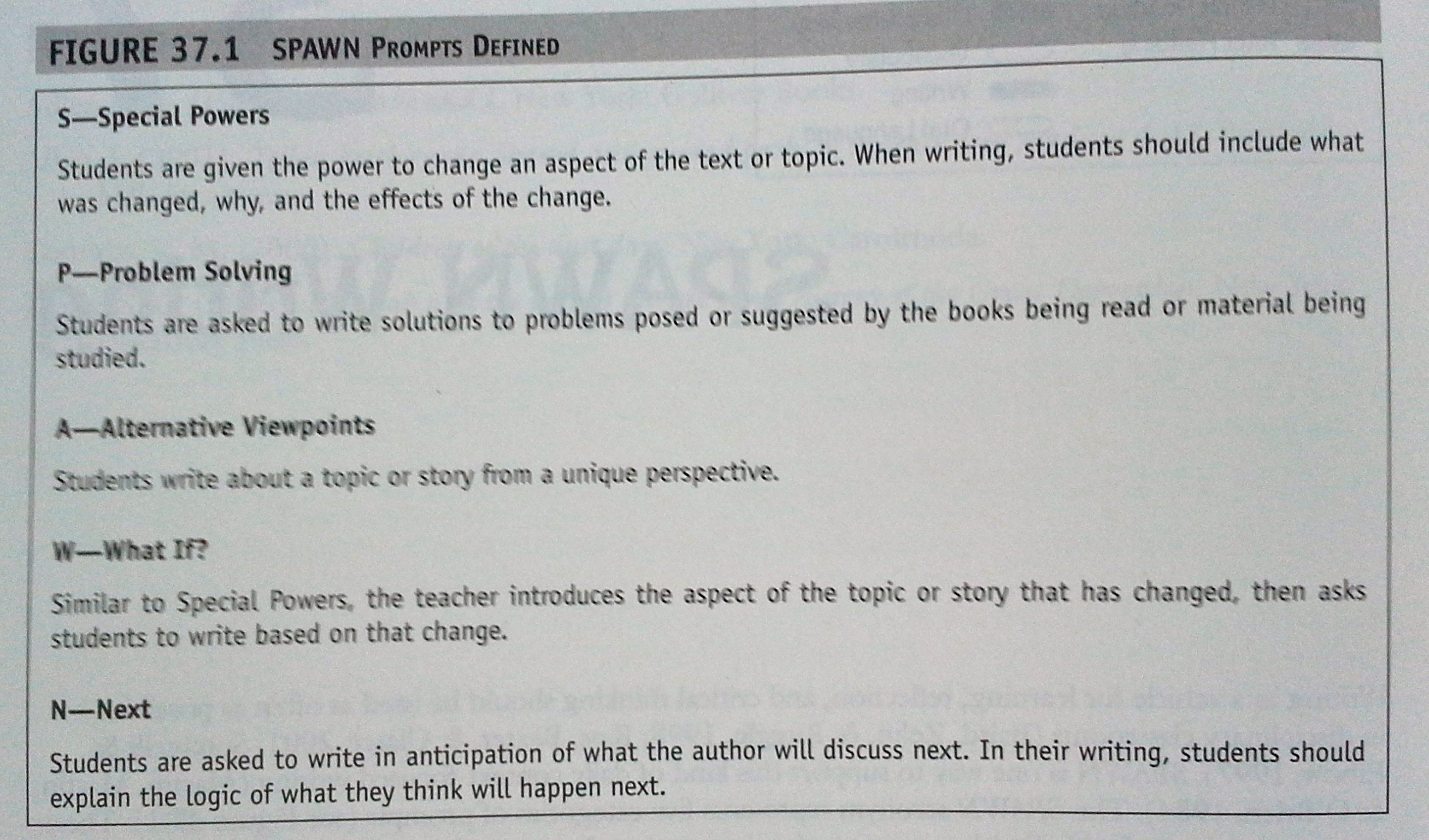
SPAWN Writing Prompts

Students need content-focused writing opportunities in Social Studies classrooms. Writing across the curriculum can be supported with SPAWN prompts. SPAWN stands for five types of writing prompts (Special Powers, Problem Solving, Alternative Viewpoints, What If?, and Next). They can be used to prepare students to learn new information about the topic or reflect on what has been learned. Fisher et al explain more below:

Spawn Acronym

WWI SPAWN Prompts

S – Special Powers
You have the power to change an important event leading up to America’s entry into World War I. Describe what it is you changed, why you changed it, and the consequences of the change.
P – Problem Solving
We have been reading about how most people in the United States were isolationists at the start of World War I. How do you think President Wilson can convince his country to enter the war?
A – Alternative Viewpoints
Imagine you’re the commander of the Lusitania. Write an accurate description in a letter format of your ship’s being torpedoed.
W – What If?
What might have happened if the Turks hadn’t entered the war on the side of the Germans?
N – Next
We learned yesterday that Germany has decided to use poison gas as part of trench warfare. What do you think the Allies will do next?

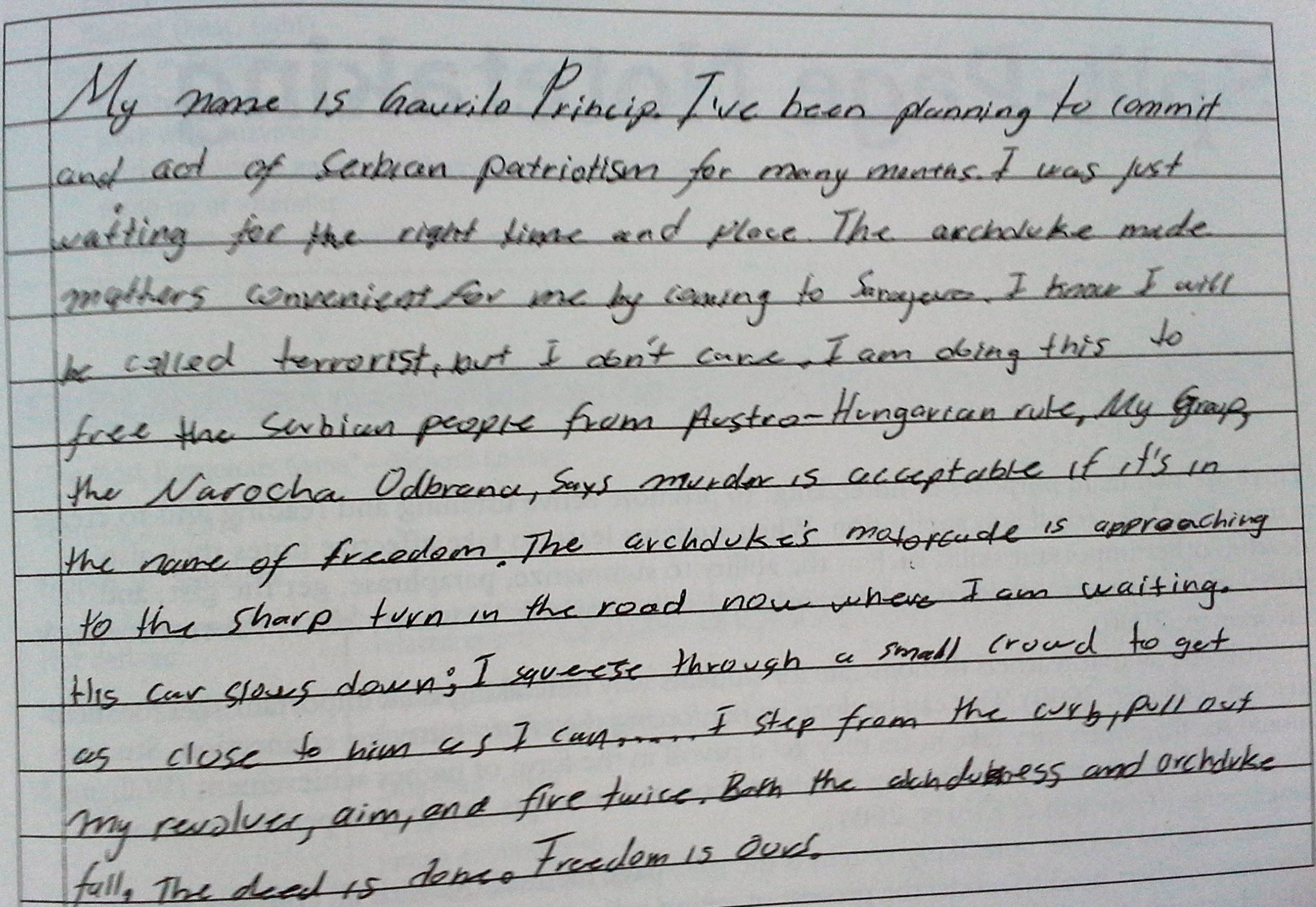
The response below is a student writing about the assassination of Archduke Franz Ferdinand from a unique perspective.

Spawn Example

The above SPAWN example from Fisher et al (2014) demonstrates how students can be factually accurate when engaging in historical writing. Please practice developing SPAWN writing prompts by contributing five in the comments section.

References

Fisher, D., Brozo, W. G., Frey, N., & Ivey, G. (2014). 50 Instructional Routines to Develop Content Literacy. Pearson Higher Ed. http://www.pearsonhighered.com/educator/product/50-Instructional-Routines-to-Develop-Content-Literacy-3E/9780133347968.page

Graham, S., & Hebert, M. (2010). Writing to read: Evidence for how writing can improve reading: A report from Carnegie Corporation of New York. Carnegie Corporation of New York.

Graham, S., & Perin, D. (2007). Writing next: Effective strategies to improve writing of adolescents in middle and high schools. New York/Washington, DC: Carnegie Corporation. Alliance for Excellent Education.

http://www.pearsonhighered.com/assets/hip/us/hip_us_pearsonhighered/samplechapter/0133347966.pdf

https://teacherhelpdesk.wikispaces.com/file/view/SPAWN.pdf 

https://sites.google.com/site/louisianatltcs/home/move-over-mr-spielberg-avatars-for-the-21st-century-learner/spawn-writing 

RAFT Writing Prompts

Graham & Herbert demonstrate the necessity of daily writing activities in Social Studies content classes. My students demonstrate their understanding of History standards via MEAL and RAFT writing assignments. As a general rule, a MEAL prompt is designed to help students analyze evidence to support an argument, while a RAFT prompt requires students to inform/explain a historical topic to an audience. This post will feature examples from an 11th grade US History class. See Dare to Differentiate’s wiki for more examples and instructions.

Role of the writer – helps the writer decide on point of view and voice.
Audience for the piece of writing – reminds the writer that he must communicate ideas to someone else and helps the writer determine content and style.
Format of the material – helps the writer organize ideas and employ the conventions of format, such as letters, interviews, and story problems.
Topic or subject of the piece of writing – helps the writer focus on main ideas.

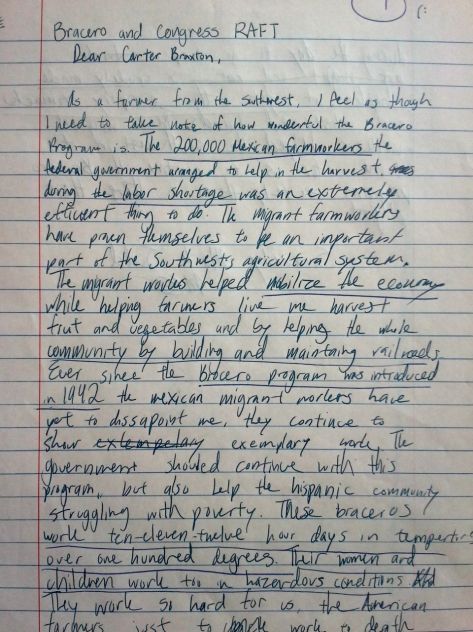
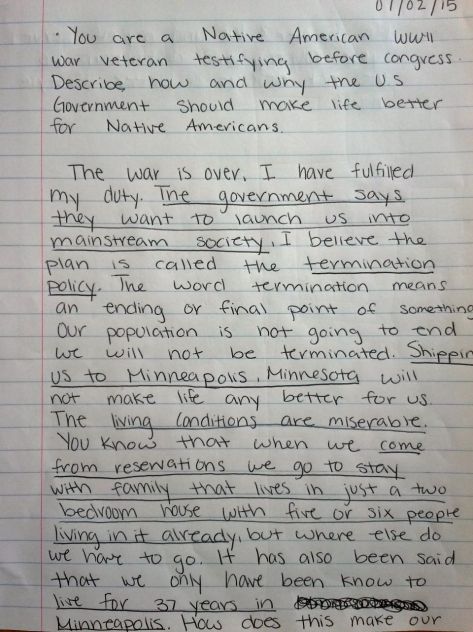
For this in-class writing assignment, students chose one out of four RAFT writing prompts. Students were allowed to use the book to complete this assignment, in fact it was designed to help them read the text. After a certain amount of time usually 20 minutes, students swapped papers, read each other’s work, then underlined the number of facts from the book included in the RAFT and reported out those numbers. I used this as a goal-setting strategy and it may or may not be used a factor when grading.

RAFT Facts

You are a 1950’s Police Officer warning a white church group about the dangers of Juvenile Delinquency.

50s Police Officer

You are a farmer, in favor of the Bracero program. Write a letter to your Congressman persuading him to continue the program, even though the American public is against it.

Bracero RAFT

You are an African American inner-city resident speaking to the NAACP about the assistance needed for the city’s poorest residents.

Black Power You are a Native American WWII veteran testifying before Congress. Describe how and why the US Government should make life better for Native Americans.
Native Amer RAFT

RAFT assignments can be used regularly to get students writing about texts, responding to texts, and summarizing texts. As a bonus, these writing assignments all have a significant correlation with improving reading comprehension. Please share examples of RAFT prompts, noting the grade level and subject it was used for in the comments section.

References

Fisher, D., Brozo, W.G., Frey, N., & Ivey, G. (2011). Fifty Instructional Routines to Develop Content Literacy. 2nd Ed. Pearson. Boston, MA.

Writing to Read

It turns out there is a large body of evidence on how writing can improve reading. Three closely related instructional practices are continually effective when used to improve students’ reading comprehension. Graham & Hebert (2010) grouped these best practices in order of effectiveness. It should be noted that these effects were all positive and that social science researchers generally interpret effect sizes as small = .20; medium = .50; and large = .80.

Graham Effect Sizes

  1. Have students write about the texts they read. (Student comprehension of social studies is improved when they write about what they read).
    1. Respond to a text in writing, perhaps by writing personal reactions, or by analyzing and interpreting texts. How do students apply the material that was read, or covered in class? What can be created from this passage? Write the Russian response to the Long Telegram. Make six points from this passage. Give me three reasons why? Extended writing has a strong and consistent positive impact on reading. Why did Kennan write the Long Telegram? Analytic essays: Describe three inventions that drove industrial growth during the 19th century. Provide reasons and/or examples for each choice.
    2. Write summaries of texts (six word memoirs/definitions, Collins 10% summaries). This technique has a stronger effect on elementary students than on middle and high school students.
      1. Identify main information
      2. Delete trivial information
      3. Eliminate redundant information
      4. Write a short synopsis of the main and supporting information for each paragraph.
      5. Teachers need to explain each step, model the strategy, and allow students time to practice applying these new skills.
      6. Summarization of longer texts requires a skeleton outline, thesis, main idea subheadings each containing 2-3 important details. Later a student should convert the outline to a written summary of the entire text.
    3. Write notes about a text (paraphrasing, dual column close reading with primary sources). Consistently has a positive impact on reading comprehension.
      1. Structured note-taking (alpha-numeric, Cornell)
      2. Concept mapping
      3. 15 minute history example. Divide class into 4 groups.
    4. Answer questions about a text in writing, or create and answer written questions about a text (Kahoot Kompetitions, effective questioning)
  2. Teach students the writing skills and processes that go into creating text
    1. Teach the process of writing
    2. Text structures for writing
    3. Paragraph or sentence construction skills.
    4. (All of these improve reading comprehension).
  3. Increase how much students write
    1. Reading comprehension is improved by increasing how often students produce their own texts.
    2. NWP (2003) study asked teachers to double the amount of writing they assign in class.

It is essential to vary these techniques in order to keep students from falling into routines where they may become bored with note-taking and writing. Social Studies teachers have a larger burden than other content teachers when preparing writing tasks that help students understand what they read, as disciplinary reading within our field makes up the majority of a student’s academic vocabulary (See below).

Marzano 55%

Future Research Should:

  1. Focus on low-achieving students.
  2. Cross-comparisons on the effects of different writing practices.
  3. Comparisons on different aspects of performance.
  4. How to bring writing practices to scale.
  5. Combining writing practices. Do more complex, multi-component practices yield stronger reading gains?
  6. Establish a greater range of writing about texts strategies.
  7. What are the long-term effects of writing and writing instruction on reading?
  8. Do students become better readers due to increased instruction in planning and revising?

References

Graham, S., & Hebert, M. (2010). Writing to read: Evidence for how writing can improve reading: A report from Carnegie Corporation of New York. Carnegie Corporation of New York.

Graham, S., Harris, K., & Hebert, M. (2011). Informing writing: The benefits of formative assessment. A Report from Carnegie Corporation of New York. Carnegie Corporation of New York.

Reading Next

Biancarosa & Snow (2004) outline 15 elements of effective literacy interventions. RN Cover Subsequent research should focus on identifying an optimal mix that will increase the literacy of middle and high school students while simultaneously building their knowledge base. The following fifteen elements are research-based best practices aimed at improving middle and high school literacy achievement:

  1. Direct, explicit comprehension instruction, which is instruction in the strategies and processes that proficient readers use to understand what they read, including summarizing, keeping track of one’s own understanding, and a host of other practices
  2. Effective instructional principles embedded in content, including language arts teachers using content-area texts and content-area teachers providing instruction and practice in reading and writing skills specific to their subject area
  3. Motivation and self-directed learning, which includes building motivation to read and learn and providing students with the instruction and supports needed for independent learning tasks they will face after graduation
  4. Text-based collaborative learning, which involves students interacting with one another around a variety of texts
  5. Strategic tutoring, which provides students with intense individualized reading, writing, and content instruction as needed
  6. Diverse texts, which are texts at a variety of difficulty levels and on a variety of topics
  7. Intensive writing, including instruction connected to the kinds of writing tasks students will have to perform well in high school and beyond
  8. A technology component, which includes technology as a tool for and a topic of literacy instruction
  9. Ongoing formative assessment of students, which is informal, often daily assessment of how students are progressing under current instructional practices
  10. Extended time for literacy, which includes approximately two to four hours of literacy instruction and practice that takes place in language arts and content-area classes
  11. Professional development that is both long term and ongoing
  12. Ongoing summative assessment of students and programs, which is more formal and provides data that are reported for accountability and research purposes
  13. Teacher teams, which are interdisciplinary teams that meet regularly to discuss students and align instruction
  14. Leadership, which can come from principals and teachers who have a solid understanding of how to teach reading and writing to the full array of students present in schools
  15. A comprehensive and coordinated literacy program, which is interdisciplinary and interdepartmental and may even coordinate with out-of-school organizations and the local community

Lit Ach Elements

Since educational research has not identified an overall strategy for directing and coordinating remedial tools for students at risk of academic failure, teachers are encouraged to experiment with these elements and report out any effective combinations. The authors recommend that three specific elements: professional development, formative assessment, and summative assessment be included in order to ensure instructional effectiveness and measuring effects.

#SSchat on RoboReaders

Rise of The Robo-Readers

July 13 @ 4pm PST/7pm EST #sschat
co-mods: @scottmpetri & @DavidSalmanson

A primer on auto essay scoring

https://historyrewriter.com/2015/07/03/role-of-robo-readers/

Q1 What is your definition of AES, robo-reading, or robo-grading? #sschat

Q2 What is greatest hope and/or your worst fear about technology-assisted grading? #sschat

Q3 When is it ok for a computer to assign grades on student work? #sschat

Q4 How can classroom teachers test & evaluate a robograder without disrupting learning? #sschat

Q5 What would parents think if Ts required Ss to use robo-graders before submitting work? #sschat

Q6 What would school admins say if you used a robograder in your classes? #sschat

Q7 How would you use a robograder in your History-Social Science class?

Q8 How could robo-readers help teachers gamify the art and process of writing?

Shameless plug: https://www.canvas.net/browse/ncss/courses/improving-historical-writing has a module on writing feedback & AES. Course is free and open til Sept. 22. #sschat

Teaser Tweets (to promote the chat after Monday – 7/6).

Are robo-graders the future of assessment or worse than useless? http://wp.me/4SfVS #sschat

Robo-readers are called Automated Essay Scorers (AES) in education research. http://wp.me/4SfVS  #sschat

In one study, Ss using a robo-reader wrote 3X as many words as Ss not using the RR. http://wp.me/4SfVS #sschat

Robo-readers produce a change in Ss behavior from never revising to 100% revising. http://wp.me/4SfVS #sschat

Criticism from a human instructor has a negative effect on students’ attitudes about revisions. http://wp.me/4SfVS #sschat

Comments from the robo-reader produced overwhelmingly positive feelings for student writers. http://wp.me/4SfVS #sschat

Computer feedback stimulates reflectiveness in students, something instructors don’t always do. http://wp.me/4SfVS #sschat

Robo-graders are able to match human scores simply by over-valuing length compared to human readers. http://wp.me/4SfVS #sschat

None of the major testing companies allow open-ended demonstrations of their robo-graders http://wp.me/4SfVS #sschat

Toasters sold at Walmart have more gov. oversight than robo-readers grading high stakes tests. http://wp.me/4SfVS #sschat

What is the difference between a robo-reader & a robo-grader? http://wp.me/4SfVS #sschat

To join the video-chat follow @ImpHRW, sign into www.Nurph.com. Enter the #ImpHRW channel. Note you will still need to enter #sschat to your tweets.

Resources

https://www.grammarly.com/1

http://www.hemingwayapp.com/

http://paperrater.com/

http://elearningindustry.com/top-10-free-plagiarism-detection-tools-for-teachers

http://hechingerreport.org/content/robo-readers-arent-good-human-readers-theyre-better_17021/

http://www.bostonglobe.com/opinion/2014/04/30/standardized-test-robo-graders-flunk/xYxc4fJPzDr42wlK6HETpO/story.html#

http://www.newscientist.com/article/mg21128285.200-automated-marking-takes-teachers-out-of-the-loop.html#.VZYoNEZZVed

Promo Video for a forthcoming Turnitin.com product

https://www.youtube.com/watch?v=aMiB4TApZa8

A longer paper by Shermis & Hamner
www.scoreright.org/NCME_2012_Paper3_29_12.pdf

Perelman’s full-length critique of Shermis & Hamner

http://www.journalofwritingassessment.org/article.php?article=69

If you are really a hard-core stats & edu-research nerd

http://www.journalofwritingassessment.org/article.php?article=65

https://www.ets.org/research/policy_research_reports/publications/periodical/2013/jpdd

http://eric.ed.gov/?q=source%3a%22Applied+Measurement+in+Education%22&id=EJ1056804

National Council of Teachers of English Statement

http://www.ncte.org/positions/statements/machine_scoring

For Further Research

Williamson, D. M., Xi, X., & Breyer, F. J. (2012). A framework for evaluation and use of automated scoring. Educational Measurement: Issues and Practice, 31(1), 2-13.

Role of Robo-Readers

Grammarly

I have increased the amount of writing in my high school World History classes over the last five years. At first, I required two DBQs per semester, then I increased that to four DBQs per semester. Next, I added a five-page research paper at the end of the school year. Now, I assign research papers during each semester. If I were to allot ten minutes of reading/grading time for each DBQ that would be 80 minutes of grading per student, multiplied by last year’s total student load of 197 for a total of 263 hours of reading and grading. Assuming I spent 30 minutes correcting each research paper, an additional 197 hours of  grading would be added to my workload. Where do I find those extra 460 hours per year? Do I neglect my family and grade non-stop every weekend? No. I use a combination of robo-readers, or automated essay scoring (AES) tools and structured peer review protocols to help my students improve their writing.

Hemmingway App

As AES has matured, a myriad of programs has proliferated that are free to educators.  Grammarly claims to find and correct ten times more mistakes than a word processor. The Hemmingway App makes writing bold and clear. PaperRater offers feedback by comparing a writer’s work to others at their grade level. It ranks each paper on a percentile scale examining originality, grammar, spelling, phrasing, transitions, academic vocabulary, voice, and style. Then it provides students with an overall grade. My students use this trio of tools to improve their writing before I ever look at it.

PaperRater

David Salmanson, a fellow history teacher and scholar, questioned my reliance on technology. The purpose of these back and forth posts is to elaborate on the continuum of use that robo-readers may develop in the K-12 ecosystem. Murphy-Paul argues a non-judgmental computer may motivate students to try, to fail and to improve more than almost any human. Research on a program called e-rater confirmed this and found that students using it wrote almost three times as many words as their peers who did not. Perelman rebuts this by pointing out robo-graders do not score by understanding meaning but by the use of gross measures, especially length and pretentious language. He feels students should not be graded by machines making faulty assumptions with proprietary algorithms.

Both of these writers make excellent points, however, classroom teachers, especially those of us in low SES public schools are going to have a difficult time improving their discipline-specific writing instruction, increasing the amount of writing assigned, not to mention providing feedback that motivates students to revise their work, prior to a final evaluation. We will need to find an appropriate balance for giving both computerized and human feedback to our students.

Mayfield maintains that automated assessment changes the locus of control, making students enlist the teacher as an ally to help them address the feedback from the computer. I have found that students in my class reluctantly revise their writing per the advice of a robo-reader, but real growth happens when students have discussions in small groups in regards to what works and what doesn’t. Asking students to write a revision memo detailing the changes they have made in each new draft helps them see writing as an iterative process instead of a one and done assignment.

Read David’s post and participate in our #sschat on this topic on July 13th at 7pm EST/4pm PST.

Robo-Readers

WWII MEAL Paragraphs

MOOC Logos

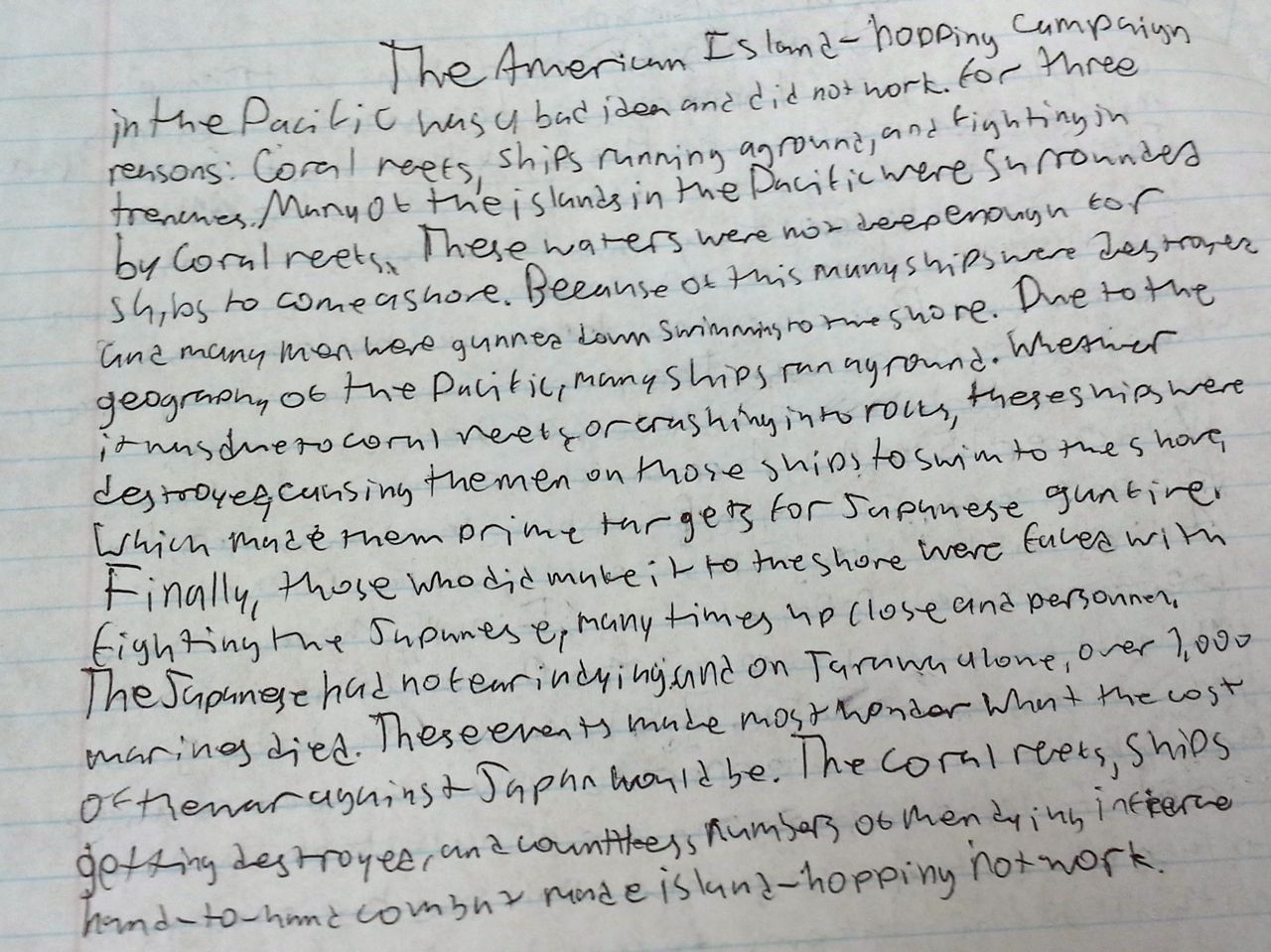
This is a follow-up from an earlier post and video lecture explaining how to use MEAL paragraphs as routine writing tasks that help students build stronger body paragraphs. Many classes start with a  “Warm Up” that is used to hook students into the lesson, or in this case textbook. In order to use MEAL paragraphs in this fashion, the instructor merely needs to pose an arguable question that requires students to take a position, then find three pieces of textual evidence and explain how the evidence supports their main idea. Finally, they link their evidence and analysis back to the main idea of the paragraph. For these examples, my questions were: (1) Was Operation Overlord a triumph of planning or a lucky break? and (2) Should island hopping be considered a success or failure?

Op Overlord_MEAL

This student does an adequate job with the MEAL format, below you can see their main idea highlighted in yellow. It is indeed a thesis that takes a position on the question and provides three reasons. I am eager to read on. Unfortunately, when highlighting the evidence in turquoise, I realize this writer only provides two pieces of evidence for their thesis. I hunt for textual evidence that the allies have succeeded in completing the first part of their plan, but I can’t find any. Therefore, I stop reading. This is not the perfect MEAL paragraph.

So unfortunate. This student had a strong thesis, solid analysis, and even restated their thesis at the end of their paragraph. They just needed to include one more piece of evidence to get the points on this quickwrite.

Ovrlrd Evidence

Island Hopping_MEAL

The next student sample on island-hopping is similarly well-organized. The main idea is highlighted in yellow. The evidence is highlighted in turquoise. The analysis is in green and the thesis is restated at the end of the paragraph in purple. Aside from a slight redundancy in swimming to shore and fighting the Japanese in trenches (not factual), this author has created a solid MEAL paragraph.

This sample can be used as a mentor text when showing students how to write MEAL paragraphs. I have found some students will copy your model word for word, so it helps to have a supply of examples that aren’t on the topic you are asking your students to write about.

Island Hopping

MEAL paragraphs should be an arrow in every effective educator’s quiver. Students who repeatedly write MEAL paragraphs gain extensive practice in identifying and explaining textual evidence. You will see an immediate improvement in their writing. Please feel free to leave any comments about integrating MEAL paragraphs into your everyday classroom practices.

Helping History Teachers Become Writing Teachers