Category Archives: Historical Writing

MOOC Launches in 3 Weeks

launch

On June 22, Improving Historical Reading & Writing launches. So far, 750 teachers have enrolled. The course is organized into 15 online modules that will be open from June 22 – Sept. 7. Course participants will be able to choose which modules to dip into and will have flexible deadlines when completing course work. Course completers will receive a grade based on reading and video quizzes and can earn badges, certificates and even purchase graduate credit from Ashland University. You can wait until September before electing to take up to three credit hours for the work you complete.

Many teachers enjoyed the previous MOOC: Helping History Teachers Become Writing Teachers. In fact, you will see how their advice and input helped shape this iteration of the course. If you click HERE to enroll, be sure to add a photo and brief bio to your Canvas profile (it makes it more likely for people to comment on your posts in the discussion boards). Don’t let the summer slide prevent you from sharing what you accomplished in historical reading and writing this year. Get inspired to try some new tools and techniques next Fall.

Kudos 1

Kudos 2

Kudos 3

Kudos 4

Kudos 5

Kudos 6

Kudos 7

Kudos 8

Text Recommendations: These books are not necessary for completing the course. We referenced them heavily while curating the course content and developing activities.

Elementary/Middle Level:
Ogle, D., Klemp, R., & McBride, B. (2007). Building Literacy in Social Studies. ASCD. Alexandria, VA.

High School/College Level:
Nokes, J.D. (2013). Building Students’ Historical Literacies. Routledge. New York, NY.

Strategies for Teaching Vocabulary

Ogle, Klemp and McBride advise against inefficient vocabulary acquisition strategies such as looking words up in the dictionary or isolated phonics instruction. They advocate for increasing independent reading in order to promote vocabulary development. It can be difficult for secondary non-ELA content teachers to provide the time and appropriate materials for independent reading in their classes.

Readers have many encounters with large numbers of words. These encounters help them relate the word to their own prior knowledge and experiences and give them practice in using their growing knowledge of these words to make inferences (Nagy, 1988, p. 32).

hunger games

A student’s vocabulary growth depends on multiple exposures to new words in a variety of contexts. Learning new words requires integration, repetition, and meaningful use. New terms need to be integrated with what students already know. New terms need to be taught and retaught in multiple contexts. Students need to use new terms in ways that are meaningful to them.

Research suggests that the human brain actively “looks” for similar information to make sense of incoming data (Jensen, 1998; Sousa, 2001; and Sprenger, 1999). Thus, learning activities that help students connect what they know to what they are about to learn can positively affect comprehension. The authors recommend concept mapping, discovering similarities and differences, and predicting ABCs as strategies that help students activate their prior knowledge.

Activating Prior Knowledge

Concept definition or semantic mapping is when students work in small groups to use context clues to guess at a word’s meaning. Then the students list all of their definitions and vote on the best one. Students also come up with at least three characteristics, synonyms and/or properties of the key word or concept. Lastly, the teacher should ask students for non-examples or contrasts. The figure below illustrates how a group of students defined “democracy”.

Concept Map

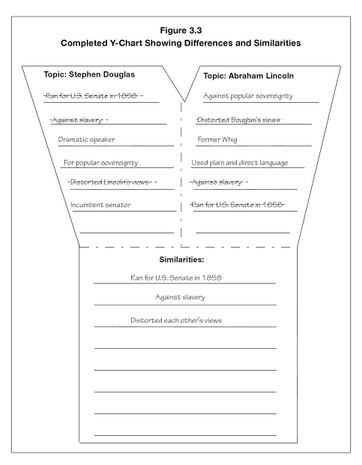
An outcome of the concept-mapping process is that students learn how to discover similarities and differences between ideas. Students  can complete a Y-chart as they read and then determine how two terms, events or people are alike. Then, students separate out the differences as they discuss the terms. Students draw lines through similarities in the top part of the chat and adds them to the bottom section.  This chart works well helping students examine the differences in social studies terms like socialism and communism.

Y-Chart

The Predicting ABCs graphic organizer allows small groups of students to share word lists and explain to each other what each term means. After skimming a chapter, students are asked identify words they think their classmates might struggle with. Then they turn to an elbow partner and discuss the words they listed in E-F. Students can move into groups and share words with the whole class.  When a student lists a word, the entire class adds it to their ABCs sheet. Then the teacher can provide whole class instruction interpreting and explaining the words. Now the class is ready to read.

Predicting ABCs Chart

There are many more resources in this information-rich chapter. In fact, this whole book is full of graphic organizers that can be adapted for use in elementary, middle and high school Social Studies classes. I like the authors’ technique of using a model teacher that encounters and solves classroom problems in each chapter.

Practice & Activities

In the past, I have conducted vocabulary tweetathons and six word definitions/memoirs. When I was a middle school teacher, I used to have students create Foldables from Dinah Zike’s videos. A few years ago, when I moved into a 1:1 environment, I had the students create flash cards and play study games on Quizlet, which led me to experiment with other vocabulary-based video games.  What tricks and tips do you have for teaching content-specific vocabulary?

Reference

Ogle, D., Klemp, R., and McBride, B. (2007).  Building Literacy in Social Studies: Strategies for Improving Comprehension and Critical Thinking . Ch. 3 (pp. 33-52). ASCD.

Teaching Vocabulary to Older Students

This post draws from Chapter Three (pp. 33-52) in Building Literacy in Social Studies: Strategies for Improving Comprehension and Critical Thinking (Ogle, Klemp & McBride, 2007).

One of the most successful strategies in improving a student’s vocabulary is providing time to read. Students do not learn most words through direct instruction. Researchers estimate that a student learns 3,000 new words per year (Nagy, Anderson, and Herman, 1987). Wide reading is a major contributor to differences in children’s vocabularies. Increasing the volume of student reading is the single most important thing a teacher can do to promote large-scale vocabulary growth (p.32). Thus, history and social science classes that build non-fiction and historical fiction reading into their everyday classroom practices often show large gains that help students build on their prior knowledge. Marzano estimated that 55% of a student’s academic vocabulary comes from reading Social Studies texts. The state of California keeps a searchable database of recommended literature by grade level for precisely this reason.

While California takes a hiatus from standardized testing in History-Social Studies (ETS is redesigning our end of year accountability exams) I am turning my 9th grade World History class into a World History Through Literature class. I am fortunate in that I work with a great group of English teachers who support me in this endeavor. They are willing to be flexible with their pacing plans so that we can align our instruction and have students read relevant literature during World History units.  Here is draft of our book list.

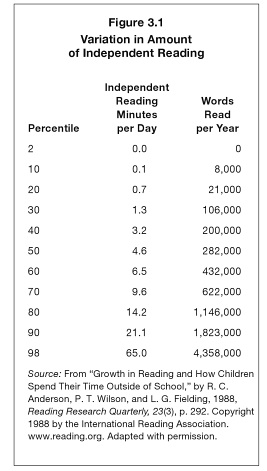
Variation in Amount of Independent Reading

As you can see in the chart below, there are staggering differences in vocabulary acquisition via independent reading. This explains why educators recommend students read 30 minutes independently every day. The average student arrives in my 9th grade World History class reading below the 6th-grade level, which explains why many History teachers opt for lecturing, instead of asking students to read Social Studies texts, which are above their zones of proximal development (ZPD). Armed with this data, it would be educational malpractice to not incorporate independent reading in my classroom.

Ind Reading Variation

One strategy the authors recommend to get students reading is a Book Pass session. This is where students pass around books, reading the jacket copy and noting on a chart whether they Want to Read, Might Want to Read or Don’t Want to Read the selections. This helps reluctant readers commit to certain titles. It is important to tell students to choose something that is fun and easy to read, as struggling readers often will choose something difficult and “fake read” it in front of their peers.

My next post will discuss more strategies for teaching vocabulary to older students.

Vietnam Veteran Interview Project

Veterans

This year end project is designed to teach persistence and interviewing skills. I am asking each student to call a Vietnam Veteran’s organization in a different state and conduct a 20 minute phone interview with a Vietnam Vet. All of the interview questions will be written in class, along with phone scripts, which will be rehearsed.

Please read the following directions carefully.

  1. Inform your parents about this project.
  2. Get parental permission before making long distance phone calls.
  3. Do not disclose your last name, school name, or location to anyone you interview.
  4. Do not give your cell phone number to anyone you interview.
  5. If your interviewee says anything inappropriate, or makes you uncomfortable, thank them for their time, hang up the phone, document it on your phone log, and promptly report it to your parents and teacher.

Cold Call Script

Hi, this is _________, a HS student calling from CA. I need to interview a Vietnam Vet for a school project. Would you know anyone willing to speak with me on the phone for 20-30 minutes? Later, when you have found someone willing to talk to you, ask permission to record the phone call. Explain that you will be typing a transcript of the interview.

Sample Interview Questions

Sample Transcript

Sample Veteran Interviews

Phone Numbers for Veterans’ Organizations

(See Dr. Petri, who will record every phone number you are given).

Necessary Elements for all 300 points

Original Interview Questions
Revised Iterations of Interview Questions
Phone Log
Interview Recording
Typed Transcript
1 page reflection paper

Final Research Papers

A study from The Concord Review found that 62% of teachers never assign a paper of 3,000-5,000 words in length, and 81% never assign a paper of over 5,000 words.

Cold War Research Paper

For this project, students combine three of their in-class writing assignments into a five-page (1,250 word) paper that argues: (1) which side was most responsible for the Cold War, (the Soviets, or the West); (2) elaborates on which events defined the Cold War; and (3) describes how the Cold War should be remembered in textbooks. Students will support their positions with evidence from the documents provided and independent research.

Imprtnce of Rsrh Ppr

Use parenthetical citations, i.e., (Cold War Causes, Handout 1), (Soviet Textbooks DBQ, BGE), or (Containment DBQ, Doc. A), and include a Works Cited page at the end of your paper. For your final grade, you will provide a one-page revision memo, a typed final draft on top of the original drafts, and four www.PaperRater.com reports all stapled together. Save this project in your Google Drive and use it for your senior portfolio.

Fitzhugh_Sources

Section One

Which side was most responsible for the Cold War, the Soviets or the West? Include an introductory paragraph that contains background on the Cold War and a thesis statement that takes a position. Explain the three main underlying causes of the Cold War and who was most responsible for the Cold War. Justify this decision by explaining who was least responsible. Include evidence from at least three documents to support your ideas and explain how the evidence proves your point. Lastly, provide a concluding thought that reconnects with your thesis.

Section Two

How did the United States prevent the Soviet Union from expanding communism? After reading about multiple Cold War events (Long Telegram, Berlin Airlift, Korean War, and Cuban Missile Crisis), define the US Cold War foreign policy and describe three instances where containment was used. Choose which example was the most significant and explain your reasoning.

Section Three

Describe how the Cold War should be remembered in future textbooks. Which Soviet accomplishments and which US accomplishments should be included in future history textbooks? Explain your reasoning. Conclude the paper with some final thoughts on what lessons the global community should learn from the Cold War between the US and the Soviets.

Revision Memo

The one-page revision memo should explicitly report how you addressed the feedback from your PaperRater reports. For example, “PaperRater gave me a 63% on Academic Vocabulary. I went back to the background essay, found five more vocabulary words and defined them in my introductory paragraph and my next PaperRater Academic Vocabulary score was a 71%.”

Next it should highlight significant changes and point out where the final essay improved from the first drafts. The purpose of revision memos is to help you become better at revising your writing. When you write a revision memo, the following points must be included:

  1. It is addressed to me.
  2. It points out what your focus was on this draft.
  3. It lists the strengths and weaknesses in your previous drafts.
  4. It details the changes you’ve made from one draft to the next.
  5. It describes your overall impression of the revision (strengths and weakness).

Each of these points must be in the memo. Typically, memos run anywhere from one to three pages in length.

The final paper should include page numbers on the bottom right-hand side of the page, be formatted in Times New Roman 12 point font, double-spaced with one-inch margins. The final document should contain a cover page and be turned in before the end of school on Friday, May 15, 2015. This entire project, which began on March 20th is worth 700 points of your final grade.

CA State Standard: 10.9.2 Students analyze international developments in the post-WWII world. Analyze the causes of the Cold War with the free world and Soviet states on opposing sides. Describe the competition for influence in Germany, Korea, and Vietnam.

Common Core Writing Standards: 1. Students will write arguments to support claims in an analysis of substantive topics or texts using valid reasoning and relevant and sufficient evidence. 5. Develop and strengthen writing as needed by planning, revising, editing, rewriting, or trying a new approach. 10. Write routinely over extended time frames with time for research, reflection, and revision.

Sample Paper

Sample Revision Memo

Grading Rubric

Improving Historical Reading & Writing

Improving Historical Reading & Writing is a free Massive Online Open Course offered through the Canvas Network (www.canvas.net). The course is designed to help history teachers improve their skills in teaching historical reading and writing. The MOOC will be organized into 15 online modules that will be open from June 22 – Sept. 7. Each module will contain multiple resources, 3-5 short lecture videos, 2-3 readings, 2-4 online discussions and an online quiz. Course participants will be able to choose which modules to participate in and will have flexible deadlines when completing course work. Course completers will receive a grade based on reading and video quizzes and can earn badges and/or certificates of completion.  There is also an option to purchase graduate credit from Ashland University for work completed. Themes for the modules are listed below. Click HERE to enroll.

Canvas 2015 MOOC

Module 1
Content Literacy and Building Academic Vocabulary

Module 2
Instructional Shifts: Common Core State Standards and College, Career, and Civic Life (C3) Framework

Module 3
Historical Thinking and The Reading Like a Historian Approach

Module 4
Developing Compelling Central Historical Questions

Module 5
Sourcing, Contextualization, and Close Reading

Module 6

Differentiation, Scaffolding, and Adapting Sources

Module 7
Corroboration Evidence and Importance of Discussion

Module 8
Assessing Student Learning through Writing

Module 9
Document-based Questions / Research Simulations

Module 10
Argumentative Writing

Module 11
Informative/Explanatory Writing

Module 12
Historical Narrative

Module 13
Providing Feedback: Automated Essay Scoring Tools

Module 14
Validating Rubrics & Choosing Mentor Texts

Module 15
History Day and Independent Student History Research Projects

The Common Core State Standards call for teachers to emphasize argumentative, informative, and narrative writing in their classroom practices. This course will help history teachers become writing teachers who teach skills and content simultaneously. Click here to enroll. For questions, contact Corbin Moore at corbinmoore1@gmail.com or Scott Petri at scottmpetri@gmail.com.

MEAL Paragraphs

Please note: This post was adapted from a PowerPoint posted online from Ms. Kelly Flynn, a teacher at St. John’s College High School in Washington DC. The changes I have made have been to make this post shorter and more appropriate for history and social studies students.

M.E.A.L. paragraphs are method of writing strong paragraphs. They can stand alone or be found within a larger work like an essay. This structure will help you become a better writer for the remainder of your high school years and make you a college-ready writer.

Chicken-Meal

The idea behind this mnemonic device is that every paragraph is like a meal. (I’m fat. I love food analogies.) A well-prepared meal is filling and a MEAL paragraph should be filling too. MEAL paragraphs are the body paragraphs in your essay. They use a different format than your introductory or closing paragraphs.

M is for… Main Idea, which is also known as a topic sentence. The topic sentence is what the entire paragraph will be about. This is the most important sentence in the paragraph because it tells your reader exactly what the subject of the paragraph will be. This is especially important in an essay, because these paragraphs will support the most important sentence of an essay: the thesis statement or main argument.

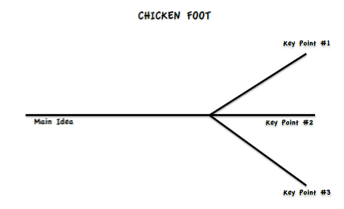
I am a traditionalist when it comes to the thesis sentence. I like it to have three legs. Thus, I often ask students to give me three reasons every time I ask a question in class. Give me three reasons why socialism is more fair than capitalism? Give me three reasons why capitalism is more efficient than socialism? Students can use a chicken foot to map out the three reasons.

Chickenfoot

The purpose of supporting sentences is to further explain and support the topic. Supporting sentences are also used to hold the reader’s interest, interpret evidence from an expert, and clarify examples from the text. In high school, you should have at least five to eight sentences in every paragraph. (Don’t just stop at five, explore of all your ideas).

E is for… EVIDENCE! What evidence or proof did you find in your reading or research? This is an opportunity to use quotes or point out examples from the text that support your claim. So you claim socialism is a better economic system than capitalism? How can you prove it?

A is for… ANALYSIS!  Analyze or explain how the evidence you provided proves the Main Idea. Giving an example of socialism isn’t enough. You need to explain HOW socialism is better than capitalism.Analysis is the trickiest part of the MEAL paragraph because you need to carefully explain  how each piece of evidence you provided makes sense as a support in this context.

L is for… LINK!  Now link the paragraph back to its original topic sentence. In the case of a MEAL paragraph, this refers to how the paragraph fits in with what the paper is trying to prove. Effective writers link the main idea of each paragraph back to the thesis/main argument.

M – Main Idea: Topic Sentence

E – Evidence: Proof Found in Primary Source/Book/Research

A – Analysis: How The Evidence Proves the Main Idea

L – Link: How a Paragraph Fits in to what the paper is trying to prove.

The Writing Center at Kennesaw State University provides a nice two-page handout that explains MEAL paragraphs in greater detail with superheros. Do college students still like superheros? My next post will feature some examples of MEAL paragraphs from my students and describe how to improve their depth and clarity.

Soviet Textbooks Essay

Soviet Txbks

What should be remembered in Soviet textbooks? Describe three achievements that should be included in Soviet textbooks. Support your reasoning with evidence from the documents: (A) Geographic Expansion; (B) Socio-Economic Accomplishments; (C) Great Terror; (D) Political Repression; (E) Military Strength; (F) Space Achievements; (G) Olympic Victories; and (H) Ballet & Cultural Achievements.

Thesis Statement Planning

Soviet textbooks should include: ____________, _____________, and _______________.

In 69 years as a country, the Soviet Union accomplished many great things, _________, _________, and _________; should be included in their textbooks to remember this time in history.

_________, ___________, and _____________ show that communism was capable of producing greatness, this paper will argue that the Soviet Union’s Cold War accomplishments should be included in their textbooks.

Outline

  1. Intro
    1. Background on the Cold War (czar, Bolshevik, capitalism, socialism, communism, Cold War, Stalin, Krushchev, Gorbachev, Sputnik, republics, satellites, and Bolshoi)
    2. Definition of terms
    3. Thesis statement
  2. MEAL paragraph – Accomplishment # 1
    1. M – Main Idea: Topic Sentence
    2. E – Evidence: Proof Found in Primary Source/Book/Research
    3. A – Analysis: How The Evidence Proves the Main Idea
    4. L – Link: How a Paragraph Fits in to what the paper is trying to prove.
  3. MEAL paragraph – Accomplishment # 2
    1. M – Main Idea: Topic Sentence
    2. E – Evidence: Proof Found in Primary Source/Book/Research
    3. A – Analysis: How The Evidence Proves the Main Idea
    4. L – Link: How a Paragraph Fits in to what the paper is trying to prove.
  4. MEAL paragraph – Accomplishment # 3
    1. M – Main Idea: Topic Sentence
    2. E – Evidence: Proof Found in Primary Source/Book/Research
    3. A – Analysis: How The Evidence Proves the Main Idea
    4. L – Link: How a Paragraph Fits in to what the paper is trying to prove.
  5. Conclusion
    1. Summarize rationale – Accomplishments 1, 2 & 3 show…
    2. Recap evidence
    3. Restate thesis

In-Text vs. Parenthetical Citations

Document A shows the incredible size of the Soviet Union and its satellite countries. This suggests that …

Poland was an East European satellite country of the Soviet Union (Document A).

Evidence-based Sentence Starters

Based on this evidence, it appears that _____________________.

This quote suggests that ______________________.

When viewing the map, it is evident that _____________.

This source reveals how US policy makers thought about ___________________.

This timeline illustrates how ____________________________.

This passage provides some insight into the nature of __________________________.

Great Terror Tweetathon

Steve Graham and Michael Herbert (2010) conducted a meta-analysis of the literature on reading and writing called Writing to Read. Part of this work, reports the results from nine studies that demonstrated how having students respond to a text in writing has a large effect (0.77) on their reading comprehension. This research suggests that writing personal reactions and/or analyzing/interpreting texts can increase reading comprehension. Therefore, I asked my students to use textual evidence to create rhyming couplets about the Great Terror. They were given a document about Stalin and the Great Terror from The DBQ Project’s excellent materials and allowed to use their cell phones to access an online rhyming dictionary.

2015-04-17 13.18.08

A few students turned in rhymes that did not reflect understanding of the material. In a future iteration of this project I will add some peer review and quantify the results. Many students, however, were creative and demonstrated strong understanding of The Great Terror. The following couplets represent their work:

As a Soviet leader, Joseph Stalin made his enemies pay
His secret police would kill 1,000 people every day

The Russians launched mass arrests and forced labor
At times it seemed by killing you, Stalin was doing you a favor

Between 1937 and 1938, the Great Terror only lasted for two years
During this time, the Soviet people lived with many fears

The Great Terror eliminated people considered an enemy of the state
A history book would conclude that this time period was not great.

Russian intellectuals were broken and corrupted
Their contributions to society were disrupted

Mercy and dignity got in the way of survival
If you valued freedom, you were Stalin’s rival

The Great Terror tried to instilled fear in a citizen’s mind and soul
Constant threats from authority added up and took their toll

Soviet History books were just another propaganda tool
Until Roy Medvedev wrote one critical of Stalin’s rule

Joseph Stalin had a huge amount of power
Which made all of his citizens tremble and cower

This quick activity aligns with what Lopez (2011) terms culturally relevant pedagogy, which emerged in response to the need for increased engagement and educational success for all learners. Many teenagers aspire to be rappers and songwriters. This exercise allowed students to work in pairs and collaborate on a task with high social capital and improve their academic vocabulary and reading comprehension. Please make a comment and let me know how you could adapt this activity to your classroom.

References

Lopez, A.E. (2011). Culturally relevant pedagogy and critical literacy in diverse English classrooms: A case study of a secondary English teacher’s activism and agency. English Teaching: Practice and Critique. pp. 75-93. December, 2011, Volume 10, Number 4. 

Six Word Definitions

Thanks to #TeachWriting, my rockin’ PLN on Twitter, I was apply to apply a new technique in my World History classroom this week. Several ELA teachers were discussing #6wordShakespeare and some of the other six-word story exercises that had been done in their classrooms. Hemingway wrote one of the most famous six word stories: For sale. Baby shoes. Never worn. These teachers described the technique as a fast brainstorming tool that gets students writing and playing with language immediately. I thought it could be used in the vocabulary-intensive unit I am currently teaching about the Cold War.

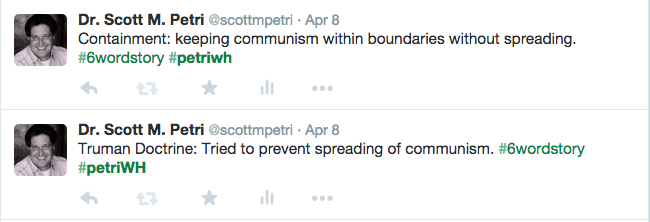
These two definitions from the book and subsequent student simplifications illustrate the concept.  Containment: The U.S. strategy of keeping communism within its existing boundaries and preventing its further expansion (p. 509). Truman Doctrine: United States policy, established in 1947, of trying to contain the spread of communism (p. 491).

6 word CW Vocab

Hyland & Tse (2007) report that many teachers regard helping students develop specialist [content] vocabulary as an important part of their role and many lists of key terms have been assembled. Marzano & Pickering (2005) offer a manual with 7,923 terms so school and district teams can choose the most important vocabulary words to teach their students. The terms were extracted from national standards documents, across eleven subject areas, and organized into grade-span intervals for: K–2, 3–5, 6–8, and 9–12 writers.

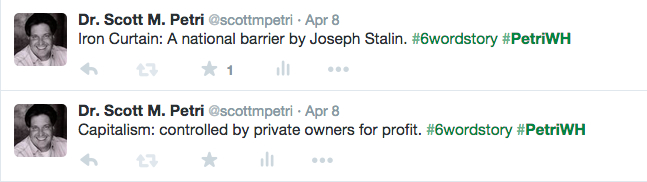
Here are examples of online definitions, along with student six-word definitions.  Iron Curtain:  The political, military, and ideological barrier erected by the Soviet Union after World War II to seal off itself and its depended eastern and central European allies from open contact with the West and other noncommunist areas (Encyclopedia Britannica). Capitalism: An economic and political system in which a country’s trade and industry are controlled by private owners for profit, rather than by the state (Google). Interestingly this term is not defined in the World History textbook, instead capital is defined as “money or wealth used to invest in business or enterprise” (p. 175).

6 word vocab

The majority of my students mastered this task and defined all seven terms in 15 minutes. I find that quantifying and charting how many terms a student completed within the allotted time helps me get a better picture of their engagement and alerts me to any comprehension problems that may be brewing.

Here some additional examples of student work:
Communism: Form of socialism advocated by Marx; Community has all power in society; All wealth and property owned collectively.
Capitalism: Private owners rather than the state; Prices are based on supply and demand; Individuals make decisions, not the government.
Cold War: Tension and hostility between two nations; Competition between U.S & Soviet states.
Iron Curtain: Prime Minister accuses Soviets of aggression. Soviets create a buffer in Europe.
Containment: Keeping communism within boundaries without spreading; America’s policy toward communist countries.
Truman Doctrine: Tried to prevent spreading of communism; 1947 USA policy stopping Soviet Socialism.

6 word stories

Kinsella (2013) argues that word knowledge is a strong predictor of academic achievement and educators cannot afford to leave vocabulary instruction to chance. She further advises that devoting attention to words that matter most is the first step in responsible lesson planning. I thought these six word definitions demonstrated understanding of Cold War terms and will continue to use it to help students master content vocabulary. It appears that finding activities like creating six-word definitions and re-tweeting favorites enable students to have fun while building their academic vocabulary. What tricks and techniques have been successful in your classroom?

References

Hyland, K., & Tse, P. (2007). Is there an “academic vocabulary”?. TESOL quarterly41(2), 235-253.

Kinsella, K. (2013). Cutting to the Common Core: Making Vocabulary Number One. Language Magazine12(12), 18-23.

Marzano, R. J., & Pickering, D. J. (2005). Building academic vocabulary: Teacher’s manual. Association for Supervision and Curriculum Development. 1703 North Beauregard Street, Alexandria, VA 22311-1714.